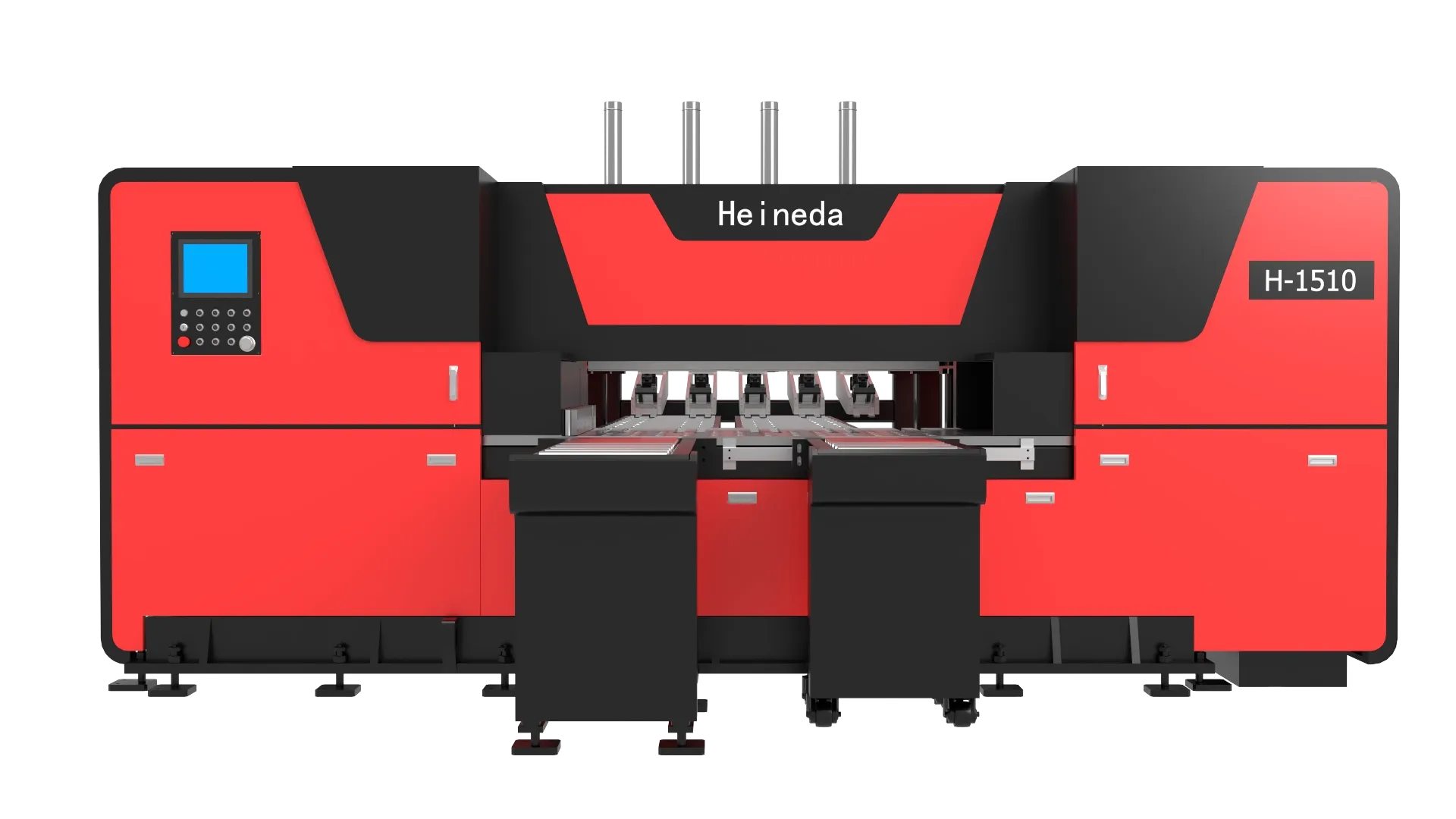
A titanium alloy plate cutting machine must overcome work hardening, extreme heat buildup, and rapid tool wear — three failure modes that destroy conventional band saws before the first cut is finished.
Key Stats: H-Series CNC Saw Milling Machine for Titanium
| Specification | Value |
|---|---|
| Cutting accuracy | ±0.1 mm |
| Max workpiece height | 100 mm |
| Speed advantage over traditional band saw | 5–10× faster |
| Motor power (H-1510 / H-2610) | 30 KW |
| Motor power (H-710) | 26 KW |
| Control system | Siemens full-auto servo feed |
| Widest model (H-2610) | 2600 mm workpiece width |
Why Titanium Is the Hardest Metal to Saw
Titanium alloy is defined as a group of alloys — most commonly Ti-6Al-4V — where the base metal's low thermal conductivity and high strength-to-weight ratio combine to create a cutting environment unlike any other metal in industrial production.
Three physics-level problems make titanium plate cutting uniquely destructive to machine tools:
Work hardening. When a blade tooth passes over titanium, the surface layer hardens immediately. The next tooth encounters a harder surface than the one before it. Standard high-speed steel blades lose edge integrity within minutes. Carbide tooling is not optional — it is the minimum viable specification.
Heat concentration. Titanium's thermal conductivity is roughly 6 W/m·K, compared to steel at ~50 W/m·K. Heat generated at the cutting zone cannot escape through the workpiece. Nearly all of it flows into the tool. Without aggressive coolant delivery directly at the cut, tool temperatures spike past 600 °C, triggering rapid crater wear and chemical diffusion between the tool and the workpiece.
Springback and vibration. Ti-6Al-4V has an elastic modulus around 114 GPa — lower than steel, which means the plate rebounds elastically after each tooth exit. This micro-vibration destabilizes the blade path, widens kerf, and can cause chatter marks or microcracks in aerospace-grade plate where surface integrity tolerances are tight.
The practical consequence: a titanium cutting machine must deliver higher clamping rigidity, controlled low cutting speed, high-pressure flood coolant, and carbide tooling — all simultaneously.
Minimum Machine Requirements for Ti-6Al-4V Plate Cutting
When selecting a titanium plate cutting solution, the machine must meet a checklist that eliminates most general-purpose saws from contention:
Rigidity first. Dual-column or heavy-gauge single-column frames prevent deflection under the lateral forces titanium generates. Any frame flex translates directly into kerf wandering.
Power reserve. Titanium's specific cutting energy is high. A machine with insufficient motor power stalls at depth or reduces feed to compensate, which compounds heat buildup. For plates above 50 mm height, motors below 26 KW are undersized.
Servo-controlled feed. Manual feed rate adjustment cannot respond fast enough to the changing resistance that work hardening creates cut-by-cut. Full-auto servo feed maintains the precise chip load that keeps heat in the acceptable range.
Coolant delivery at the cut. The coolant must reach the tooth-workpiece interface, not flood the general machine bed. Misdirected coolant provides no thermal benefit and increases oxidation risk on titanium surfaces.
Accuracy retention under heat. The machine's linear guides and drive systems must maintain ±0.1 mm accuracy even as the cutting zone reaches high temperatures. Thermal drift in the machine frame produces out-of-tolerance parts in batch production.
For operations that already run steel plate cutting and want to add titanium, the critical difference is not the software — it is the frame stiffness and coolant system rated for titanium's thermal load.
How the Heineda H-Series Handles Ti-6Al-4V
The H-series CNC saw milling machine is Heineda's purpose-built answer for hard metal cutting — titanium alloy, high-temperature stainless, and age-hardened stainless steel are all within its rated material range.
Three model configurations address different production widths:
| Model | Workpiece Width | Motor |
|---|---|---|
| H-710 | 700 mm | 26 KW |
| H-1510 | 1500 mm | 30 KW |
| H-2610 | 2600 mm | 30 KW |
All three share the same core architecture: Siemens control system, full-auto servo feed, and a milling-mode cutting action that is fundamentally different from a traditional band saw. Instead of a continuous loop blade under tension, the H-series uses a milling cutter path that removes titanium in controlled chip segments. This approach:
- Reduces the contact time each carbide edge spends in the cut, lowering heat accumulation per pass
- Allows the servo system to modulate feed in real time based on cutting resistance feedback
- Produces a cut at ±0.1 mm accuracy — tight enough for aerospace structural components made from Ti-6Al-4V plate
- Runs 5–10× faster than a comparable traditional band saw on the same titanium workpiece
The Siemens control system means the H-series integrates directly into factory automation lines, which matters for aerospace subcontractors where traceability and throughput are both contractual requirements.
"If X → Choose Y" Decision Table for Titanium Plate Cutting
| Your situation | Right choice |
|---|---|
| Ti-6Al-4V plate ≤700 mm wide, batch production | H-710 (26 KW, 700 mm) |
| Ti plate 700–1500 mm wide, aerospace tolerance | H-1510 (30 KW, ±0.1 mm) |
| Wide titanium slabs, metallurgy or forging plant | H-2610 (30 KW, 2600 mm width) |
| Mixed titanium + high-temp stainless line | H-series (rated for both material types) |
| General steel plate — titanium not required | Steel plate cutting line — see model selector |
| Need titanium + aluminum on one line | H-series for Ti; E/HL series handles aluminum separately |
| Manual feed, tight budget | Not recommended for Ti-6Al-4V — servo feed is a requirement, not an option |
Get a Heineda Custom Quote — tell us your titanium plate dimensions and monthly volume and we'll confirm which H-series model holds ±0.1 mm on your specific alloy grade. 👉 Request Free Quote
Titanium Cutting Machine vs. Alternatives: What Fails and Why
A titanium alloy saw is not interchangeable with a general metal cutting machine — the material science forces specific equipment choices.
Standard horizontal band saw. Band tension and blade speed are fixed parameters on most horizontal band saws. Titanium requires slow, consistent feed with carbide teeth. Most horizontal band saws lack the servo control to prevent the operator-induced feed surges that cause work hardening to spike. Result: blade life measured in minutes per cut instead of hours.
Waterjet cutting. Waterjet avoids heat entirely, which eliminates thermal damage. However, titanium plate above 50 mm height challenges waterjet kerf quality, and cut speed at thickness is slow. Capital cost and abrasive consumption make waterjet uneconomical for high-volume titanium plate cutting in aerospace production.
Wire EDM. Wire EDM produces excellent surface finish on titanium but is orders of magnitude slower than saw milling. It is the right tool for titanium complex profiles, not straight plate cuts.
H-series CNC saw milling. The H-series sits at the intersection of speed, accuracy, and material compatibility. At 5–10× the throughput of a band saw and ±0.1 mm accuracy, it covers the production case — straight plate cuts at aerospace tolerances — that band saws and EDM cannot simultaneously satisfy.
For context, the same machine handles steel plate cutting operations, making it a dual-material asset for shops running mixed workloads.
FAQ
Q: Can a standard band saw cut titanium alloy plate? A: A standard band saw can make the cut, but tool life is measured in minutes rather than hours due to work hardening and heat buildup. Titanium cutting requires carbide tooling, servo-controlled feed, and high-pressure coolant — specifications most standard band saws do not meet. The result on a non-rated machine is premature blade failure, inaccurate cuts, and potential workpiece damage.
Q: What is the cutting accuracy of the H-series on Ti-6Al-4V? A: The H-series CNC saw milling machine delivers ±0.1 mm cutting accuracy across all three models (H-710, H-1510, H-2610). This tolerance is consistent on titanium alloy, high-temperature stainless, and age-hardened stainless steel within the 100 mm maximum workpiece height.
Q: How much faster is the H-series compared to a traditional band saw on titanium? A: The H-series runs 5–10× faster than a traditional band saw on the same titanium workpiece. The speed advantage comes from the milling-mode cutting action, which removes material in controlled chip segments rather than relying on a continuous blade loop under tension.
Q: Which H-series model handles the widest titanium plate? A: The H-2610 handles workpieces up to 2600 mm wide, driven by a 30 KW motor with Siemens full-auto servo feed. It is the appropriate choice for metallurgy plants, forging operations, or aerospace subcontractors cutting wide titanium slab stock.
Q: Does Heineda offer support for integrating the H-series into an automated titanium cutting line? A: Yes. The Siemens control system and servo feed architecture on the H-series are designed for factory automation integration, covering loading, feed, and unloading in a continuous production line. Contact the engineering team at heinedasaw.com/contact to discuss automation configuration for your specific layout.
Q: What is the difference between Ti-6Al-4V and other titanium alloys from a cutting standpoint? A: Ti-6Al-4V (Grade 5) is the most common aerospace titanium alloy and the hardest to cut in the alpha-beta titanium family. Its combination of high tensile strength (~950 MPa), low thermal conductivity, and strong work-hardening tendency makes it the benchmark for rating any titanium cutting machine. A machine rated for Ti-6Al-4V can handle most other titanium alloy grades.
If you remember one thing from this article: titanium alloy plate cutting fails on conventional machines because of heat, not hardness — and the H-series solves this with servo-controlled feed and milling-mode cutting that keeps heat per tooth-pass within carbide's survival range.
Get a Heineda Custom Quote — the H-series is in production; model availability depends on your plate dimensions and volume. 👉 Request Free Quote