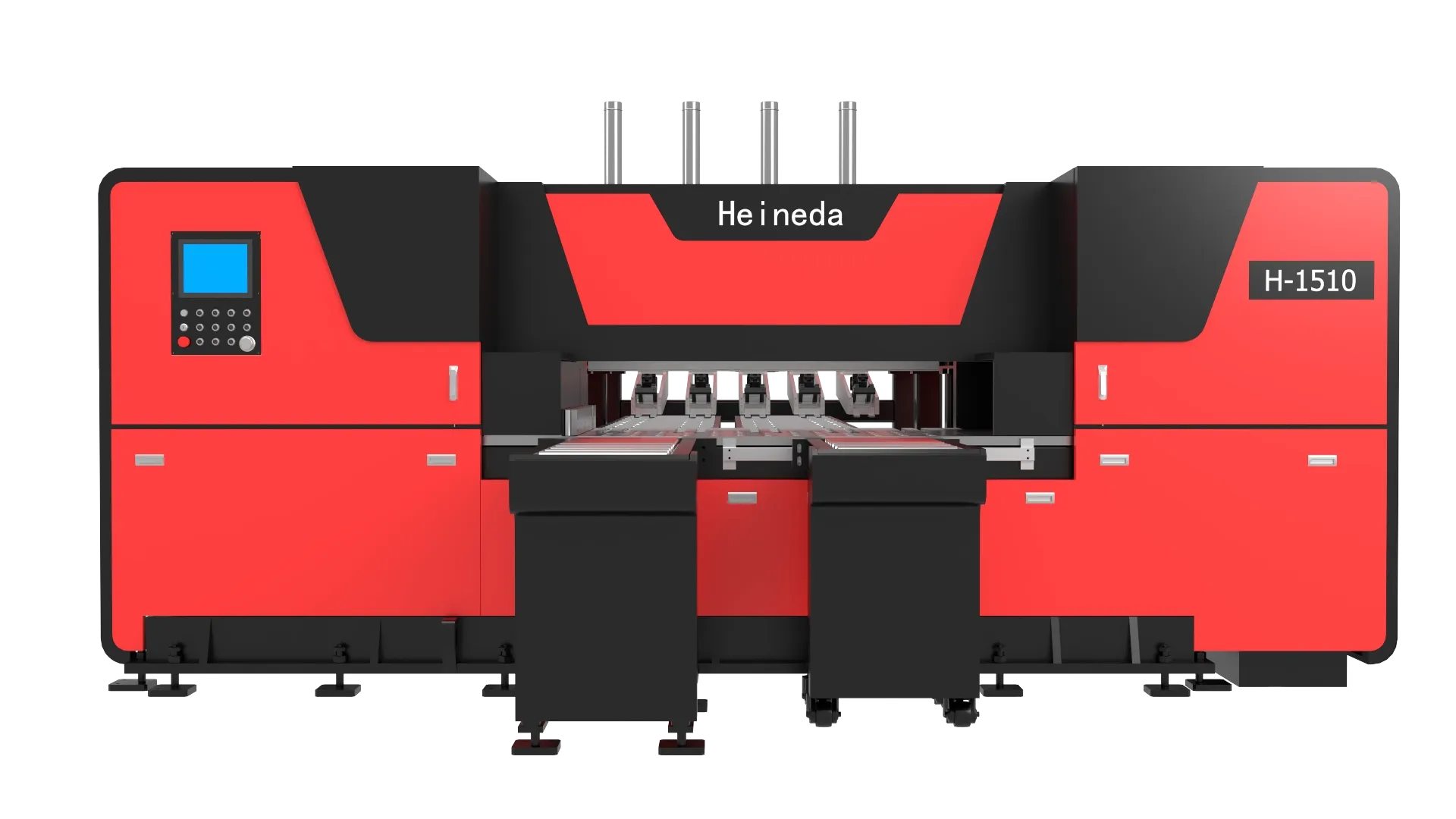
For steel plate cutting, a circular saw delivers ±0.1 mm accuracy at 5–10× the throughput of a traditional band saw, making it the preferred choice for high-volume precision work, while a band saw remains the better option for thick irregular sections, non-ferrous bundles, and applications where kerf width and blade cost outweigh cycle-time requirements.
Key Stats at a Glance
| Metric | Circular Saw (H-series CNC) | Band Saw (Aluminum Band Saw) |
|---|---|---|
| Cutting accuracy | ±0.1 mm | ±0.1 mm / 100 mm squareness |
| Kerf width | Narrower (saw-mill class) | ≤ 2 mm |
| Speed vs. traditional band saw | 5–10× faster | Baseline |
| Max workpiece height (steel plate) | 100 mm | Thick plate & round bar bundles |
| Motor power | 26 KW (H-710) / 30 KW (H-1510, H-2610) | 30–55 KW (aluminum band saw) |
| Surface finish | Mirror-class milled finish | Ra < 25 μm |
| Max plate width covered | 2600 mm (H-2610 model) | Configured per application |
| Daily throughput (aluminum variant) | — | Up to 80 tons / day |
All figures are Heineda factory-verified specifications. No estimated values are used above.
What Each Machine Actually Does
A circular saw for steel plate is a rotating toothed disc — or in the H-series case a CNC saw-milling spindle — that engages the workpiece with a continuous shearing action. The Heineda H-series uses a Siemens control system with full-auto servo feed, enabling programmed multi-cut sequences on materials as demanding as titanium alloy, high-temperature stainless, and age-hardened stainless steel.
A band saw is a continuous loop blade running over two or more wheels that draws teeth through the workpiece in a single plane. The Heineda aluminum band saw uses a dual-column 4-screw design for rigidity, and supports automatic loading, conveying, and unloading integration. Its strength is material versatility: aluminum billet, thick plate, round bar bundles, and irregular profiles all feed through the same machine.
The plate cutting saw comparison below isolates the six factors that most production engineers actually argue over.
Accuracy and Surface Finish
When dimensional tolerance drives the buying decision, both technologies reach ±0.1 mm — but they get there differently.
The H-series CNC circular saw achieves ±0.1 mm through rigid spindle geometry and servo-controlled feed. Because the tool removes material in a milling action rather than pure sawing, the cut face is flat and square with no blade-deflection artifacts. This matters enormously in mold making and aerospace fabrication, where downstream grinding time is a direct cost.
The Heineda aluminum band saw holds ≤ 0.1 mm/100 mm squareness and Ra < 25 μm surface finish. Those numbers are excellent for non-ferrous work. On hard steel, however, band saw blades flex under lateral load, and squareness degrades as height-to-width ratio increases. For steel plates taller than roughly 80 mm, the circular saw's rigid spindle maintains tolerance where band saw blade tension cannot.
Winner for steel plate accuracy: Circular saw (H-series), especially above 80 mm workpiece height.
Kerf Width and Material Yield
Kerf width is the material consumed by the cut — narrower means less scrap, lower cost-per-part, and better yield on expensive alloys.
The Heineda band saw holds kerf ≤ 2 mm, which is already tight by industrial standards. The H-series circular saw uses a thinner saw-mill disc, producing a narrower kerf than a standard band saw loop on equivalent stock. On a production run of 500 steel plate blanks from aerospace-grade titanium, a 1 mm kerf advantage compounds quickly into measurable material savings.
For aluminum billets and non-ferrous profiles where the band saw is the primary tool, the ≤ 2 mm kerf is the correct benchmark. Tight kerf on high-value aluminum stock cuts raw material cost across multi-thousand-ton annual volumes.
Winner for kerf: Circular saw on steel; band saw is best-in-class for non-ferrous profiles. See the steel plate cutting product page for H-series model selection.
Speed and Throughput
Speed is where the circular saw vs band saw steel debate becomes one-sided for production environments.
The H-series CNC circular saw runs 5–10× faster than a traditional band saw — Heineda's own factory benchmark on steel plate. At the low end of that range (5×), a band saw line producing 20 cuts per hour becomes a circular saw line producing 100 cuts per hour with the same operator headcount. At 10×, the economics of capital investment shift dramatically: one H-series machine replaces two to four band saw cells.
The band saw's strength is daily aggregate throughput on non-ferrous: up to 80 tons per day of aluminum billet on the Heineda aluminum band saw. That figure reflects continuous-loop operation with integrated automation — loading, conveying, unloading — running around the clock. For billet production lines, daily tonnage matters more than per-cut cycle time.
Winner for throughput on steel plate: Circular saw, by a factor of 5–10×. For aluminum billet volume, band saw wins on aggregate tons-per-day.
Noise, Vibration, and Operating Environment
Cold saw vs band saw is often a noise and vibration debate in shared production facilities.
Band saws are inherently quieter: the continuous blade contact distributes cutting force over many teeth simultaneously, dampening vibration. The Heineda band saw's dual-column 4-screw frame further stiffens the structure, keeping noise and chatter low even at high feed rates.
Circular saws — including CNC saw-milling spindles — generate higher peak noise during tooth engagement, particularly on hard steel. The H-series mitigates this through Siemens-controlled servo feed that maintains constant chip load, but a circular saw cell still requires hearing protection zones that a band saw cell may not.
Winner for noise and vibration: Band saw. For facilities with shared floor space or strict noise regulations, this is a meaningful differentiator.
Blade Cost and Consumable Economics
Blade cost is a hidden variable that frequently reverses the apparent speed advantage of circular saws in total-cost-of-ownership models.
Band saw blades for aluminum and non-ferrous steel are relatively inexpensive consumables — bi-metal or carbide-tipped loops that are replaced per-run or weekly depending on volume. For aluminum specifically, blade life on the Heineda band saw is long because aluminum is not abrasive.
Circular saw blades — especially the carbide or cermet-tipped discs needed for hard stainless and titanium — carry a higher unit cost and shorter life on abrasive alloys. The H-series is optimized for exactly these materials (titanium alloy, high-temp stainless, age-hardened stainless), so blade cost per cut must be factored against the 5–10× speed advantage and the reduced downstream finishing time.
For a steel cutting method comparison that includes total consumable cost, the crossover point typically sits at mid-volume runs on hard alloys: below ~200 cuts/day on titanium, band saw blade economics may favor the slower machine; above that, the H-series cycle time savings dominate. See the aluminium billet cutting page for non-ferrous consumable benchmarks.
Decision Matrix: If X → Choose Y
| Condition | Choose Circular Saw (H-series) | Choose Band Saw |
|---|---|---|
| Workpiece: steel plate, titanium, hard stainless | ✓ | |
| Workpiece: aluminum billet, round bar bundles, irregular profiles | ✓ | |
| Required accuracy: ±0.1 mm on steel above 80 mm height | ✓ | |
| Volume: > 200 cuts/day on hard alloy | ✓ | |
| Volume: up to 80 tons/day aluminum | ✓ | |
| Plate width up to 2600 mm | ✓ (H-2610) | |
| Shared floor, noise-sensitive facility | ✓ | |
| Aerospace / mold / automotive tolerance | ✓ | |
| Billet production line integration | ✓ | |
| Budget: lower upfront capital | ✓ | |
| Budget: lower cost-per-part at high volume | ✓ | |
| Downstream grinding cost must be eliminated | ✓ |
Get a Heineda Custom Quote — Tell us your plate width, alloy grade, and daily cut volume; Heineda's engineers will recommend the right H-series model or band saw configuration for your exact application. 👉 Request Free Quote
FAQ
Q: Is a circular saw more accurate than a band saw for steel plate? A: At the ±0.1 mm level, both technologies match. However, the H-series CNC circular saw maintains that tolerance on steel plates up to 100 mm height through rigid spindle geometry and servo-controlled feed, while band saw accuracy degrades on tall, narrow steel sections due to blade deflection under lateral load. For steel plate work above 80 mm height, the circular saw holds tighter real-world tolerance.
Q: What is the kerf difference between a circular saw and a band saw? A: The Heineda aluminum band saw produces a kerf of ≤ 2 mm, which is tight for continuous-loop tooling. The H-series circular saw uses a thinner-disc geometry that produces a narrower kerf on equivalent steel plate stock. On high-value alloys like titanium or aerospace aluminum, a 0.5–1 mm kerf reduction across hundreds of cuts per shift translates to measurable raw material savings.
Q: How much faster is a circular saw than a band saw on steel? A: The Heineda H-series CNC circular saw runs 5–10× faster than a traditional band saw on steel plate. This is a factory-verified benchmark, not an estimate. At 5× throughput, a single H-series cell replaces two band saw stations; at 10×, the capital case for circular saw investment becomes compelling even at moderate volumes.
Q: Which machine handles hard materials like titanium and age-hardened stainless? A: The H-series CNC steel plate saw milling machine is specifically designed for titanium alloy, high-temperature stainless, and age-hardened stainless steel. A standard band saw is not recommended for these materials at production volumes — blade deflection, heat buildup, and short blade life make band saws uneconomic on hard alloys above light-duty use.
Q: What H-series model should I choose for my plate width? A: Heineda offers three H-series models: H-710 for plates up to 700 mm wide (26 KW motor), H-1510 for plates up to 1500 mm wide (30 KW motor), and H-2610 for plates up to 2600 mm wide (30 KW motor). All models hold ±0.1 mm cutting accuracy and run on Siemens control systems with full-auto servo feed. Contact Heineda with your plate dimensions and alloy grade for a model recommendation.
Q: Is a band saw ever the right choice for steel applications? A: Yes — for lower-volume steel work, irregular section profiles, mixed non-ferrous and steel lines, or facilities with strict noise limits, a band saw remains cost-competitive. The Heineda aluminum band saw's dual-column 4-screw design handles thick plate and round bar bundles with Ra < 25 μm surface finish. The decision hinges on daily cut volume, alloy hardness, and whether downstream finishing cost is accounted for in the comparison.
Q: Which Heineda machine do aerospace manufacturers use? A: Aerospace customers typically specify the H-series CNC circular saw for steel, titanium, and high-temp stainless plate work requiring ±0.1 mm tolerance, and the E/HL-series fully automatic aluminum plate cutting machine for 1xxx–7xxx series aluminum alloys up to 4000 mm × 4000 mm × 205 mm. Both machine families are used in aerospace fabrication, mold making, and automotive production.
If you remember one thing from this article: for steel plate above 80 mm height at production volume, the circular saw wins on accuracy, speed, and cost-per-part; for aluminum billet, non-ferrous profiles, and noise-sensitive environments, the band saw remains the right tool — and Heineda builds both.
Get a Heineda Custom Quote — Whether you need the H-series circular saw for hard steel and titanium or a fully automatic band saw for aluminum billet lines, Heineda engineers spec the machine to your material and volume. 👉 Request Free Quote