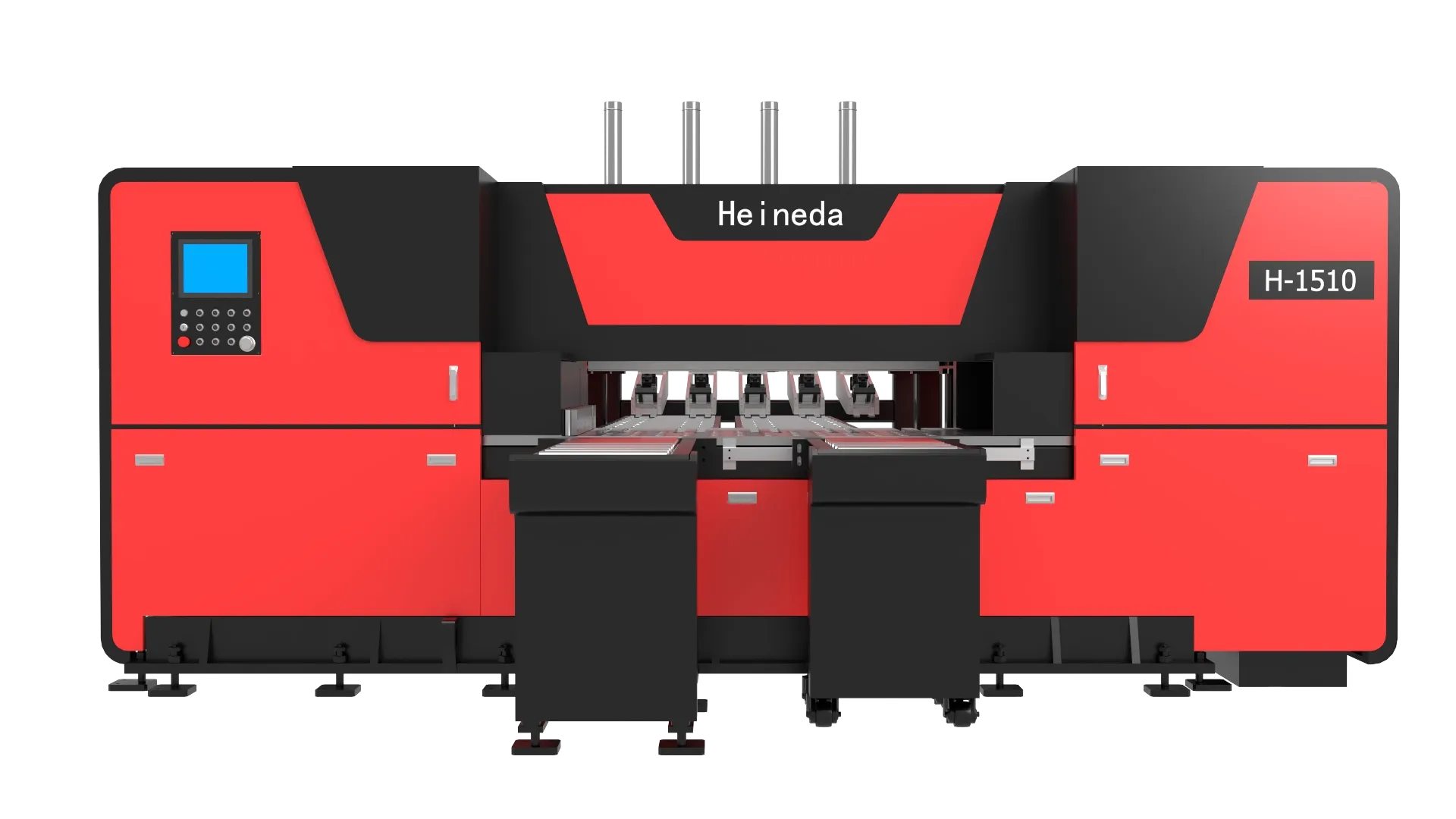
A Siemens controlled metal cutting automation line pairs a Siemens CNC or PLC controller with servo-driven feed mechanisms, real-time monitoring, and networked I/O to deliver cutting accuracy of ±0.1 mm, predictable cycle times, and direct integration into MES and ERP systems on a production floor.
Key Stats
| Metric | Value | Source Machine |
|---|---|---|
| Cutting accuracy | ±0.1 mm | H-series CNC Steel Plate Saw Milling Machine |
| Speed vs traditional band saw | 5–10× faster | H-series (H-710 / H-1510 / H-2610) |
| Surface finish (aluminum) | Ra < 25 μm | Aluminum Band Saw |
| Cutting squareness (aluminum) | ≤0.1 mm / 100 mm | Aluminum Band Saw |
| Kerf width | ≤2 mm | Aluminum Band Saw |
| Daily throughput (aluminum billets) | Up to 80 tons | Aluminum Band Saw |
| Max workpiece (aluminum plate) | 4000 mm × 4000 mm × 205 mm | HL-12CNC |
| Aluminum plate accuracy | ±0.3 mm | E/HL-series Fully Automatic |
What Siemens CNC Control Actually Does Inside a Cutting Line
Siemens CNC metal cutting control is the layer of software and hardware that translates a cut program into closed-loop servo commands, monitors real-time feedback from encoders and sensors, and surfaces diagnostic data to operators or upstream systems.
Inside Heineda's H-series CNC steel plate saw milling machines, the Siemens controller manages three concurrent tasks: servo feed positioning (targeting ±0.1 mm accuracy), spindle load monitoring to protect the blade during cuts through titanium alloy, high-temperature stainless, or age-hardened stainless steel, and handshaking with line-level I/O for loader/unloader coordination. The result is a siemens cnc metal cutting cell that can run lights-out shifts without a dedicated operator watching each cut.
Why does the controller brand matter? Siemens platforms use open, documented fieldbus protocols — PROFINET, PROFIBUS, OPC UA — so a siemens controlled sawing machine connects to any SCADA or MES layer without a custom gateway. Proprietary controls from niche saw builders require vendor-specific middleware, which adds integration cost and creates a single-vendor dependency for software updates.
For buyers comparing against Behringer, MEP, Cosen, Pedrazzoli, or DoAll, the practical question is: does the controller expose raw process data to your factory network? Siemens-controlled lines do this by default.
Servo Feed Precision: What the Numbers Mean on the Shop Floor
Servo controlled band saw and milling feed systems are not simply "more accurate" than hydraulic feeds — they are *programmable* and *repeatable* in a way hydraulic systems cannot match.
A hydraulic feed delivers force with pressure, but position feedback is indirect. A servo feed measures encoder counts at the axis motor, compares position to the commanded setpoint dozens of times per second, and corrects continuously. For the H-710 (700 mm wide), H-1510 (1500 mm wide), and H-2610 (2600 mm wide) models, this means every part in a batch of 500 lands at ±0.1 mm — not just the first few before thermal drift moves the hydraulic valve spool.
For aerospace and mold-making shops supplying the automotive sector, this repeatability eliminates the secondary grinding pass that hydraulic-feed machines typically require on thick sections up to 100 mm workpiece height. At 26 KW (H-710) and 30 KW (H-1510 / H-2610), the motors have enough torque headroom to maintain feed-rate consistency even when cutting through unexpected hardness variations in age-hardened stainless — a condition that stalls underpowered machines and destroys blade geometry.
PLC Integration and Real-Time Monitoring in a Production Line
Industrial automation cutting line design depends on how cleanly each machine accepts and broadcasts state. A Siemens-controlled cutting line speaks PROFINET natively, which means:
- Start / stop / fault signals flow over standard fieldbus rather than hardwired relays
- Cut count, cycle time, and blade-load telemetry post to a historian in real time
- Alarm escalation routes to operator HMI screens, mobile alerts, or MES dashboards without custom drivers
Heineda's H-series machines ship with full-auto servo feed and Siemens control as standard, not as an upgrade. The loading, conveying, and unloading integration points are designed to accept standard PLC I/O — either Siemens S7 series or any third-party PLC that supports PROFINET. This matters for factories that have already standardized on a particular automation backbone: the siemens controlled sawing machine slots into the existing architecture rather than requiring a parallel control network.
Real-time monitoring on Heineda's aluminum band saws includes light-curtain protection that halts the line on a broken beam without requiring a PLC ladder-logic change. Safety I/O is handled at the safety-rated controller level, keeping the safety layer independent of the process program.
For a deeper look at how these machines handle steel plate applications, see the full H-series steel plate cutting lineup.
Get a Heineda Custom Quote — Tell us your material, cut width, and daily volume and we'll spec the right Siemens-controlled cutting line for your production rate. 👉 Request Free Quote
Industry 4.0 Readiness: OPC UA, Nesting, and Data Traceability
Industry 4.0 readiness in a metal cutting line means each machine can act as a data node — publishing process variables, consuming job orders, and participating in digital-twin feedback loops — without requiring physical reconfiguration.
Heineda's fully automatic aluminum plate cutting machines (E/HL series) add a second layer of automation intelligence: auto nesting optimization. The controller calculates the most material-efficient cut layout from a job queue and executes it without operator input. For operations running 1xxx–7xxx series aluminum alloys in the E-6 (1600 mm wide), E-10 (3000 mm wide), or HL-12CNC (4000 mm wide) models, this means measurably lower scrap rates on high-value aerospace plate — a benefit that compounds across shifts.
The air-bearing work table on E/HL-series machines protects the aluminum surface during positioning. This is not cosmetic: for aerospace-grade 7075 or 7050 plate, surface scratches force a rework or rejection that costs more than the machine itself per incident.
From an Industry 4.0 standpoint, the smart metal cutting machine delivers three data streams a factory intelligence layer can consume: 1. Part traceability — which batch, which program, which blade, which time 2. Predictive maintenance signals — blade load trending, feed-motor current signatures 3. OEE inputs — uptime, cycle count, alarm frequency
These streams are available on Siemens-controlled lines because the controller architecture was designed for network connectivity. Proprietary controls typically require a third-party data-extraction appliance to surface equivalent data.
Siemens Control vs Proprietary Control: Production Metric Comparison
When production managers evaluate a siemens cnc metal cutting line against a machine with a proprietary control, the comparison rarely comes down to the cut itself — accuracy and speed are similar at the high end. The divergence appears in integration cost, spare-parts lead time, and total cost of ownership over five to ten years.
| Decision Factor | Siemens-Controlled Line | Proprietary Control |
|---|---|---|
| Fieldbus compatibility | PROFINET / OPC UA native | Vendor gateway required |
| Spare controller availability | Global distributor network | Sole-source from OEM |
| Software update dependency | Siemens lifecycle roadmap | OEM support contract |
| Data export to MES/ERP | Standard OPC UA tags | Custom API or screen-scraping |
| Training availability | Siemens certified courses worldwide | OEM training only |
| Integration labor (new line) | Lower — standard I/O mapping | Higher — custom middleware |
For plate service centers, forging plants, and billet production lines running multi-machine cells, the integration labor differential alone can recover the price premium of a Siemens-controlled line within the first year of operation.
"If X → Choose Y" Decision Engine
| If your situation is... | Then choose... |
|---|---|
| Cutting titanium alloy, high-temp stainless, or age-hardened stainless steel at ±0.1 mm | H-series CNC Steel Plate Saw Milling Machine (Siemens control, servo feed) |
| Processing aluminum billets, round bar bundles, or thick plate up to 80 t/day | Aluminum Band Saw with automation loading/unloading integration |
| Cutting large aluminum plate up to 4000 × 4000 × 205 mm with auto nesting | E/HL-series Fully Automatic Aluminum Plate Cutting Machine |
| Needing the widest cut width (2600 mm steel, 4000 mm aluminum) | H-2610 (steel) or HL-12CNC (aluminum) |
| Replacing a hydraulic-feed machine to eliminate secondary grinding | H-series (servo feed, ±0.1 mm repeatability) |
| Integrating into an existing Siemens S7 or PROFINET automation backbone | Any Heineda H-series — ships with Siemens control as standard |
| Prioritizing surface finish on aerospace-grade aluminum plate | E/HL-series with air-bearing work table (Ra < 25 μm class) |
FAQ
Q: What does "Siemens controlled" mean on a metal cutting machine? A: It means the machine's motion control, feed axis, and I/O coordination run on a Siemens CNC or PLC platform — typically an 828D, 840D, or S7 series controller. This gives the machine native PROFINET and OPC UA connectivity, a globally supported spare-parts chain, and a programming environment (ISO G-code or ladder logic) that most automation engineers already know.
Q: How much more accurate is a servo controlled band saw versus a hydraulic-feed saw? A: Hydraulic feeds typically achieve ±0.5 mm to ±1 mm positional repeatability across a production batch. Heineda's H-series servo feed achieves ±0.1 mm — a 5× to 10× improvement in positional accuracy. More importantly, servo accuracy is stable over long runs because the encoder-feedback loop corrects for thermal and load variation continuously, whereas hydraulic valve drift accumulates over time.
Q: Can a Siemens controlled sawing machine connect directly to our MES system? A: Yes. Siemens controllers expose process data via OPC UA, which is the standard protocol for MES and ERP integration. A Heineda H-series machine can publish cut count, cycle time, blade load, and alarm states to any OPC UA-capable historian or MES without custom middleware. For legacy systems that use PROFIBUS rather than PROFINET, a gateway module is available from Siemens directly.
Q: What materials can the H-series CNC Steel Plate Saw Milling Machine handle? A: The H-series handles titanium alloy, high-temperature stainless steel, and age-hardened stainless steel — materials that destroy standard band-saw blades quickly due to work hardening and heat generation. The Siemens controller's real-time spindle load monitoring protects the blade by adjusting feed rate before overload occurs. Applications span aerospace, metallurgy, automotive, and mold making.
Q: How does auto nesting optimization reduce material waste on the aluminum plate cutting machines? A: The E/HL-series controller accepts a job queue (a list of required part dimensions) and calculates the most efficient cut layout across each incoming plate before the first cut runs. For 7xxx aerospace alloys where raw material cost is high, nesting efficiency improvements of 3–8% translate directly to measurable cost savings per shift.
Q: Is the Siemens control on Heineda machines a standard feature or an upgrade option? A: On the H-series CNC Steel Plate Saw Milling Machine, Siemens control and full-auto servo feed are standard — not an optional upgrade. You do not need to specify them separately when quoting. To confirm the exact controller model for your integration requirements, contact the Heineda team directly.
Q: How does a Siemens-controlled cutting line compare to Behringer or MEP on Industry 4.0 readiness? A: Behringer and MEP both offer capable machines at the high end, and some models use Siemens controls as well. The differentiating factors are integration support, lead time for the Asian market, and whether the control configuration matches your factory's existing automation standard. Heineda machines ship with Siemens control as standard and are designed for loading/conveying/unloading integration — making them a direct competitor on capability for facilities that already run Siemens automation infrastructure.
If you remember one thing from this article: a Siemens controlled metal cutting automation line is not primarily a faster saw — it is a data-connected, servo-precise cutting node that integrates cleanly into any modern factory automation backbone, and that integration advantage compounds in value every year the line runs.
Get a Heineda Custom Quote — Share your cut spec and we'll confirm which H-series or E/HL-series model matches your Industry 4.0 integration requirements and daily throughput target. 👉 Request Free Quote