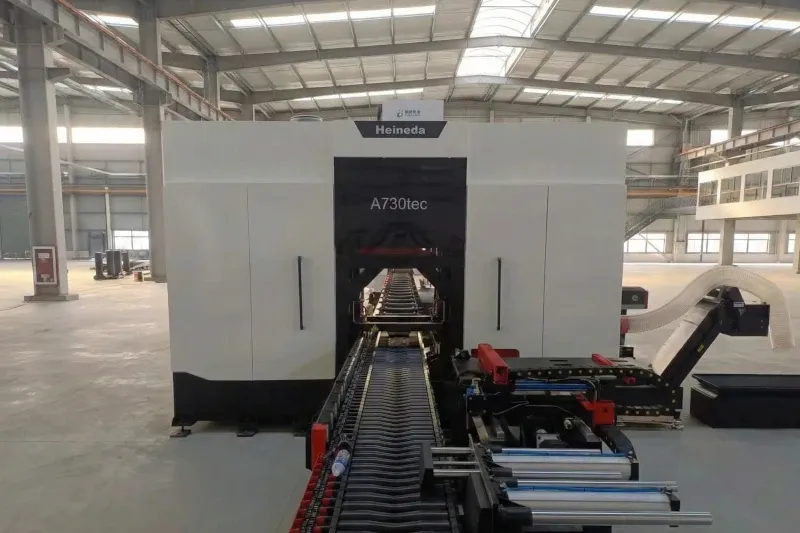
A semi automatic bandsaw machine automates the cut cycle — blade descent, feed, and retract — while a human loads each part; a fully automatic bandsaw runs unattended through an entire batch, with powered conveyors handling loading and unloading. The productivity gap between them is real but smaller than most sales decks suggest, and the right choice depends almost entirely on your shift volume and part mix.
Key Stats
| Metric | Semi-Automatic | Fully Automatic (Heineda reference) |
|---|---|---|
| Cutting squareness | ≤0.1 mm / 100 mm | ≤0.1 mm / 100 mm |
| Surface finish | Ra < 25 μm | Ra < 25 μm |
| Kerf width | ≤2 mm | ≤2 mm |
| Daily aluminum billet capacity | Operator-paced | Determined by billet diameter, cutting length, material properties, and production setup. |
| Payback period | Determined by shift schedule, labor cost, and throughput; contact Heineda for project-specific estimates. | Determined by shift schedule, labor cost, and throughput; contact Heineda for project-specific estimates. |
| Automation integration | Optional add-on | Native (loading / conveying / unloading) |
What "Semi-Automatic" Actually Means at the Machine Level
A semi automatic band saw machine is one where the cutting motion — blade clamping, feed rate, head return — is controlled by a programmable logic sequence, but the material handling before and after each cut still requires an operator. The machine does not idle waiting for button presses mid-cut; it idles waiting for the next part to be staged.
That distinction matters because most productivity analyses compare theoretical cycle times, not actual throughput. On a semi automatic horizontal bandsaw cutting 150 mm round bar, a trained operator can stage, clamp, and clear parts in under 30 seconds. If the cut itself takes 90 seconds, the operator is idle 75% of the cut cycle — which means adding a conveyor system captures only that 25% loading window, not the full cycle.
The practical throughput ratio between semi-automatic and fully automatic on a single part number, single shift, with one skilled operator is typically 1 : 1.3 to 1 : 1.6. The gap widens significantly only when:
- Batch sizes exceed ~200 pieces per setup
- Night shifts or lights-out operation are required
- Part weight exceeds 20 kg (ergonomic fatigue becomes a real throughput constraint)
Where the Productivity Gap Actually Comes From
The productivity gap between a semi automatic bandsaw and a fully automatic bandsaw machine is not primarily about the cut itself — both run the same blade at the same feed rate into the same material. The gap comes from three sources: material handling time, shift coverage, and setup amortization.
Material handling time is the dominant factor on heavy stock. On aluminum billet lines where Heineda's fully automatic systems achieve high daily throughput, a large fraction of that output comes not from a faster blade but from roller conveyors that feed, index, and eject material continuously while the blade is already descending on the next cut. A semi automatic bandsaw in the same application with one operator physically repositioning billets achieves lower output — not because the machine is slower but because one person cannot move billet fast enough to keep pace.
Shift coverage is the second lever. A fully automatic semi automatic bandsaw — or rather, a fully automatic machine — can run a third unmanned shift. At 8 hours per shift × 3 shifts, that is 24 hours of spindle time against a semi-automatic's realistic 14–16 hours (two staffed shifts plus changeover). The asset utilization gap is ~50%, and that gap directly affects payback period.
Setup amortization favors semi-automatic machines in job shops. A semi automatic horizontal bandsaw can change over from one part number to another in under five minutes. A fully automatic line with bar feeders and integrated conveyors may require 20–40 minutes of mechanical adjustment. If you run 15 different part numbers per day, that setup overhead erodes much of the throughput advantage.
Payback Period by Shift Volume
Payback period for any capital equipment depends on the incremental output value it creates. For bandsaw automation, the relevant variable is how many additional tons (or pieces) per year the upgrade produces relative to its cost.
Using Heineda's aluminum billet line as a reference model:
Single-shift operation (one operator, 8 h/day): The fully automatic upgrade adds incremental throughput over a skilled semi-automatic operator. The payback period needs to be evaluated against your specific margins and labor costs. For most single-shift shops, the payback may be too long to justify unless labor cost is exceptionally high or night-shift expansion is already planned.
Two-shift operation: The automation premium starts making economic sense. Adding a third unmanned shift produces additional capacity at near-zero marginal labor cost. Payback can be significantly faster at the same margin assumption.
Three-shift or 24/7 operation: Fully automatic is the only rational choice. Semi-automatic requires multiple operators, and labor cost alone often exceeds the financing cost of the automated machine.
The crossover point for most shops is somewhere between 1.5 and 2 staffed shifts per day.
Which Shops Should Not Bother Upgrading
Not every shop should upgrade from a semi automatic bandsaw to a fully automatic bandsaw machine, and buying the more expensive machine for the wrong operation is a common and expensive mistake.
Job shops with high mix / low volume should stay semi-automatic. If your average batch is under 50 pieces and you run more than 8 distinct part numbers per day, the setup time on a full-auto line consumes most of the throughput advantage. A high-quality semi automatic band saw machine with digital readout and quick-clamp vises will outperform a full-auto machine in total pieces-out per dollar invested.
Shops cutting oversized or irregular profiles face similar logic. Heineda's aluminum billet lines support "round bar bundles and irregular profiles," but fully automatic feeding systems are optimized for consistent cross-sections. Mixed-profile days mean manual intervention on a full-auto machine — at which point you are operating a very expensive semi-automatic.
Operations with fewer than 200 cuts per day rarely justify the full-auto premium. The maintenance overhead (conveyor chains, bar feeders, sensors, PLC logic) adds cost and downtime risk that a simpler semi-automatic machine does not carry.
Shops where surface finish is the constraint, not throughput, should focus on blade specification and cutting parameters rather than automation level. Both semi and fully automatic configurations can achieve Ra < 25 μm and ≤0.1 mm/100 mm squareness — the automation level does not change the cut quality ceiling.
"If X → Choose Y" Decision Engine
| Your Situation | Recommended Choice |
|---|---|
| Single shift, <200 cuts/day, high part mix | Semi-automatic bandsaw |
| Single shift, 200–500 cuts/day, 1–3 part numbers | Semi-automatic with optional conveyor add-on |
| Two shifts, high-volume single part number | Fully automatic bandsaw machine |
| Three shifts or lights-out required | Fully automatic only |
| Parts >20 kg each, operator ergonomics a concern | Fully automatic (loading assist or full conveyor) |
| Irregular profiles, mixed cross-sections daily | Semi-automatic (full-auto feed unreliable) |
| Aluminum billet cutting, high daily volume target | Heineda full-auto with conveyor integration |
| Aerospace or tight-tolerance plate work | CNC saw-milling (different category entirely) |
Get a Quote for the Right Configuration
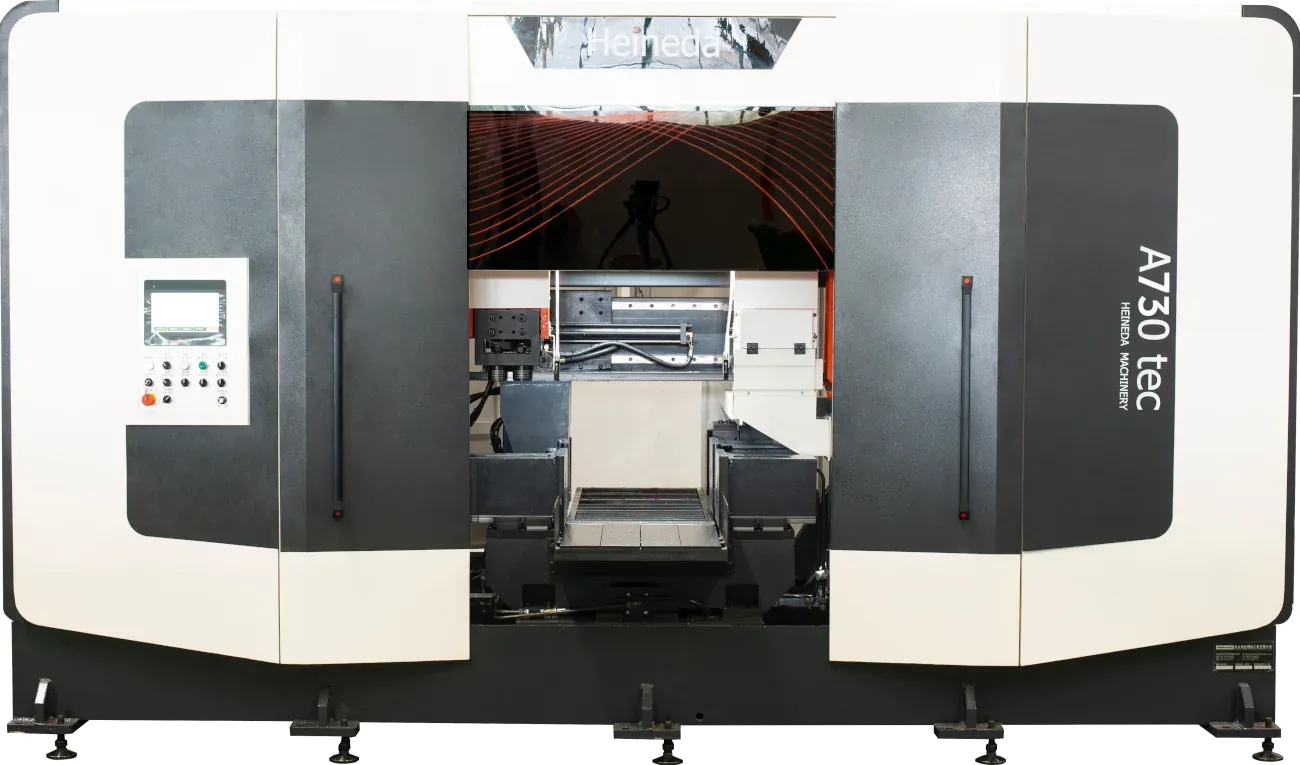
Running 1–2 shifts on aluminum billet, bar stock, or structural profiles? Heineda's engineering team sizes the right machine — semi-automatic or fully automatic — based on your daily tonnage, part mix, and shift schedule, not a generic catalog recommendation.
Get a Quote → heinedasaw.com/contact
Provide your daily volume target and current part mix and the team will return a throughput model with analysis.
FAQ
Q: What is the main difference between a semi automatic bandsaw machine and a fully automatic one? A: A semi automatic bandsaw machine automates the cut cycle (clamping, feed, retract) but requires an operator to load and unload each part. A fully automatic bandsaw adds powered conveyors and indexing systems to handle material movement without operator intervention, enabling lights-out or multi-shift operation.
Q: How much faster is a fully automatic bandsaw compared to semi-automatic? A: On a like-for-like part in a single-shift staffed operation, the throughput ratio is typically modest — the gap comes primarily from material handling time. The gap grows substantially when comparing multi-shift fully automatic operation to single-shift semi-automatic — full-auto systems achieve higher throughput because they eliminate manual billet handling between cuts.
Q: At what production volume does upgrading to fully automatic pay back within two years? A: Two staffed shifts per day is approximately the crossover point where full-auto payback becomes attractive. Single-shift operations generally see longer payback periods, which most shops consider marginal unless third-shift expansion is already planned. Actual payback depends on your specific margins and labor costs.
Q: Can a semi automatic horizontal bandsaw achieve the same cut quality as a fully automatic machine? A: Yes. Cut quality — squareness ≤0.1 mm/100 mm, surface finish Ra < 25 μm, kerf width ≤2 mm — is determined by machine rigidity, blade specification, and cutting parameters, not automation level. Both machine types can achieve the same quality ceiling when properly set up.
Q: Which industries use fully automatic bandsaw machines most commonly? A: High-volume aluminum processing is the primary application — billet production lines, plate service centers, and extrusion plants where throughput targets require multi-shift operation. Semi-automatic machines are more common in mold shops, job shops, and fabrication facilities with variable part mixes.
Q: Is a semi automatic band saw machine suitable for cutting materials other than aluminum? A: Semi automatic bandsaws cut steel, stainless steel, titanium, and non-ferrous alloys — the automation level is independent of material capability. For hard alloys (titanium, age-hardened stainless, high-temp alloys), Heineda's CNC Steel Plate Saw Milling machine is a separate category designed for those materials.
Q: What maintenance differences should I expect between semi-automatic and fully automatic bandsaws? A: A fully automatic bandsaw adds conveyor drives, bar feeders, PLC sensor arrays, and pneumatic or servo indexing systems to the base machine. These components add maintenance overhead — chain lubrication, sensor calibration, actuator wear — that a semi-automatic machine does not carry. For low-volume shops, this added complexity often outweighs the throughput benefit.
If you remember one thing from this article: the productivity gap between a semi automatic bandsaw and a fully automatic machine is mostly a shift-count story — at one shift, the gap rarely justifies the cost; at two or more shifts, the math usually does.
Talk to an Engineer Before You Decide
Heineda's applications team has configured both semi-automatic and fully automatic bandsaw systems for billet lines, plate service centers, and job shops across the aluminum and steel supply chain. They will tell you honestly if the upgrade makes sense for your volume — and quote you the right machine if it does.
Get a Quote → heinedasaw.com/contact