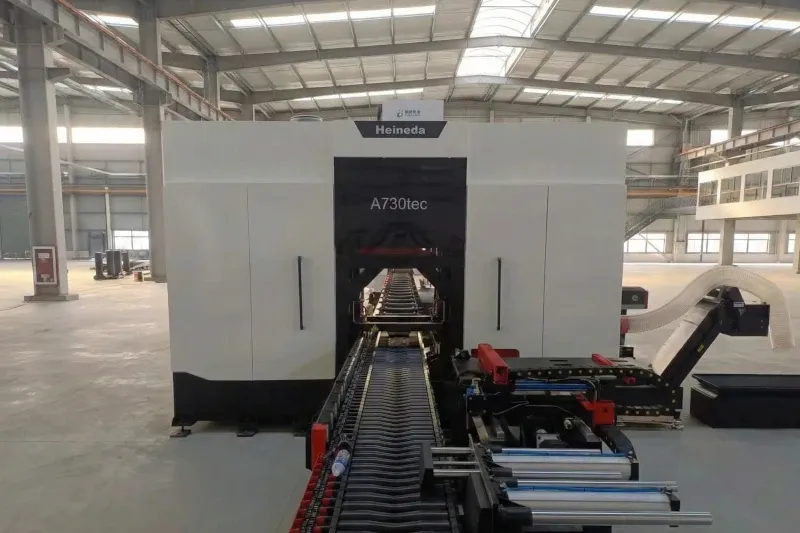
A pipe cutting band saw machine is a horizontal or double-column band saw configured with a pipe-profile vise, adjustable jaw inserts, and a blade pitch matched to wall thickness — enabling clean, burr-free cuts on hollow round, square, and rectangular tube sections as well as solid round bars.
Key Stats at a Glance
| Specification | Heineda Value |
|---|---|
| Cutting squareness (aluminum band saw) | ≤ 0.1 mm / 100 mm |
| Surface finish after cut | Ra < 25 μm |
| Kerf width | ≤ 2 mm |
| Daily aluminum billet capacity | Determined by billet diameter, cutting length, material properties, and production setup. |
| CNC steel plate saw cutting accuracy | ± 0.1 mm (stated) |
| Aluminum plate saw cutting accuracy | ± 0.3 mm (ref) |
| Largest workpiece handled (E/HL series) | 4000 mm × 4000 mm × 205 mm |
Round Stock vs Structural Profiles: Why the Distinction Matters
Round stock and structural profiles behave differently under a band saw blade, and the machine configuration that excels on one will underperform on the other.
Round bar and pipe present a curved contact surface. At the moment the blade enters the workpiece, tooth engagement is at a single tangent point; mid-cut it widens to the full diameter, then narrows again on exit. This variable chip load stresses the blade unless feed rate is actively modulated — a feature found on servo-controlled saws like Heineda's aluminum band saw, which supports full automation integration including loading, conveying, and unloading. For tube cutting band saw work specifically, the blade passes through two walls of thin material separated by air. A blade pitched too coarse will hook the inner wall; a blade pitched too fine will choke on thick-wall hydraulic pipe. The correct starting point is at least three teeth in contact with the wall at all times.
Structural profiles — I-beam, angle iron, channel, H-section — have alternating thick flange and thin web sections. Each flange-to-web transition changes effective cutting depth abruptly, making a consistent feed rate equally important. The Heineda aluminum band saw's dual-column 4-screw design keeps the beam perpendicular to the vise face through the entire stroke, which is critical for keeping a structural cut square when cross-section geometry changes mid-pass.
The practical upshot: a pipe and tube cutting machine needs a self-centering or V-block vise to grip the round OD without marring the surface. A structural steel saw needs a wide, flat vise jaw that clamps across the flange footprint. Machines designed for bundles — like Heineda's aluminum band saw handling round bar bundles — use a bundle vise with extended jaw travel.
Vise Clamping Types and When to Use Each
When selecting a pipe saw machine, the vise type drives cut quality more than almost any other factor.
| Vise Type | Best For | Limitation |
|---|---|---|
| Self-centering V-block | Round pipe, round bar, tube bundles | Poor grip on flat/structural profiles |
| Dual flat jaw | Structural steel, square tube, billets | Poor centering on round OD |
| Roller-feed roller clamp | Long bar and tube stock in automatic mode | Not suited for short offcuts |
| Hydraulic bundle clamp | Multiple round bars or tube bundles per cut | Requires pre-stacking fixture |
Heineda's aluminum band saw specifically supports round bar bundles, meaning the hydraulic bundle clamp is a standard capability — not a special order — on the aluminum platform. For customers cutting both round aluminum billet and rectangular plate in the same facility, the recommended approach is to specify the aluminum band saw for the round-stock and billet line, and route flat plate to the E/HL series aluminum plate cutting machine which supports workpieces up to 4000 mm × 4000 mm × 205 mm with air-bearing table protection.
Angle Cutting Capability: Mitre vs Fixed-Head Machines
A metal tube cutting machine used in fabrication — structural frames, handrails, process piping — often needs cuts at angles other than 90°. Not all band saws offer this.
Fixed-head saws cut at 90° only. They are faster to set up, structurally stiffer, and better suited to production where every cut is a cross-cut. The Heineda aluminum band saw's dual-column 4-screw frame is a fixed-head geometry, optimized for high-throughput billet-line scenarios.
Mitre/swivel-head saws rotate the bow assembly relative to the vise — typically 0° to 60° left — for angled cuts. This is essential for structural fabrication where tube ends must be mitered for welded joints. If your application is primarily fabrication rather than production parting, confirm that any band saw you evaluate has a graduated swivel scale and a positive-stop lock at common angles (22.5°, 30°, 45°).
For structural steel band saw applications in heavy fabrication, the relevant question is not only angle range but also how the machine handles the feed rate change as blade engagement increases at shallow miter angles. Automatic servo feed — standard on Heineda CNC machines — adjusts feed in real time to avoid blade deflection during angled cuts.
For aluminum billet cutting lines where every cut is a 90° parting cut, a fixed-head machine with automation integration is the correct choice. Heineda's aluminum billet cutting line details are available at heinedasaw.com/aluminium-billet-cutting/.
Get a Heineda Custom Quote — tell us your pipe OD, wall thickness, material, and daily volume and we'll match you to the right band saw configuration. 👉 Request Free Quote
Which Heineda Configurations Handle Pipes, Tubes, and Solid Billets
The Heineda product line addresses three distinct material geometries. Understanding where each machine fits prevents over-specification and under-performance.
Aluminum Band Saw — Pipes, Round Bars, and Billet Bundles
When the material is aluminum and the geometry is round — extruded round bar, hollow round tube, or billet — Heineda's aluminum band saw is the primary recommendation. Key attributes relevant to round bar band saw and tube work:
- Kerf width ≤ 2 mm preserves material yield on expensive aluminum alloy billet
- Surface finish Ra < 25 μm eliminates a secondary facing operation for most aerospace and automotive customers
- Cutting squareness ≤ 0.1 mm / 100 mm meets tolerance requirements for billet-to-press feeding
- Automation integration — loading, conveying, unloading — enables unmanned night shifts on high-volume tube parting
Light curtain protection is standard, enabling safe operation for automated lines where operators are present near the infeed conveyor.
CNC Steel Plate Saw Milling Machine (H-Series) — Solid Steel Billets and Thick-Wall Structural
The H-series (H-710, H-1510, H-2610) is not a tube-cutting machine. Its design targets flat plate and solid billet in titanium alloy, high-temperature stainless, and age-hardened stainless steel — materials where a conventional band saw is less efficient. With ± 0.1 mm accuracy (stated), the H-series is the right tool when the material is high-hardness and the cross-section is solid or near-solid.
For customers cutting large-diameter thick-wall steel pipe (wall thickness approaching the OD), the H-series 100 mm max workpiece height is the hard constraint; pipe OD must fit within that envelope.
Fully Automatic Aluminum Plate Cutting Machine (E/HL Series) — Large Flat Stock Only
The E/HL series handles aluminum plate up to 4000 mm × 4000 mm × 205 mm with auto nesting optimization and an air-bearing table. This is the correct machine for plate service centers and sheet metal fabricators. It is not a pipe or tube machine.
Decision Engine: "If X → Choose Y"
| Scenario | Recommended Heineda Machine |
|---|---|
| Aluminum round bar bundles, high daily volume (≥ 20 t/day) | Aluminum Band Saw (bundle clamp + automation) |
| Aluminum hollow tube, surface finish critical (Ra < 25 μm) | Aluminum Band Saw |
| Aluminum billet for forging / extrusion press feed | Aluminum Band Saw — see billet cutting details |
| Solid steel billet, titanium alloy, or hardened stainless | CNC Steel Plate Saw Milling Machine (H-series) |
| Large aluminum plate, nesting required | Fully Automatic Aluminum Plate Cutting Machine (E/HL) |
| Mixed round + flat aluminum in one facility | Aluminum Band Saw (round) + E/HL series (plate) |
| Structural steel fabrication, miter cuts required | Confirm swivel-head spec with Heineda engineering |
| Thick-wall steel pipe, OD ≤ 100 mm | H-710 (within 700 mm width, 100 mm height limit) |
FAQ
Q: What blade pitch should I use on a tube cutting band saw for thin-wall aluminum tube? A: For thin-wall aluminum tube, use a blade pitch that keeps at least 3 teeth in simultaneous contact with the wall. For wall thicknesses of 2–5 mm, a 6–10 TPI variable-pitch blade is a common starting point. Heineda's engineering team can specify the exact pitch based on your OD, wall thickness, and feed rate when you request a quote.
Q: Can Heineda's aluminum band saw cut stainless steel pipe? A: The aluminum band saw platform is optimized for aluminum alloys (1xxx–7xxx series). For stainless steel pipe and tube — particularly high-temperature or age-hardened grades — the H-series CNC steel plate saw milling machine is the appropriate choice, as it is specifically rated for high-temp stainless and age-hardened stainless steel.
Q: How does a self-centering V-block vise differ from a standard flat jaw vise on a pipe saw machine? A: A self-centering V-block vise grips round OD at two tangent points symmetrically, keeping the pipe axis aligned with the blade regardless of diameter variation within a range. A flat jaw vise clamps flat faces and cannot reliably center round stock — the pipe rolls or shifts under cutting load, producing an angled cut. For any metal tube cutting machine handling round cross-sections, a V-block or hydraulic self-centering vise is mandatory for cut quality.
Q: What daily output can I expect from Heineda's aluminum band saw on round billet parting? A: The aluminum band saw supports high-volume production of aluminum billets when configured with full automation (loading, conveying, unloading). Actual output depends on billet diameter, cut length, and alloy hardness.
Q: Is a horizontal band saw or a vertical band saw better for pipe cutting? A: Horizontal band saws are preferred for production pipe and tube cutting because gravity-assisted blade feed provides a more consistent and controllable cutting force than a vertical layout. The workpiece also lies flat and stable in the vise without requiring fixturing to hold it upright. Heineda's aluminum band saw is horizontal, consistent with industry-standard practice for high-volume round bar band saw and tube parting lines.
Q: What is the difference between a pipe cutting band saw and a structural steel band saw? A: A pipe cutting band saw is characterized by its vise geometry (V-block or self-centering for round OD) and blade pitch selection (fine pitch for thin walls). A structural steel band saw uses flat vise jaws to grip flanges and can handle I-beam, channel, and angle iron where the cross-section is asymmetric. Some machines support both with interchangeable vise inserts, but high-volume production lines are typically dedicated to one geometry for maximum throughput and consistent setup.
If you remember one thing from this article: the vise type and blade pitch — not the machine frame size alone — are what separate a capable pipe cutting band saw machine from one that mars tube surfaces or produces angled cuts on thin-wall material. Match those two parameters to your specific OD and wall thickness before selecting any machine.
Get a Heineda Custom Quote — our engineers review your material spec, daily volume, and cut tolerance before recommending a configuration. 👉 Request Free Quote