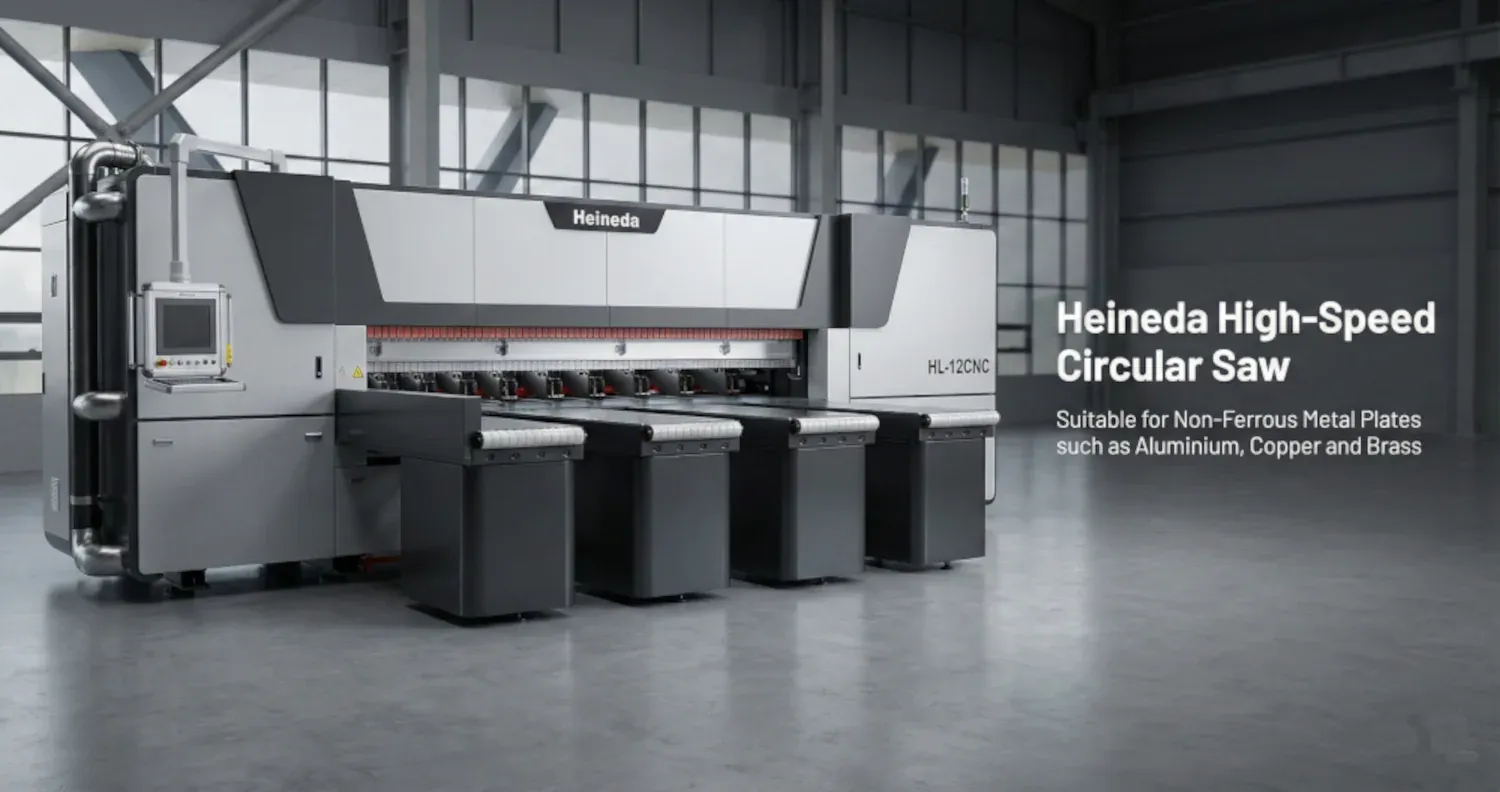
A panelsaw machine is a heavy-duty industrial saw designed to cut large flat panels — most commonly aluminum plate, steel plate, or engineered sheet goods — to precise dimensions in a single straight pass.
Key Stats: Panelsaw Machine at a Glance
| Metric | Value |
|---|---|
| Heineda max panel size (HL-12CNC) | 4000 mm × 4000 mm × 205 mm |
| Cutting accuracy (aluminum plate) | ±0.3 mm |
| Material range | 1xxx–7xxx aluminum alloys |
| Motor power (all aluminum plate models) | 30 kW |
| Smallest Heineda model table width (E-6) | 1600 mm |
| Mid-range table width (E-10) | 3000 mm |
| Work table technology | Air-bearing (frictionless sheet movement) |
What Is a Panelsaw Machine — and How Does the Terminology Work?
"Panelsaw machine," "panel saw machine," and "panel saw" all refer to the same class of equipment. Panelsaw (one word) is simply a common single-word variant used across B2B platforms such as Alibaba.com and Made-in-China.com; buyers use both forms interchangeably in search queries. The defining characteristic of any panelsaw is that it moves the sheet (or a carriage-mounted blade) along a fixed horizontal bed, keeping the workpiece flat throughout the cut rather than standing it on edge.
A beam saw (also written *beam saw CNC* when numerically controlled) is a subset of the panelsaw family most often associated with cutting wood-based panels. In metal fabrication, the term "beam saw" is rarely used; buyers instead ask for an *automatic panel saw machine* or a *CNC panel saw* depending on how much automation they need.
Panel Saw vs. CNC Panel Saw vs. Panelsaw Machine — Practical Differences
These three labels sit on a spectrum of automation:
Panel saw (manual/semi-auto): The operator positions the sheet by hand using mechanical stops. Feed rate and stop positions are set manually for each job. Output is adequate for low-mix, high-volume runs of standard sizes.
Automatic panel saw machine: Adds a programmable stop system and motorized feed. The machine indexes to the next cut dimension without the operator repositioning the sheet. Heineda's E-series machines fall here: servo-driven automatic feed, programmable stops, and digital length control.
CNC panel saw (full CNC): A CNC controller governs every axis — feed, stop position, blade depth, and in advanced models, sheet rotation for cross-cuts. Heineda's HL-12CNC adds a full CNC control layer on top of the automatic feed, enabling auto nesting optimization that maximizes yield from each sheet before a single cut is made.
The practical rule: if your cut list changes frequently or you cut sheets to many different lengths in a single shift, the step up from automatic to CNC pays back in reduced setup time within months.
Sizing a Panelsaw for Aluminum Plate Work
Four parameters govern model selection for aluminum plate cutting:
1. Table width vs. sheet width. The machine's table must be at least as wide as your widest incoming sheet. Standard aluminum plate in industrial supply chains comes in widths up to 1500 mm (E-6 covers this), 2500 mm (E-10 covers this), and up to 4000 mm (HL-12CNC covers this).
2. Blade depth (cutting height). Heineda's aluminum plate machines handle workpiece heights up to 205 mm, accommodating thick plate and stacked thin sheet in a single pass.
3. Programmable stop range. The cutting accuracy specification of ±0.3 mm applies across the full length range. For aerospace and automotive customers, this tolerance is sufficient for plate blanking before secondary machining.
4. Air-bearing work table. All three Heineda aluminum plate models use an air-bearing table. This eliminates friction-induced scratching on soft 1xxx and 3xxx alloys and allows a single operator to reposition heavy plate with minimal effort, a critical ergonomic and productivity factor when sheets exceed 100 kg.
If X → Choose Y: Heineda Panelsaw Model Selector
| If your sheet width is... | And your automation need is... | Choose |
|---|---|---|
| Up to 1600 mm | Programmable stops, auto feed | E-6 |
| Up to 3000 mm | Programmable stops, auto feed | E-10 |
| Up to 4000 mm | Programmable stops, auto feed | E-10 or HL-12CNC |
| Up to 4000 mm | CNC nesting, full-axis control, variable job lists | HL-12CNC |
| Any width, cutting 1xxx–3xxx soft alloys with scratch-critical finish | All models (air-bearing table standard) | E-6 / E-10 / HL-12CNC |
| Any width, cutting 7xxx aerospace alloy plate | Full power and rigidity required | HL-12CNC (30 kW, CNC feed) |
Mid-Article CTA
Cutting aluminum plate to dimension and need a panelsaw model recommendation? Heineda's engineers review your sheet dimensions, alloy grade, and daily volume to provide a written recommendation.
Frequently Asked Questions
Q: What is the difference between a panelsaw machine and a band saw for aluminum? A: A panelsaw machine cuts flat sheet in a single straight pass using a circular or carbide-tipped blade running along a horizontal bed. A band saw uses a continuous loop blade best suited for cutting aluminum billets, bars, and profiles — not flat sheet. For plate-to-blank operations, a panelsaw is faster and produces a flatter, more consistent cut face.
Q: What does "auto panel saw" mean on Alibaba listings? A: "Auto panel saw" and "automatic panel saw machine" both indicate that the machine uses motorized, programmable feed and stop systems rather than manual positioning. The operator enters the cut length on a digital panel; the machine feeds the sheet to that stop automatically and signals when ready to cut.
Q: Can a panelsaw machine cut 7xxx aerospace aluminum alloy? A: Yes. Heineda's E-10 and HL-12CNC are rated for 1xxx–7xxx aluminum alloys. The 30 kW motor and rigid frame handle the higher cutting forces required by age-hardened 7075 and 7050 plate without deflection.
Q: What cutting accuracy should I expect from a panelsaw machine for aluminum plate? A: Heineda's aluminum plate panelsaw machines hold ±0.3 mm across the full workpiece length, up to 4000 mm. This is sufficient for most plate blanking and structural fabrication applications. For tighter tolerances, secondary operations or a CNC saw milling machine (Heineda H-series, ±0.1 mm) would be appropriate.
Q: What is an air-bearing work table and why does it matter on a panelsaw? A: An air-bearing table floats the workpiece on a thin film of pressurized air, eliminating metal-to-metal contact between the sheet and the table surface. This prevents scratching on soft aluminum alloys (especially cosmetically sensitive 1xxx/3xxx series), reduces the force needed to reposition heavy sheets, and extends table surface life. All Heineda aluminum plate models include this feature as standard.
Q: How does a CNC panel saw differ from an automatic panel saw? A: An automatic panel saw uses programmable stops and motorized feed but still requires the operator to manage the cut sequence and sheet positioning for each new job. A CNC panel saw — such as Heineda's HL-12CNC — adds full CNC control over all axes, a nesting optimization algorithm that calculates the most material-efficient cutting order from a job list, and reduces operator involvement to loading and unloading sheets.
Q: What is the maximum sheet size a Heineda panelsaw machine can handle? A: The HL-12CNC handles sheets up to 4000 mm × 4000 mm × 205 mm. The E-10 handles widths up to 3000 mm. The E-6 is rated for widths up to 1600 mm. All three models share the same ±0.3 mm (ref) cutting accuracy and 30 kW motor specification.
If You Remember One Thing
A panelsaw machine — whether you call it a panel saw, panelsaw, or automatic panel saw machine — is sized first by your widest incoming sheet, then by how much job variety you run per shift: the E-6 and E-10 handle fixed-format production, while the HL-12CNC's nesting CNC is the right tool whenever your cut list changes.
End CTA
Ready to specify a panelsaw machine for your aluminum plate operation? Send Heineda your sheet dimensions, alloy grade, and target daily output — the team will recommend the right model and provide a formal quotation.