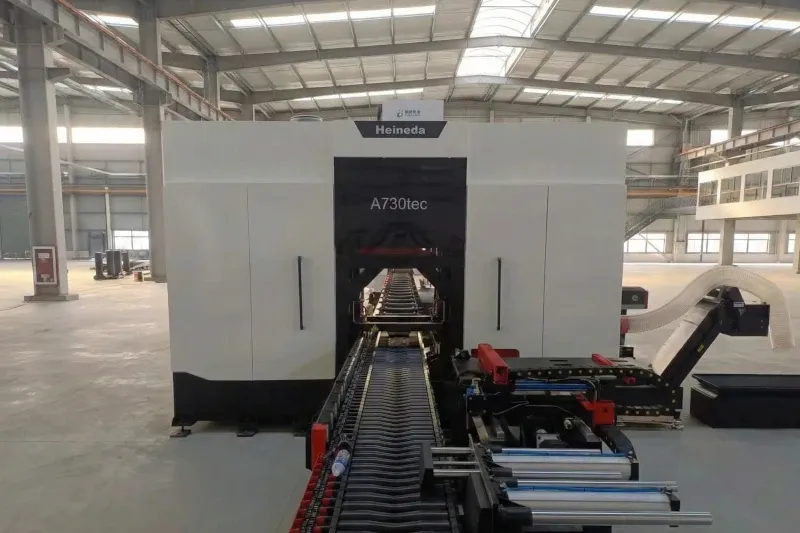
The right industrial metal cutting equipment for your operation depends on four factors: the material you cut, the tolerance you need, the volume you run, and the operating cost you can sustain — and no single technology wins on all four at once.
Key Performance Stats
| Metric | Heineda Band Saw | Heineda CNC Saw-Mill | Heineda Auto Plate Saw | Typical Laser |
|---|---|---|---|---|
| Cutting accuracy | ≤0.1 mm/100 mm | ±0.1 mm (stated) | ±0.3 mm (ref) | ±0.05–0.1 mm |
| Surface finish | Ra < 25 μm | — | — | Ra 3–12 μm |
| Max workpiece width | Round bar / billet | 2600 mm | 4000 mm | 1500–3000 mm |
| Kerf (material waste) | ≤2 mm | ≤2 mm | ≤2 mm | 0.2–0.3 mm |
| Daily throughput | Depends on workpiece dimensions, cut length, alloy grade, and automation configuration. | Depends on workpiece dimensions, cut length, alloy grade, and automation configuration. | 4000 × 4000 × 205 mm slabs | Varies by thickness |
| Drive power | — | 26–30 KW | 30 KW | Depends on laser model and power rating. |
What Is Industrial Metal Cutting Equipment?
Industrial metal cutting equipment is any machine-tool category engineered to separate metallic stock — billets, plate, bar, tube, or profile — at production volumes with repeatable dimensional accuracy. The four dominant technologies in modern plants are:
1. Band saws — a continuous toothed blade running on two or more wheels 2. Circular / cold saws — a rotating toothed disc that generates no heat at the cut face 3. Laser cutters — a focused photon beam that melts or vaporizes material 4. Waterjet cutters — a high-pressure water-abrasive stream that erodes material without heat
Each technology has a hard ceiling and a natural home. Choosing the wrong machine type inflates operating cost, degrades cut quality, or constrains throughput — sometimes all three.
Band Saws: Where They Win
Band saws are the workhorses of heavy-duty metal cutting when stock cross-sections are large, material is expensive, and kerf waste must stay low. A narrow blade — as thin as 1.6 mm on precision machines — removes far less material per cut than a circular saw or laser.
Where band saws dominate:
- Aluminum billets and plate: Heineda's dual-column 4-screw aluminum band saw is designed for consistent squareness and high daily throughput, making it suitable for plate service centers and extrusion billet lines.
- Thick-section material: Laser and waterjet power requirements grow sharply beyond 25–50 mm; band saws cut 200 mm aluminum slab routinely at lower energy per kilogram.
- Bundle cutting: Round bar bundles and irregular profiles are handled by infeed conveyors without manual repositioning.
- Material-sensitive cuts: The Ra < 25 μm surface finish reduces or eliminates secondary machining on aluminum billets destined for extrusion dies.
Where band saws lose: cycle time on thin sheet (< 3 mm), high-mix short-run plate cutting that demands instant program change, and applications requiring contour cuts rather than straight crosscuts.
CNC Saw-Milling: The High-Accuracy Steel Plate Answer
CNC saw-milling is a hybrid metal cutting machine that combines a circular saw blade with a milling cutter in a single automated pass, delivering machined-face tolerances at production speed. This matters when downstream operations require tight fits — aerospace frames, mold-base blocks, and automotive structural parts where ±0.1 mm is a print requirement, not a stretch goal.
Heineda's H-series CNC Steel Plate Saw Milling Machine handles titanium alloy, high-temperature stainless, and age-hardened stainless — materials that conventional band saws struggle to finish cleanly. The Siemens control system with full-auto servo feed is engineered for high-efficiency throughput compared to manual band saws on the same steel plate task. Three model widths (700 mm, 1500 mm, 2600 mm) cover everything from mold-base slabs to wide structural plate.
Where CNC saw-milling wins: hard alloy plate (titanium, specialty stainless), repetitive straight cuts requiring machined-quality faces, high-volume steel plate service centers.
Where it loses: contour cutting, thin-gauge sheet metal, and materials requiring no-heat-affected-zone (HAZ) surfaces.
Laser and Waterjet: Precision Contour Cutting
Laser cutting is an industrial cutting machine technology that uses a focused beam to melt, burn, or vaporize metal along a programmed path, enabling contour cuts impossible with any saw. Fiber lasers dominate below 25 mm on mild steel and stainless; they produce sub-0.1 mm tolerances and a narrow 0.2–0.3 mm kerf.
Laser wins when:
- Cut geometry is complex (holes, slots, nested shapes from sheet)
- Material thickness is under 25 mm
- Small batch or prototype work requires no tooling change
- Surface finish on the cut edge is critical for thin sheet
Laser loses when:
- Material exceeds 40–50 mm (cutting speed drops sharply; cost per cut rises)
- Reflective aluminum plate triggers back-reflection issues on CO₂ lasers (fiber is safer but still slower on thick sections)
- The operation is volume crosscutting of billet or bar stock — laser is structurally the wrong tool
Waterjet is a heavy duty metal cutting process that uses a 60,000–90,000 psi water-abrasive stream to cut any material without heat, making it the default for heat-sensitive alloys, thick composites, and titanium parts where any HAZ is unacceptable. Operating cost (abrasive consumption, pump maintenance) is the primary constraint. Waterjet does not compete with band saws on throughput or cost per cut for straight crosscutting.
"If X → Choose Y" Decision Engine
| Situation | Best Technology |
|---|---|
| Cutting aluminum billet or round bar bundles, high daily volume | Heineda aluminum band saw |
| Cutting thick steel plate (titanium, hardened stainless) to ±0.1 mm | Heineda H-series CNC saw-mill |
| Cutting large aluminum plate (up to 4000 × 4000 mm) for mold or aerospace blanks | Heineda HL-12CNC auto plate saw |
| Complex contour cuts in sheet metal < 25 mm | Fiber laser cutter |
| Heat-sensitive alloy, any thickness, contour cuts | Waterjet cutter |
| Mixed billet + bar + profile, automation line | Heineda band saw with auto load/unload integration |
| High-volume straight cuts on steel plate, machined-face finish needed | CNC saw-mill (H-710 / H-1510 / H-2610) |
| Budget is primary constraint, straight crosscuts only | Band saw (lowest operating cost per cut) |
Get a Quote for Your Cutting Application
Heineda engineers configure band saws, CNC saw-mills, and automatic plate saws to your material, volume, and tolerance requirements — before you commit to a specification.
Request a free application review →
Leading manufacturers have used Heineda equipment to reduce per-cut material waste and increase throughput. Tell us your stock profile and we will recommend the right machine model.
FAQ
Q: What is the difference between a band saw and a circular saw for metal cutting? A: A band saw uses a continuous loop blade with small teeth running at constant speed; it removes a narrow kerf (≤2 mm on Heineda machines) and handles large cross-sections with low heat generation. A circular saw uses a rotating disc blade; it cuts faster on thin sections but generates more heat and produces a wider kerf. For thick aluminum billet or steel bar, band saws offer lower material waste and better surface finish.
Q: Can industrial band saws cut titanium and hardened stainless steel? A: Standard aluminum band saws are not optimized for titanium or age-hardened stainless. Heineda's H-series CNC Steel Plate Saw Milling Machine is specifically rated for titanium alloy, high-temperature stainless, and age-hardened stainless, using a 26–30 KW motor and Siemens-controlled servo feed to manage the high cutting forces these materials generate.
Q: What cutting accuracy can I expect from a production band saw? A: Heineda's aluminum band saw holds cutting squareness to ≤0.1 mm/100 mm and surface finish Ra < 25 μm. The CNC saw-mill reaches ±0.1 mm (stated) on cut length. The fully automatic aluminum plate saw delivers ±0.3 mm (ref) across workpieces up to 4000 × 4000 × 205 mm.
Q: When does laser cutting outperform band sawing for metal? A: Laser cutting outperforms band sawing when you need contour cuts (curves, holes, slots), when material thickness is under 25 mm, and when batch sizes are small with frequent geometry changes. Band saws outperform laser on thick cross-sections (> 50 mm), high-volume straight crosscutting, and applications where operating cost per cut must stay low — laser abrasives and power consumption become expensive at high volume.
Q: What is the operating cost difference between band saw and waterjet for heavy duty metal cutting? A: Waterjet is significantly more expensive to operate than band sawing — abrasive garnet costs $0.15–0.30 per pound and a high-volume system may consume hundreds of pounds per shift. A band saw's main consumable is the blade, replaced every 100–500 hours depending on material. For straight crosscutting of metal bar, billet, or plate at volume, band saws offer the lowest cost per cut of any technology.
Q: How much aluminum can a production band saw cut per day? A: Heineda's aluminum band saw is designed for high daily throughput of aluminum billets in a fully automated loading-conveying-unloading configuration. This figure covers round bars, thick plate, and irregular profiles run through the dual-column 4-screw structure with light curtain protection.
Q: What aluminum alloy series can the automatic plate saw handle? A: Heineda's fully automatic aluminum plate cutting machine handles the full range from 1xxx through 7xxx series aluminum alloys, covering pure aluminum, heat-treatable aerospace alloys (2xxx, 7xxx), structural alloys (5xxx, 6xxx), and specialty grades. The air-bearing work table protects surface finish across all series.
If you remember one thing from this article: the technology that wins on tolerance (laser) rarely wins on throughput or operating cost for thick-section straight cuts — and the technology that wins on throughput and cost (band saw) is the wrong choice for contour work or thin sheet. Match the machine to the cut, not to the brand catalog.
Talk to a Cutting Application Engineer
Heineda manufactures aluminum band saws, CNC saw-mill machines, and fully automatic plate saws used by aerospace, automotive, and metallurgy operations worldwide. If your current metal cutting equipment is a bottleneck — on accuracy, throughput, or material waste — a 20-minute application review often identifies a direct upgrade path.
Contact: sales@heinedasaw.com | heinedasaw.com