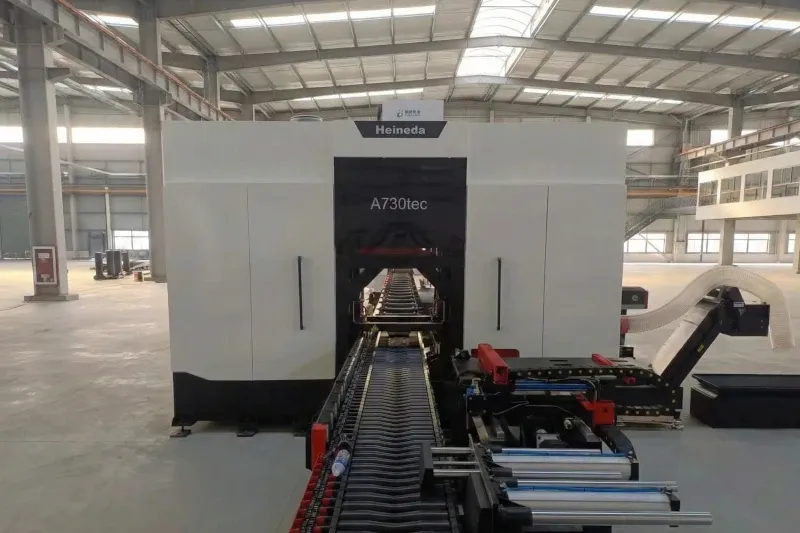
The right industrial metal cutting band saw for your operation depends on three decisions: workpiece material and geometry, required throughput (tons per shift), and the level of feed automation that matches your labor model.
Key Performance Specs at a Glance
| Spec | Value | Machine Series |
|---|---|---|
| Cutting squareness (aluminum) | ≤ 0.1 mm / 100 mm | Aluminum Band Saw |
| Surface finish | Ra < 25 μm | Aluminum Band Saw |
| Daily aluminum billet capacity | Determined by billet diameter, cutting length, material properties, and production setup. | Aluminum Band Saw |
| Kerf width | ≤ 2 mm | Aluminum Band Saw |
| CNC saw-mill cutting accuracy | ± 0.1 mm (stated) | H-Series CNC Saw Milling Machine |
| CNC saw-mill speed advantage | High-efficiency design | H-Series CNC Saw Milling Machine |
| Aluminum plate cutting accuracy | ± 0.3 mm (ref) | E/HL-Series Plate Cutting Machine |
| Max aluminum plate size | 4000 mm × 4000 mm × 205 mm | HL-12CNC |
What "Industrial Grade" Means for a Metal Cutting Band Saw
An industrial horizontal band saw is distinguished from a workshop machine by its structural rigidity, servo-controlled feed, and the ability to run unmanned shifts. At the base level, rigidity is achieved through a dual-column, four-screw frame design — this keeps the blade perpendicular to the workpiece through the entire cut, which is how squareness tolerances of ≤ 0.1 mm per 100 mm are maintained even on large cross-sections. Without that structural baseline, tolerances drift as cut depth increases and feed force rises.
Industrial machines also carry light-curtain safety systems rather than mechanical guards, because loading and unloading must remain accessible to automation. If your production cell requires a robot or conveyor interface, confirm that the machine's safety architecture is designed for it — retrofit light curtains on a mechanical-guard machine are rarely reliable.
Capacity Grades: Matching Throughput to the Right Machine
Industrial metal band saw categories split cleanly by daily tonnage requirement:
Entry-level industrial (up to ~20 tons/day). A manually loaded industrial horizontal bandsaw with servo gravity feed handles most jobber and plate service center needs. Blade changes and vise setup are operator-driven. Labor cost per cut is higher, but capital cost is lower and the machine is flexible across stock sizes.
Mid-volume (20–80 tons/day). An automated industrial metal band saw with conveyor integration handles loading, part transfer, and unloading without an operator at the machine. The aluminum band saw series is designed for high daily throughput at this tier. Automation integration — including roller conveyors, bundle loading, and outfeed stacking — is built into the machine interface rather than bolted on.
Ultra-high-volume / specialized materials. When workpieces are titanium alloy, high-temperature stainless, or age-hardened stainless, a conventional saw blade loses speed and tool life quickly. The H-Series CNC Steel Plate Saw Milling Machine runs a milling-style cut that is engineered for high-efficiency throughput on these materials, with ± 0.1 mm accuracy (stated). It is not a band saw — it uses a circular saw/milling spindle — but it fills the same production role for plate stock and is worth evaluating in the same selection process.
Reference customers operating at high-volume aluminum billet production use automated aluminum band saw lines that combine bundle feeding, automatic vise, and outfeed conveyors.
Blade Spec and Kerf: Why 2 mm Matters at Scale
Every millimeter of kerf width is material lost as chips. At high daily volumes, a kerf reduction from 3 mm to ≤ 2 mm recovers a significant percentage of the material that would otherwise be swarf — a meaningful yield improvement at aluminum billet pricing. The industrial metal band saw series maintains ≤ 2 mm kerf by combining a rigid frame (limiting blade deflection under feed force) with a blade tension system that keeps the blade tracking true.
Surface finish of Ra < 25 μm at the cut face also matters for downstream operations. When cut faces go directly to welding, anodizing, or assembly, a finish better than Ra 25 μm eliminates a secondary grinding step. Confirm surface finish spec against your downstream process before selecting a lighter-duty machine.
Automation Levels: What Each Tier Adds
| Automation Level | Operator Role | Throughput Ceiling | Typical Application |
|---|---|---|---|
| Manual feed, manual vise | Load, clamp, start each cut | Low | Prototype shop, short runs |
| Servo gravity feed, manual load | Load bundle, machine cuts to stop | Medium | Plate service center |
| Full-auto servo feed + conveyor | Supervise, handle exceptions | Up to 80 t/day | Billet production line |
| CNC saw-mill (H-Series) | Program, supervise | Very high (5–10× band saw speed) | Titanium, aerospace stainless plate |
Automation integration for the aluminum band saw series covers loading conveyors, automatic vise clamping, and outfeed stacking — each can be specified independently to match the cell layout.
Decision Engine: Matching Machine to Application
| If your application is… | Then choose… |
|---|---|
| Aluminum billet bundles, round bar, irregular profiles, ≤ 80 t/day | Aluminum Band Saw (dual-column, 4-screw, conveyor-ready) |
| Titanium alloy or high-temp / age-hardened stainless plate | H-Series CNC Saw Milling Machine (H-710 / H-1510 / H-2610) |
| Large-format aluminum plate up to 4000 × 4000 × 200 mm | E-6 / E-10 / HL-12CNC Aluminum Plate Cutting Machine |
| Mixed aluminum alloy grades 1xxx–7xxx, aerospace or mold stock | HL-12CNC with auto nesting optimization |
| High surface finish required, Ra < 25 μm, direct-to-assembly | Aluminum Band Saw series with correct blade spec |
| Budget-constrained, low daily volume, flexible stock sizes | Manual-load industrial horizontal band saw with servo feed |
Get a Quote for Your Cutting Requirements
Heineda engineers size machines to actual workpiece dimensions, material grade, and daily volume targets — not catalog defaults.
Provide: material type, cross-section dimensions, daily tonnage target, and whether you need conveyor integration. Heineda will recommend the correct capacity grade and automation level.
FAQ
Q: What is the difference between an industrial horizontal band saw and a standard band saw? A: An industrial horizontal bandsaw uses a horizontal blade orientation to cut bar stock and billet fed lengthwise, rather than standing the workpiece upright. Industrial-grade machines add servo feed control, rigid dual-column frames, and automation interfaces that workshop band saws omit. Squareness tolerances of ≤ 0.1 mm/100 mm and surface finishes of Ra < 25 μm are only achievable with the structural rigidity and blade tensioning of an industrial horizontal band saw.
Q: How much aluminum can an industrial metal band saw cut per day? A: Heineda's aluminum band saw series is designed for high daily throughput of aluminum billet when equipped with full loading, automatic vise, and outfeed conveyor integration. Actual throughput depends on cross-section size, alloy, and bundle configuration.
Q: Can an industrial metal cutting band saw handle titanium or high-temperature stainless steel? A: Conventional band saws lose blade life quickly on titanium alloy and age-hardened stainless. For those materials, the H-Series CNC Steel Plate Saw Milling Machine is the correct choice — it is engineered for high-efficiency cutting on hard alloys and holds ± 0.1 mm accuracy (stated). It handles titanium, high-temperature stainless, and age-hardened stainless with a Siemens-controlled, full-auto servo feed.
Q: What kerf width should I specify for an industrial metal band saw? A: Specify ≤ 2 mm kerf for aluminum billet and bar applications. At high daily volumes, a narrower kerf recovers usable material that would otherwise be swarf. Heineda's aluminum band saw maintains ≤ 2 mm kerf through blade tensioning and the rigid four-screw dual-column frame.
Q: What automation options are available for a metal band saw industrial line? A: The aluminum band saw series supports loading conveyors, automatic bundle vise clamping, and outfeed stacking — each specifiable independently. The machine is also designed for light-curtain safety rather than mechanical guards, which is required for robot or conveyor integration. For plate stock, the E-Series and HL-12CNC include air-bearing work tables and auto nesting optimization as standard.
Q: Which industries use industrial steel band saws and aluminum band saws at scale? A: Common applications include aluminum billet production, aerospace plate processing, primary aluminum metallurgy, industrial aluminum extrusion, automotive, and mold-making. H-Series CNC machines serve aerospace, metallurgy, automotive, and mold-making applications where hard alloys require accuracy at high feed rates.
Q: How do I choose between the H-710, H-1510, and H-2610 CNC saw milling models? A: The three H-Series models differ only in maximum workpiece width: 700 mm (H-710), 1500 mm (H-1510), and 2600 mm (H-2610). All three share 100 mm maximum workpiece height, ± 0.1 mm accuracy, and Siemens control. Select the model whose width capacity covers your widest plate with the smallest margin — oversizing width increases cost without benefit.
If you can only remember one thing: match the machine to daily tonnage and material hardness first — capacity grade and automation level follow from those two numbers, not from machine branding.
Request a Specification Review
Heineda application engineers review your workpiece drawing, alloy grade, and production schedule to confirm machine model, blade specification, and automation configuration before you commit to a purchase order.
Contact: sales@heinedasaw.com | heinedasaw.com