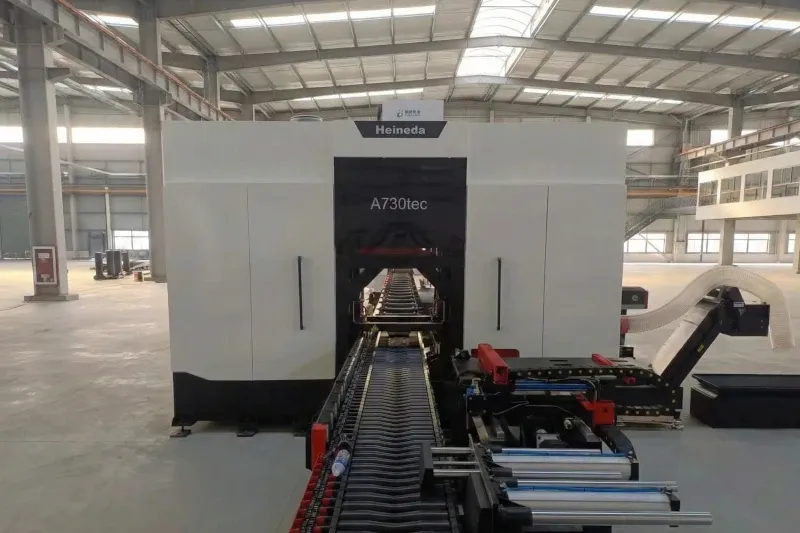
A band saw cuts aluminum by running a continuous loop blade at high tooth-per-minute speeds, where widely-spaced variable-pitch teeth shear through the soft alloy cleanly, evacuate chips before they reweld, and exit with a surface finish under Ra 25 μm and a kerf no wider than 2 mm.
Key Performance Stats
| Metric | Value | Source |
|---|---|---|
| Surface finish | Ra < 25 μm | Heineda aluminum band saw spec |
| Cutting squareness | ≤ 0.1 mm / 100 mm | Heineda aluminum band saw spec |
| Kerf width | ≤ 2 mm | Heineda aluminum band saw spec |
| Daily throughput | Depends on workpiece dimensions, cut length, alloy grade, and automation configuration. | — |
| Workpiece range | Round bar bundles, thick plate, profiles, billets | Heineda aluminum band saw application list |
How Blade Tooth Geometry Drives Aluminum Band Saw Cutting
Blade tooth geometry is the starting point for understanding how a band saw works: every cut is an engineered sequence of engagement, shear, and chip release performed by each tooth in the loop.
Aluminum is soft but highly ductile — it does not fracture ahead of the blade; it deforms plastically. That means two things must happen at every tooth:
1. High rake angle (typically 10°–15° positive) so the tooth peels rather than plows. Plowing generates heat and built-up edge; peeling produces a clean chip that releases from the gullet. 2. Deep, wide gullet between each tooth so the soft aluminum chip has somewhere to go before the next tooth engages. Gullet depth on aluminum-specific blades is noticeably deeper than on steel blades.
Variable-pitch blade patterns (e.g., 2/3 TPI or 3/4 TPI) reduce harmonic vibration — a consistent single pitch hits the workpiece at a fixed resonant frequency, whereas variable spacing staggers the impacts and keeps the cut smooth. For thin-wall extrusions, a higher TPI (fewer gaps) provides more support and prevents the tooth from "diving" through the thin wall.
Blade material for aluminum cutting band saws is almost always bi-metal (high-speed steel teeth on a flexible alloy steel backer), though carbide-tipped variants appear on high-volume production lines cutting 7xxx-series alloys where abrasiveness is higher.
Speed Settings: Why Aluminum Needs More Blade Speed Than Steel
When cutting aluminum on a bandsaw, blade speed (measured in surface feet per minute, SFM, or meters per minute) must be set correctly or the blade will weld chips into the gullets and destroy itself within minutes.
Steel is cut at roughly 80–200 SFM. Aluminum is cut at 800–3,000 SFM depending on alloy series:
- 1xxx / 3xxx / 5xxx (soft alloys): 1,500–3,000 SFM. Very high speed; chips clear fast.
- 6061-T6 / 6082-T6: 1,000–2,000 SFM. Most common structural alloy; the standard target range.
- 7075 / 7050 (hard aerospace alloys): 800–1,500 SFM. Still faster than steel, but the higher alloying elements increase heat sensitivity.
The reason speed matters: at low blade speed, each tooth spends too long in the cut, the chip does not clear the gullet, and aluminum — which melts at only 660 °C — can reach its own melting point at the contact zone and fuse back onto the blade. This is called chip welding (or built-up edge), and it is the single most common failure mode on aluminum cutting band saws.
Heineda's aluminum band saw line is designed with servo-controlled feed rate and adjustable blade speed to match the full 1xxx–7xxx alloy range without manual dial-guessing.
Coolant Strategy: Flood, Mist, or Dry?
Coolant strategy for band saw aluminum cutting is not optional — it determines whether chips release cleanly or reattach to the blade, and whether the blade life is measured in hours or shifts.
Three approaches are used in industrial practice:
1. Flood coolant (water-soluble oil emulsion) The default for production band sawing of aluminum billets and thick plate. A 5–8% emulsion concentration delivers lubricity to prevent built-up edge, flushes chips away from the tooth, and keeps workpiece temperature stable for dimensional accuracy. Heineda's aluminum band saw achieves squareness ≤ 0.1 mm/100 mm in flood-cooled production, enabling round bar bundles and billet packs to be sawn without re-facing.
2. Minimum quantity lubrication (MQL) / air-mist Used on thinner plate and extrusion profiles where a flood of liquid would contaminate downstream processes (e.g., anodizing lines). MQL delivers 5–50 mL/hr of lubricant directly to the blade-workpiece interface as an atomized mist. Surface finish stays within Ra 25 μm; throughput is lower than flood because chip clearing relies more on blade speed.
3. Dry cutting Feasible only for short bursts on soft 1xxx / 3xxx alloys with very high blade speeds. Not recommended for sustained production — blade life drops sharply and chip welding becomes likely within minutes on harder alloys.
Chip Clearing: The Hidden Variable That Destroys Blade Life
Chip clearing is the mechanism by which cut material is carried out of the kerf before the next tooth re-enters; without it, aluminum band saw cutting stalls, blade teeth fracture, and surface finish degrades.
Aluminum produces long, ductile chips (type 2 and type 3 continuous chips in ISO terminology). These chips do not break off like steel chips — they curl and pack. Three forces work together to clear them:
- Blade speed carries chips up and out of the gullet via centrifugal force.
- Coolant flow flushes chips off the blade as it exits the kerf on the return side.
- Gullet geometry (deep, wide) provides the physical volume to hold each chip through the cut arc before release.
On high-volume lines — running high daily tonnage of aluminum billets — chip conveyors run continuously to remove accumulation from under the saw head. Letting chips pile up against the blade guide introduces lateral force, widens the kerf beyond the 2 mm spec, and eventually causes blade wander that ruins squareness.
Band Saw vs. Circular Saw: Why Band Saws Win on Thick Cross-Sections
Band saw aluminum cutting outperforms circular saws on thick cross-sections for three structural reasons:
Kerf economics: A circular saw blade for thick aluminum runs 4–6 mm kerf; a band saw runs ≤ 2 mm. On large-diameter billet packs, that extra 2–4 mm per cut across high daily tonnage represents significant material savings.
Heat distribution: A circular saw tooth re-enters the cut every revolution, returning before the heat it generated has dissipated. A band saw tooth returns to the cut only after traveling the full loop length — several seconds later — so each tooth has time to cool. Aluminum's low melting point makes this thermal difference decisive on cross-sections above ~80 mm.
Blade cost vs. material removed: Band saw blades cost a fraction of large-diameter circular saw blades, and they consume less power per unit of material removed on cross-sections above 100 mm. For round bar bundles and multi-layer billet stacks — core applications at aluminum extrusion plants and billet production lines — band saws are the standard industrial choice.
Decision Engine: Which Setup Fits Your Cut?
| If your situation is... | Then choose... |
|---|---|
| Thick billets (≥ 100 mm) or billet bundles | Aluminum band saw, flood coolant, variable-pitch blade |
| Thin extrusion profiles (< 20 mm wall) | Band saw, MQL mist, high TPI blade (4–6 TPI) |
| Aerospace 7075 / 7050 alloys | Band saw, flood coolant, bi-metal or carbide blade, 800–1,500 SFM |
| High-speed plate cutting (1xxx–7xxx, up to 4 m × 4 m) | Fully Automatic Aluminum Plate Cutting Machine |
| One-offs or small shop cuts | Dry or MQL, variable-pitch bi-metal blade, 1,000–1,500 SFM |
| Maximum throughput production line | Dual-column Heineda aluminum band saw with automation integration |
Ready to match your aluminum cutting spec to the right machine? Heineda's engineering team reviews your alloy series, cross-section, and daily tonnage — and recommends the exact blade, speed, and coolant setup. Get a Quote →
Frequently Asked Questions
Q: What blade speed should I use when cutting aluminum on a band saw? A: For common structural alloys like 6061-T6, target 1,000–2,000 SFM. Softer 1xxx–3xxx alloys can run 1,500–3,000 SFM. Hard aerospace alloys like 7075 should stay at 800–1,500 SFM. Running too slow causes chip welding; running too fast without adequate coolant increases heat at the contact zone.
Q: Why does aluminum weld to band saw blades? A: Aluminum melts at only 660 °C. At low blade speed or without coolant, friction at the tooth-workpiece interface raises local temperature above aluminum's welding threshold and fused material sticks to the blade face. This is called built-up edge. Correct blade speed, a positive rake angle, and flood or mist coolant prevent it.
Q: How does a band saw work differently from a circular saw for aluminum? A: A band saw uses a continuous loop blade where each tooth re-enters the cut after a full loop cooling interval — several seconds. A circular saw tooth re-enters every fraction of a second. On cross-sections above ~80 mm, band saws run cooler, produce a narrower kerf (≤ 2 mm vs. 4–6 mm for circular), and cost less per unit of aluminum removed. That is why production billet lines use band saws, not circular saws.
Q: What coolant is best for band saw aluminum cutting? A: A water-soluble oil emulsion at 5–8% concentration is the standard for production band sawing. It lubricates the blade-aluminum interface, flushes chips, and holds temperature. Minimum quantity lubrication (MQL) mist is preferred when flood coolant would contaminate downstream finishing processes.
Q: How many teeth per inch (TPI) should an aluminum band saw blade have? A: For thick billets and bar bundles (> 50 mm), use a variable-pitch blade in the 1.4/2 TPI or 2/3 TPI range — wide gullets clear the long ductile chips. For thin-wall extrusions (< 20 mm wall), step up to 4–6 TPI to support the workpiece and prevent tooth diving. Never use a fine-tooth steel blade on aluminum; the gullets are too shallow and will pack immediately.
Q: Can Heineda's aluminum band saw cut mixed billet bundles and irregular profiles? A: Yes. Heineda's dual-column 4-screw aluminum band saw is designed for round bar bundles, thick plate, irregular profiles, and billet packs. It achieves cutting squareness ≤ 0.1 mm/100 mm and surface finish Ra < 25 μm across these applications, and supports automation integration for loading, conveying, and unloading.
Q: What daily throughput is realistic for an industrial aluminum band saw? A: Heineda's aluminum band saw is designed for high daily throughput of aluminum billets. Actual throughput depends on cross-section size, alloy series, and automation level. Integrating the saw with automated loading and chip conveying helps reach higher capacity; manual loading reduces it by 30–50%.
If you remember one thing from this article: aluminum band saw cutting works because high blade speed, deep-gullet variable-pitch blades, and consistent coolant flow combine to shear and evacuate ductile aluminum chips before they can reattach — delivering a kerf under 2 mm and surface finish under Ra 25 μm that circular saws cannot match on thick cross-sections.
Specify your alloy, cross-section, and daily volume — Heineda will size the right machine. Used by leading manufacturers for high-volume aluminum billet and plate sawing. Contact Heineda for a Quote →