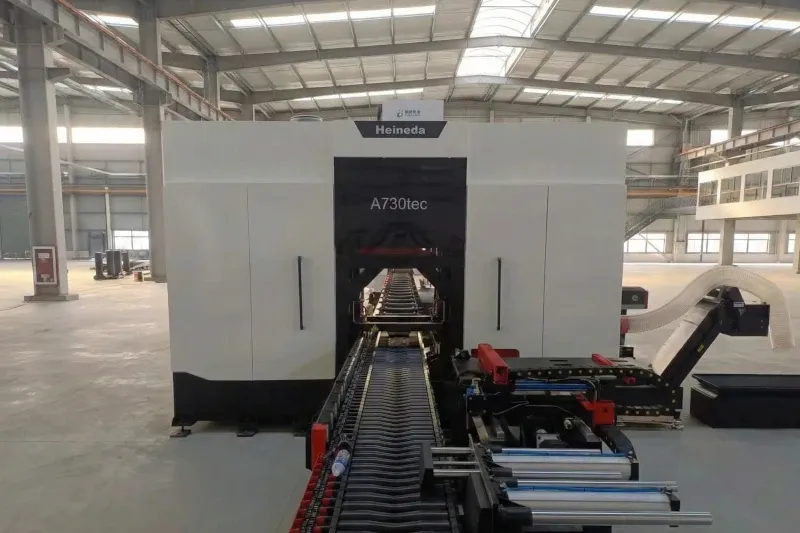
A horizontal mitre metal band saw is a horizontal band saw whose pivot head — or swivelling vice — rotates the cutting plane to a programmed angle, so a single pass delivers a precise bevel or compound miter without repositioning the workpiece.
Key Stats at a Glance
| Specification | Typical Range | Why It Matters |
|---|---|---|
| Mitre angle range (single) | 0 ° – 60 ° left | Covers most structural steel joints |
| Mitre angle range (dual) | 45 ° left / 45 ° right | Required for symmetrical frame fabrication |
| Cutting squareness (straight) | ≤ 0.1 mm / 100 mm | Heineda aluminum band saw benchmark |
| Angular repeat accuracy | ±0.1 ° – ±0.5 ° | Determines joint gap in weld prep |
| Blade speed range (metal) | 20 – 80 m/min | Matched to material hardness |
| Kerf width (quality machines) | ≤ 2 mm | Minimises material loss per cut |
What Makes a Mitre Band Saw Different from a Straight-Cut Machine
A straight-cut horizontal band saw holds the vice fixed at 90 ° to the blade path; the blade descends vertically and the cut face is always square to the bar axis. A horizontal mitre band saw adds one critical degree of freedom: the head (or the vice assembly) swivels in the horizontal plane so the blade meets the workpiece at a chosen angle.
This distinction matters because mitre cuts cannot be replicated by tilting the workpiece manually on most production machines — the clamping force needed to hold heavy structural steel at an angle introduces positional error and safety risk. A proper mitre machine rotates its cutting geometry while keeping the workpiece flat and firmly clamped.
Key mechanical differences:
- Swivel head vs. swivel vice. Premium machines rotate the entire cutting head; entry-level designs rotate only the vice. Head-swivel designs maintain blade tension geometry across the full angle range and are preferred for consistent accuracy above 30 °.
- Angle stop system. Manual machines use a graduated scale with lock bolts; semi-automatic and CNC machines use servo-driven detents or encoder feedback.
- Dual-column vs. single-column frame. Dual-column (four-screw) construction — the frame architecture used in Heineda's aluminum band saw line — resists the lateral blade force that increases at steep mitre angles.
Applications That Require Angled Cuts
Structural Steel Fabrication
Columns, beams, and bracing in steel frames are routinely mitre-cut at 30 °, 45 °, or 60 ° before welding. A purpose-built mitre band saw eliminates a secondary grinding or gas-cutting operation and delivers a mill-finish bevel face that drops straight onto the weld table. Facilities cutting high volumes of H-beam, I-section, or square hollow section for building frames depend on the mitre capability to maintain throughput — manual repositioning for each cut is not viable beyond a few pieces per shift.
Frame and Chassis Manufacturing
Automotive sub-frames, trailer chassis, agricultural equipment booms, and bicycle frame tubes all require compound angle joints. Aluminium frame tubes must be cut to precise compound angles so that TIG-welded joints close without shimming. The tighter the angular repeat accuracy, the lower the rework rate in the weld cell.
Pipe and Tube Cutting
Pipe saddle cuts and branch connections in HVAC, pressure vessel, and petrochemical pipework involve saddle angles from 15 ° to 60 °. A horizontal mitre band saw handles round tube consistently because the vice holds circular cross-sections flat while the head rotates — a geometry that circular saws or cold saws cannot replicate on large-diameter pipe without specialist fixturing.
Aluminium Profile and Extrusion Cutting
Extrusion fabricators cutting door frames, curtain-wall mullions, and solar-panel mounting rails need corner mitre joints at exactly 45 °. Because aluminium is soft and prone to burr, the low kerf width (≤ 2 mm) and the fine surface finish achievable with a band saw (Ra < 25 μm on Heineda aluminium band saw models) reduce or eliminate deburring.
What Mitre Angle Range Should You Specify?
The angle range you need determines which machine class to consider:
| Required range | Machine type | Typical use case |
|---|---|---|
| 0 ° – 45 ° (left only) | Basic mitre band saw | General fabrication, frame manufacturing |
| 0 ° – 60 ° (left only) | Mid-range mitre band saw | Structural steel, heavy sections |
| 45 ° left / 45 ° right | Dual-head or dual-vice mitre saw | Symmetrical truss fabrication, decorative steelwork |
| 0 ° – 60 ° with compound | CNC mitre + tilt head | Aerospace, precision pipe fabrication |
Most structural fabrication shops need a minimum of 0 ° to 60 ° in one direction. Shops that produce symmetrical components — trusses, sign frames, architectural features — benefit from dual-direction capability because it halves the setup time for mirror-image pieces.
For aluminium profile cutting where the dominant use case is 45 ° corner joints, a machine with a precise 45 ° detent stop and an angular repeat accuracy of ±0.1 ° is more valuable than a wide continuous range with looser tolerance.
When a Straight-Cut Machine Plus a Mitre Fixture Is the Better Choice
A dedicated mitre band saw is not always the right answer. Consider a straight-cut horizontal band saw with a separate angle-setting fixture when:
- Annual mitre volume is low. If fewer than 10 % of your cuts require an angle, the capital cost and footprint of a mitre machine is rarely justified. A bolt-on angle fixture achieves ± 0.5 ° and costs a fraction of a full mitre head.
- Section size is very large. Wide-flange beam above 600 mm or billet above 500 mm diameter is difficult to handle on a swivel-head machine; a fixed-head machine with a purpose-built angled vice is safer and more practical.
- You already own a straight-cut machine. Retrofitting an adjustable angle vice to an existing machine extends its capability without a full capital replacement cycle. Heineda's double-column aluminum band saw, for example, supports automation integration that can include angled pre-fixtures on the infeed roller conveyor.
- Batch sizes are large and angles are fixed. If you cut 1 000 pieces per shift all at 30 °, a fixed-angle dedicated saw outperforms a general-purpose mitre machine on throughput and machine cost.
- Material is a steel plate rather than bar or section. Plate cutting at angles is better served by Heineda's CNC Steel Plate Saw Milling Machine (H-series), which achieves ±0.1 mm cutting accuracy (stated) and is engineered for high-efficiency cutting of titanium alloy, high-temperature stainless, and age-hardened stainless steel.
If X → Choose Y: Quick Decision Table
| Your situation | Recommended solution |
|---|---|
| Structural steel beams, varied angles, high volume | Horizontal mitre band saw, 0 °–60 °, semi-auto or CNC |
| Aluminium extrusion corner joints at 45 ° | Horizontal mitre band saw with precision 45 ° detent, Ra < 25 μm blade spec |
| Aluminium billet cross-cut at 90 °, up to 80 t/day | Straight-cut horizontal band saw (Heineda aluminum band saw, dual-column 4-screw) |
| Steel plate, flat parts, tight tolerance (±0.1 mm) | CNC Steel Plate Saw Milling Machine (Heineda H-710 / H-1510 / H-2610) |
| Mixed angle and square cuts, low mitre volume | Straight-cut machine + adjustable angle fixture |
| Large aluminium sheet, complex nesting | Fully Automatic Aluminum Plate Cutting Machine (Heineda E-6 / E-10 / HL-12CNC) |
| Pipe saddle cuts, 15 °–60 °, round section | Horizontal mitre band saw with round-tube vice inserts |
Talk to Heineda About Your Cutting Application
Not sure whether a mitre band saw, a straight-cut machine, or a plate saw-milling centre fits your production profile? Heineda's engineering team can map your section size, material, required angle range, and daily volume to the right machine in one conversation.
FAQ
Q: What is the difference between a mitre band saw and a miter band saw? A: None — "mitre" is the British/Commonwealth spelling and "miter" is the American spelling. Both refer to the same machine type: a horizontal band saw whose cutting head or vice swivels to deliver angled cuts. You will find both spellings used on supplier listings and specification sheets.
Q: What mitre angle range do I need for structural steel fabrication? A: Most structural steel applications require a range of 0 ° to 60 ° in at least one direction. This covers the most common joint angles in column-and-beam construction, portal frames, and bracing connections. If you fabricate symmetrical trusses or decorative steelwork with mirror-image joints, specify a dual-direction machine with 45 ° capability in both left and right directions.
Q: Can a horizontal mitre band saw cut round bar and pipe as well as square section? A: Yes, provided the vice is equipped with V-block inserts or self-centring round-tube jaws. Most production-grade mitre band saws include these as standard accessories. For large-diameter pipe (above 300 mm), confirm that the machine's throat capacity and clamping pressure are rated for the round cross-section at the steepest angle you need.
Q: How accurate is a mitre band saw compared to a cold saw or circular saw? A: A well-maintained horizontal mitre band saw with a quality blade achieves angular repeat accuracy of ±0.1 ° to ±0.5 ° and a surface finish suitable for direct welding without secondary grinding. Cold saws and circular saws are faster per cut but are limited to smaller section sizes, generate more heat in the cut, and are more expensive to run per metre of blade life. For large sections above 200 mm, a band saw is typically the only practical option.
Q: Is a CNC mitre band saw worth the premium over a manual or semi-automatic model? A: For high-mix, low-volume production where operators change angle settings frequently, CNC is worth the investment — encoder-driven angle positioning eliminates setup error and scales to lights-out operation. For dedicated production runs at one or two fixed angles, a semi-automatic machine with precision mechanical stops delivers equivalent accuracy at lower capital cost. The payback calculation depends on your setup frequency and batch sizes.
Q: When should I use a CNC plate saw-milling machine instead of a mitre band saw? A: When your workpiece is flat plate rather than bar, section, or tube, and when tolerance tighter than ±0.1 mm is required. Heineda's H-series CNC Steel Plate Saw Milling Machine is engineered for high-efficiency plate work, handles materials up to 100 mm thick, and manages difficult alloys including titanium and age-hardened stainless steel. For bar and section work, the mitre band saw remains the preferred choice.
Q: What surface finish does a metal band saw produce on an aluminium mitre cut? A: On aluminium alloys, a properly tensioned band saw blade with the correct pitch and feed rate delivers a surface finish of Ra < 25 μm — fine enough for most structural bonding and anodising applications without intermediate deburring. Heineda's aluminum band saw achieves this finish benchmark as a published specification.
If You Remember One Thing
A horizontal mitre metal band saw earns its place on the floor when you have regular, varied-angle cuts on bar, section, or tube — if your work is mostly flat plate, a CNC saw-milling machine is faster; if angled cuts are rare, a fixture on a straight-cut machine costs less; but for structural fabrication, frame manufacturing, and pipe cutting where angles change throughout the day, a dedicated mitre band saw is the tool that keeps the weld table fed without a secondary operation.
Request a Machine Recommendation from Heineda
Jiangsu Heineda Sawing Machinery has delivered band saws and plate cutting centres to leading manufacturers on four continents. Describe your material, section size, required angles, and daily volume — and receive a specific machine recommendation with reference cut data.