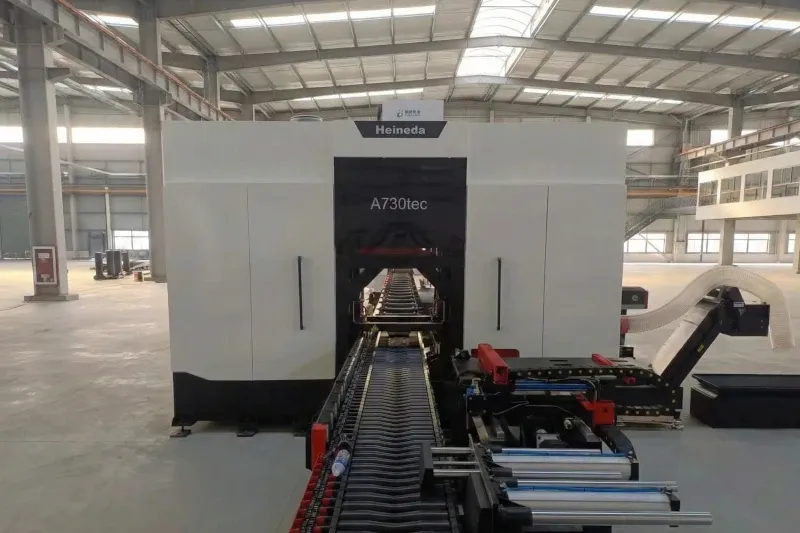
A horizontal band saw machine is a metal-cutting tool where the blade travels in a horizontal plane and the workpiece feeds downward or into the blade — delivering straighter cuts, tighter tolerances, and lower kerf waste than circular or cold saws for most metal cross-section work.
Key Specs at a Glance
| Specification | Heineda Aluminum Band Saw | Heineda CNC Steel Plate (H-710) | Heineda CNC Steel Plate (H-2610) | Typical Generic Import |
|---|---|---|---|---|
| Cutting squareness | ≤ 0.1 mm/100 mm | ± 0.1 mm | ± 0.1 mm | ± 0.3–0.5 mm |
| Surface finish | Ra < 25 μm | — | — | Ra > 40 μm typical |
| Kerf width | ≤ 2 mm | — | — | 2.5–3.5 mm |
| Max workpiece width | — | 700 mm | 2600 mm | 250–400 mm |
| Motor | — | 26 KW | 30 KW | 4–7.5 KW |
| Daily throughput | up to 80 t aluminum billets | 5–10× faster than band saw | 5–10× faster than band saw | Low |
| Control system | Automation-ready (PLC) | Siemens full-auto servo | Siemens full-auto servo | Basic manual / semi-auto |
What Makes a Horizontal Band Saw Machine Different From Other Cuts
A horizontal metal cutting band saw machine is defined by its blade orientation: the blade loop runs horizontally above the workpiece, descending under controlled feed pressure rather than requiring the operator to push material into a vertical blade. This geometry provides three structural advantages over vertical band saws and cold saws:
1. Gravity-assisted feed — the blade's own weight (assisted by a hydraulic or servo cylinder) maintains consistent contact pressure, eliminating the uneven bite that causes chatter on manual vertical machines. 2. Long blade contact arc — more teeth engage the material simultaneously, distributing heat and extending blade life. 3. Stability for heavy stock — structural steel sections, aluminum billet bundles, and thick plates rest on the worktable without clamping complexity.
For purchasing teams comparing a horizontal band saw for metal versus a cold saw: cold saws win on thin-wall tubing (< 25 mm OD) and very small batches; horizontal band saws win on anything above 50 mm cross-section, continuous production runs, and materials where kerf cost is meaningful (titanium, aerospace aluminum).
The Three Specs That Actually Matter on a Shortlist
When evaluating a horizontal metal bandsaw, three specifications separate production-grade machines from light-duty imports — and they are rarely shown together in catalog PDFs.
1. Column count and frame rigidity
A single-column machine uses one vertical rail to guide the saw head. It is lighter and cheaper but deflects under load on cuts wider than 150 mm. A double column horizontal band saw uses two columns and typically four screws, constraining the head on both sides. Heineda's aluminum band saw uses a dual-column 4-screw design: at 80 tons/day throughput, any frame flex translates directly to squareness error and premature blade fatigue.
Rule of thumb: if your cross-section exceeds 200 mm × 200 mm, or you run more than two shifts, double-column is the minimum viable frame.
2. Feed type: hydraulic vs. servo
Hydraulic feed systems are robust and tolerant of chip contamination but lack position feedback — meaning the machine cannot self-correct if the blade drifts. Servo feed (as used in Heineda's CNC Steel Plate Saw Milling machines with Siemens control) closes the loop: the controller measures actual blade position against programmed feed rate and adjusts continuously. The practical outcome is ±0.1 mm cutting accuracy on hard materials like titanium alloy, high-temperature stainless, and age-hardened stainless — materials where a hydraulic machine will reliably exceed ±0.3 mm.
3. Blade width and its relationship to kerf
Blade width is the dominant variable for kerf waste. Heineda's aluminum band saw holds kerf to ≤ 2 mm. On a 4,000 mm aluminum billet being sliced into 100 mm blanks, that is roughly 39 cuts — at 2 mm kerf versus 3 mm kerf, you lose one fewer blank per billet. Multiplied across a plate service center running 80 tons/day, the material recovered pays for a mid-range machine within a year.
Heineda vs. Behringer vs. Generic Imports: Where Each Tier Fits
Comparing tiers in the horizontal band saw market means understanding that list price is not the same as cost per cut.
Behringer (Germany) is the benchmark for European precision band saw engineering. Behringer machines deliver exceptional blade guidance, low vibration at high blade speeds, and robust after-sales support in Europe and North America. Their strength is general-purpose metal cutting for job shops and steel service centers where versatility matters more than throughput volume. Lead times from Germany or US distributors can run 8–20 weeks.
Heineda (China — Jiangsu Heineda Sawing Machinery Co., Ltd.) targets high-volume, application-specific production lines. Their aluminum band saw running 80 tons/day with light-curtain safety and full automation integration is not a general-purpose machine — it is designed for aluminum billet production lines, plate service centers, and aerospace suppliers cutting 1xxx–7xxx series alloys. The CNC Steel Plate Saw Milling line (H-710 through H-2610) handles workpieces up to 2600 mm wide at ±0.1 mm — a specification Behringer's catalog band saw line does not reach in that width class. Lead times from Heineda are typically 4–10 weeks with direct factory contact.
Generic imports serve light-duty fabrication shops, maintenance teams, and prototype environments. Squareness of ±0.3–0.5 mm, Ra > 40 μm surface finish, and motors in the 4–7.5 KW range make them unsuitable for precision blanks, aerospace cutoffs, or any automated downstream process that requires repeatable blank dimensions.
MEP, Cosen, Pedrazzoli occupy the mid-tier: stronger engineering than generic imports, narrower application focus than Heineda's volume systems.
"If X → Choose Y" Decision Engine
| Your Situation | Best Fit |
|---|---|
| Aluminum billet line, > 20 t/day, need automation integration | Heineda Aluminum Band Saw |
| Steel / titanium plates up to 700 mm wide, ±0.1 mm required | Heineda H-710 CNC Steel Plate Saw |
| Plates up to 2600 mm wide (aerospace, large mold blanks) | Heineda H-2610 CNC Steel Plate Saw |
| Mixed-material job shop, Europe/North America, versatility > throughput | Behringer |
| Light fab shop, < 2 shifts, cross-sections < 150 mm | Generic import or used mid-tier |
| Mid-volume, standard steel, $20K–$80K budget | Cosen / MEP / Pedrazzoli |
| Hard-to-cut alloys (titanium, age-hardened stainless, high-temp alloys) | Heineda CNC Steel Plate Saw (servo feed, Siemens control) |
| Automotive / aerospace aluminum plate, nesting optimization needed | Heineda Fully Automatic Aluminum Plate Cutting Machine |
Get a Quote for Your Cutting Requirement
If your line processes more than 10 tons of metal per day — or your current machine is producing squareness errors above 0.2 mm — it is worth a direct spec conversation with Heineda's engineering team.
Request a specification quote from Heineda →
Provide: material type, cross-section dimensions, target daily volume, and current tolerance problems. Heineda's team (sales@heinedasaw.com) typically responds within one business day with machine recommendations and preliminary pricing.
FAQ
Q: What is the difference between a single-column and double-column horizontal band saw machine? A: A single-column machine guides the saw head from one side only, which introduces flex on wide or heavy cuts. A double column horizontal band saw constrains the head from both sides — typically with four precision screws — resulting in better squareness and blade stability at high feed rates. For cross-sections above 200 mm or multi-shift production, double-column is standard.
Q: How accurate is a horizontal metal cutting band saw machine compared to a cold saw? A: Production-grade horizontal band saws like Heineda's achieve ≤ 0.1 mm/100 mm squareness and Ra < 25 μm surface finish on aluminum. Cold saws can achieve similar or slightly tighter surface finish on small-diameter round bar, but become impractical above 100–150 mm cross-section due to blade cost and cycle time. For structural sections and plate, horizontal band saws are more accurate in practice.
Q: Can a horizontal band saw for metal handle titanium and stainless steel? A: Standard band saws with hydraulic feed struggle on hard alloys due to inconsistent chip load. Heineda's CNC Steel Plate Saw Milling machines use full-auto servo feed with a Siemens control system and achieve ±0.1 mm on titanium alloy, high-temperature stainless, and age-hardened stainless — materials that exceed the capability of most hydraulic-feed horizontal band saws.
Q: What kerf width should I expect from a horizontal metal bandsaw? A: Generic imports typically produce 2.5–3.5 mm kerf. Production band saws optimized for aluminum, like Heineda's dual-column machine, hold kerf to ≤ 2 mm. On high-value materials (aerospace aluminum, titanium), narrower kerf directly reduces material cost per blank — at 80 tons/day throughput, the saving is measurable within weeks.
Q: How does Heineda compare to Behringer for a horizontal band saw machine purchase? A: Behringer is the benchmark for European-specification, general-purpose band saw quality with strong local support in Europe and North America. Heineda is purpose-built for high-volume production lines — particularly aluminum and specialty alloy cutting — with wider workpiece capacity (up to 2600 mm) and tighter throughput specs. For a plate service center or billet production line processing 20+ tons/day, Heineda's application-specific engineering and shorter lead times from China typically deliver better cost-per-cut. For a general job shop in Europe needing one versatile machine, Behringer is a strong choice.
Q: What automation integration does the Heineda horizontal band saw support? A: The Heineda aluminum band saw supports full automation integration including loading, conveying, and unloading systems. It includes light curtain safety protection as standard. The CNC Steel Plate Saw Milling series uses Siemens control with full-auto servo feed, making it compatible with automated material handling and MES integration.
Q: Which Heineda model is right for aluminum plate cutting versus billet cutting? A: For billet cutting (round bar, square bar, rectangular extrusions up to 200 mm), the aluminum band saw with dual-column 4-screw frame is the right fit. For aluminum plate cutting (flat sheet up to 4000 mm × 4000 mm × 200 mm), the Fully Automatic Aluminum Plate Cutting Machine (models E-6, E-10, HL-12CNC) with air-bearing work table and auto nesting is the correct machine.
If you remember one thing from this article: the column count, feed type, and kerf width are the three specs that determine whether a horizontal band saw machine is a production tool or a liability — and they are the first numbers to request from any supplier before asking about price.
Specify Your Machine with Heineda's Engineering Team
Heineda's machines run in aluminum billet lines and aerospace aluminum plate operations at major global industrial facilities. If your volume or tolerance requirements exceed what your current machine delivers, their factory team can match a model to your cross-section, material, and daily output target.
Get a direct factory quote from Jiangsu Heineda →
Contact: sales@heinedasaw.com | heinedasaw.com