Direct Answer
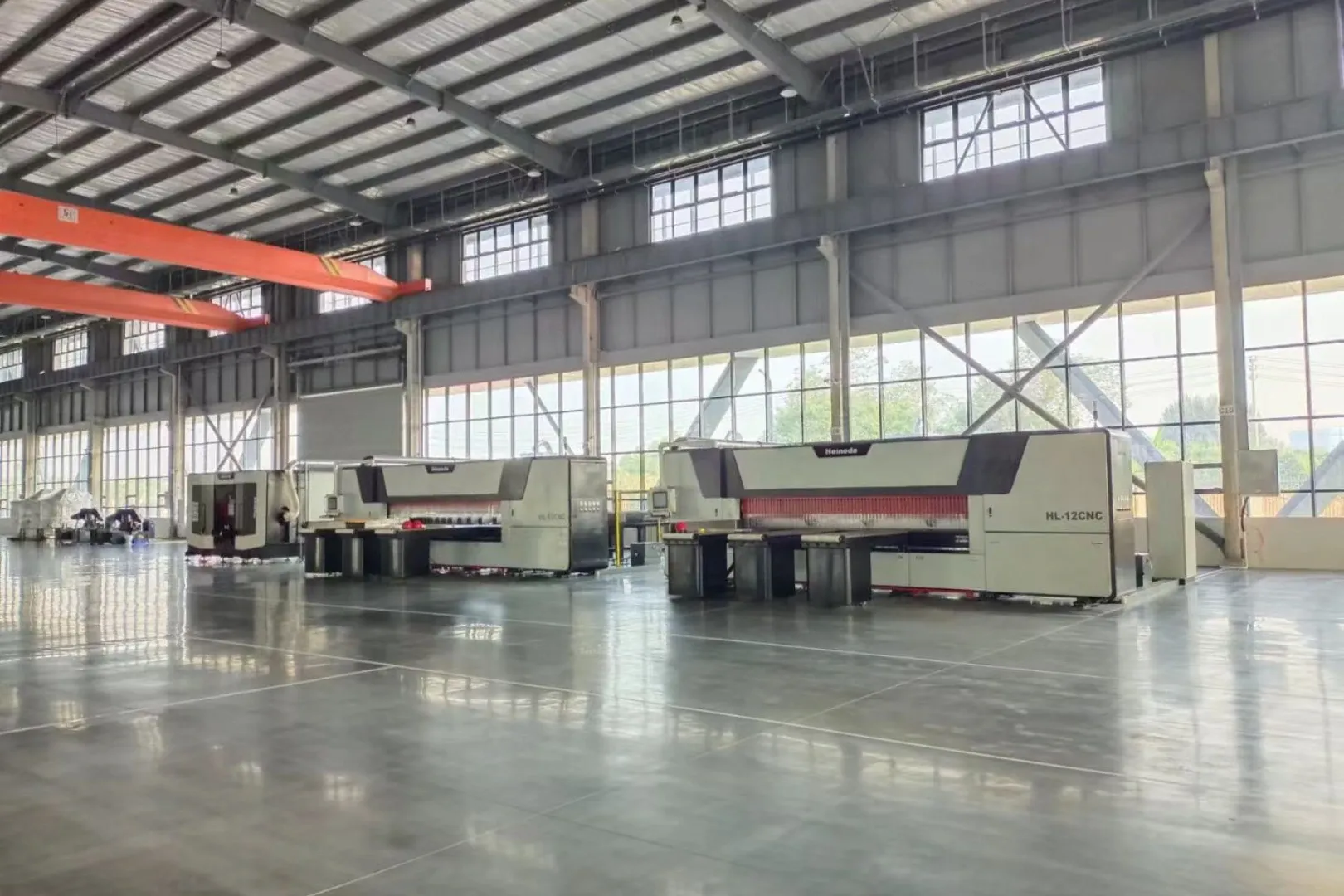
A Heineda sawing machine is a precision metal-cutting machine manufactured by Jiangsu Heineda Sawing Machinery Co., Ltd. in Yixing, Jiangsu, China. The lineup covers three distinct machine types: aluminum band saws (for aluminum profiles, bars, and billets), CNC steel plate saw-milling machines (for steel and stainless steel plate), and fully automatic aluminum plate cutting machines (for high-volume aluminum plate processing). Each machine is designed around a specific material and production workflow — not as a general-purpose metal cutter.
Key Stats
| Specification | Value | Source |
|---|---|---|
| Aluminum band saw kerf width | ≤ 2 mm | Heineda product spec |
| Band saw squareness | ≤ 0.1 mm / 100 mm | Heineda product spec |
| Band saw surface finish | Ra < 25 µm | Heineda product spec |
| Daily billet throughput | Up to 80 tons | Heineda aluminum band saw |
| CNC saw-milling accuracy (H-series) | ± 0.1 mm | Heineda H-series spec |
| Max plate size (HL-12CNC) | 4000 × 4000 × 205 mm | Heineda E/HL series |
| Plate cutting accuracy | ± 0.3 mm | Heineda E/HL series |
| Saw motor (H-1510/H-2610) | 30 KW / 40 HP | Heineda H-series spec |
The Three Heineda Sawing Machine Types
| Machine Type | Primary Material | Key Differentiator | Best-Fit User |
|---|---|---|---|
| Aluminum Band Saw | Aluminum bars, billets, profiles | Kerf width ≤ 2 mm; Ra < 25 µm surface finish | Extrusion processors, aluminum casting houses |
| CNC Steel Plate Saw-Milling Machine (H-710 / H-1510 / H-2610) | Steel, stainless steel, titanium alloy | Integrated saw + milling in one CNC cycle | Steel service centers, aerospace/mold shops |
| Fully Automatic Aluminum Plate Cutter (E-6 / E-10 / HL-12CNC) | 1xxx–7xxx aluminum alloy plate | Air-flotation table; automatic nesting optimization | Automotive, aerospace, batch plate processors |
Machine 1 — Aluminum Band Saw
What It Does
The aluminum band saw uses a continuous band blade running over two wheels to slice through aluminum stock. Heineda's design emphasizes two operational priorities that aluminum processors care about most: tight kerf control and surface quality.
- Maximum kerf width: 2 mm — narrow kerf directly reduces material loss on every cut. On high-value aluminum alloy billet, kerf loss adds up quickly across a shift.
- Surface roughness Ra < 25 µm — a finish tight enough that many downstream operations can proceed without a secondary facing pass.
- Dual-column, 4-leadscrew structure — frame rigidity that keeps the blade tracking straight under the load variation of cutting irregular profiles or bundled bars.
- Throughput: up to 80 tons of aluminum billet per day — the figure comes from Heineda's production data for the high-speed horizontal configuration.
Two Configurations
Horizontal band saw — suited for aluminum bars, billets, and irregular profiles. The workpiece lies flat; the blade descends through the material.
Vertical band saw — suited for large-format aluminum slab and heavy ingot cutting. The vertical orientation handles the geometry of large cross-sections more effectively.
Both configurations support integration with automated loading conveyors and unloading systems, which matters for facilities running continuous production rather than manual single-piece operations.
Who Should Be Looking at This Machine
A facility processing aluminum extrusion stock, billet for forging, or irregular profiles in medium-to-high volume — and where cut quality (finish roughness, squareness ≤ 0.1 mm/100 mm) affects whether a secondary operation is needed. If your current saw is leaving burrs or requiring a deburring step on most cuts, the Heineda band saw's design is worth evaluating.
Machine 2 — CNC Steel Plate Saw-Milling Machine
What It Does
This machine does two things in one setup: it saws steel plate to a programmed dimension, then a milling head cleans the cut edge — all under CNC control with servo-driven feed. The result is a dimensionally accurate plate blank with a finished edge, without moving the part to a second machine.
Three Model Sizes
| Model | Max Workpiece Width | Max Workpiece Height | Saw Motor |
|---|---|---|---|
| H-710 | 700 mm (27.5") | 100 mm (3.9") | 26 kW / 35 HP |
| H-1510 | 1,500 mm (59.1") | 100 mm (3.9") | 30 kW / 40 HP |
| H-2610 | 2,600 mm (102.3") | 100 mm (3.9") | 30 kW / 40 HP |
All three models work from a minimum material length of 3,100 mm; the H-2610 scales to 8,000 mm and beyond.
Control System
The H-series machines run on Siemens control hardware. For industrial buyers, this matters for two practical reasons: Siemens spare parts and technicians are available globally, and control firmware is familiar to operators who have worked on other Siemens-equipped machines. Proprietary or unfamiliar controls add operator training cost and complicate long-term maintenance.
Material Range
The H-series is specified for steel, stainless steel, titanium alloy, and heat-resistant / precipitation-hardened stainless — the "difficult-to-machine" category that wears down conventional band saws or circular saws faster than the economics justify. The optimized saw process Heineda references in their specs is about blade path geometry and cutting parameters that extend blade life on hard alloys, reducing the per-cut consumable cost.
Where the Economics Show Up
The ROI case for a saw-milling machine versus a standalone saw is straightforward: every plate that needs a clean edge currently moves from the saw to a milling machine. That's a material handling operation, a second setup, a second operator touchpoint, and a second queue. On a shop running 50–200 plate blanks per day, eliminating that transfer step is a measurable labor and throughput gain. The machine costs more upfront; the question is how many shifts it takes to recover that delta.
For aerospace and mold applications where edge finish is a quality requirement rather than a preference, the integrated machine also reduces the variation introduced by part repositioning between two separate machines.
Need Help Choosing the Right Heineda Machine? — tell us your material, workpiece dimensions, and daily volume. Heineda's application engineers will match the right machine type and model to your requirements. 48-hour quote turnaround. 👉 Get a Free Machine Recommendation
Machine 3 — Fully Automatic Aluminum Plate Cutting Machine
What It Does
This machine is a high-speed circular saw platform for aluminum plate, built for batch production rather than jobbing work. It handles 1xxx through 7xxx series aluminum alloy, up to 200 mm thick, in sheet sizes up to 4,000 mm × 4,000 mm.
Three Model Sizes
| Model | Max Plate Size | Max Thickness | Machine Footprint (L × W × H) |
|---|---|---|---|
| E-6 | 3,000 mm × 1,600 mm | 200 mm | 6,814 × 4,716 × 2,138 mm |
| E-10 | 3,000 mm × 3,000 mm | 200 mm | 7,943 × 6,192 × 2,396 mm |
| HL-12CNC | 4,000 mm × 4,000 mm | 205 mm | 9,200 × 7,810 × 2,854 mm |
All three models run a 30 kW / 40 HP saw motor.
Design Features That Matter in Production
Air-flotation work table — the plate floats on an air cushion rather than sliding on a solid surface. This protects the plate face (critical for 6061, 7075, and anodizing-grade aluminum where surface scratches create rework), and it reduces the force needed to reposition heavy plate, which matters for operator ergonomics on thick-section material.
Automatic nesting optimization — the control system programs cut sequences to minimize offcut waste. For aluminum plate at current commodity prices, nesting software that recovers even 3–5% additional yield from each sheet pays for itself quickly at volume.
Cutting accuracy: ±0.3 mm — sufficient for structural aluminum components, automotive panel blanks, and mold base plates. Applications requiring tighter tolerances (±0.1 mm) should look at the CNC saw-milling machine instead.
Intelligent speed adjustment — the saw motor adapts feed rate to the material cross-section and alloy grade rather than running at fixed parameters. This matters for protecting blade life when cutting 7-series high-strength alloys versus softer 1-series sheet.
Who This Machine Is For
Production-scale aluminum plate processors running consistent or semi-consistent cut programs: automotive stamping blank suppliers, aerospace skin panel processors, mold base plate houses. A facility doing custom one-off cuts for a fabrication shop has no use for automatic nesting. A facility running 200 identical 500 mm × 500 mm blanks per day from 3,000 mm × 1,500 mm sheet stock — that's the machine's home.
How to Choose Between the Three Heineda Sawing Machine Types
Work through three questions:
1. What are you cutting?
- Aluminum profiles, bars, billets → Aluminum Band Saw
- Steel or stainless steel plate, titanium → CNC Steel Plate Saw-Milling Machine
- Aluminum plate in sheets → Fully Automatic Aluminum Plate Cutter
2. What does the cut surface need to look like?
- Needs edge finish in the same operation → CNC Steel Plate Saw-Milling Machine
- Clean saw finish is acceptable → Band Saw or Aluminum Plate Cutter
3. What is your production volume and batch structure?
- Continuous high-volume, same cut repeated → Fully Automatic Aluminum Plate Cutter (nesting optimization, auto-feed)
- Mixed material sizes, profiles, or bundled bar → Aluminum Band Saw
- Plate cutting with variable dimensions, edge finish required → CNC Saw-Milling Machine
Common Questions About Heineda Sawing Machines
Q: What cutting accuracy do Heineda sawing machines achieve? A: It depends on the machine type. The aluminum band saw achieves cut squareness ≤ 0.1 mm per 100 mm. The CNC steel plate saw-milling machine achieves ±0.1 mm dimensional accuracy. The fully automatic aluminum plate cutter achieves ±0.3 mm. For precision plate work where ±0.1 mm matters, the H-series saw-milling machine is the right tool.
Q: Do Heineda machines support automation integration? A: Yes. The aluminum band saw line supports automated loading, conveying, and unloading systems. The fully automatic aluminum plate cutter is designed with auto-feed as a core feature. The CNC saw-milling machine operates in a fully automatic work cycle that reduces operator touchpoints.
Q: What materials can a Heineda sawing machine handle? A: The aluminum band saw and fully automatic plate cutter are designed for aluminum (1xxx–7xxx series). The CNC steel plate saw-milling machine handles steel, stainless steel, titanium alloy, and heat-resistant alloys. Cross-material questions (copper, composites, non-ferrous alloys outside aluminum) should be directed to Heineda's engineering team.
Q: What control system do Heineda CNC sawing machines use? A: The H-series CNC saw-milling machines run Siemens control systems. Siemens is the stated reason for the reliability cited in Heineda's specs, and it provides buyers with a globally serviceable control platform.
Q: How does Heineda handle after-sales support for export customers? A: Heineda exports to Southeast Asia, the Middle East, and Europe. Buyers in those regions should confirm service coverage, spare parts lead times, and commissioning support terms before purchase. Contact sales@heinedasaw.com with your location and machine type for specifics.
Q: Can Heineda customize a sawing machine for my production setup? A: Heineda accepts application-specific customization requests, including feed system configuration, cutting envelope adjustments, and control integrations. Custom machine projects require an engineering review phase and typically carry longer lead times than standard models.
Specifications Reference Table
| Spec | Aluminum Band Saw | CNC Saw-Milling (H-1510) | Auto Aluminum Plate Cutter (E-10) |
|---|---|---|---|
| Primary Material | Aluminum bar/billet/profile | Steel plate, stainless, titanium | Aluminum plate (1xxx–7xxx) |
| Max Workpiece | Bundled bar cutting | 1,500 mm wide × 100 mm | 3,000 mm × 3,000 mm × 200 mm |
| Cutting Accuracy | ≤ 0.1 mm/100 mm squareness | ±0.1 mm | ±0.3 mm |
| Surface Finish | Ra < 25 µm | Milled edge finish | N/A (saw cut) |
| Daily Throughput | Up to 80 tons (horizontal config.) | — | — |
| Control System | — | Siemens | Intelligent speed control |
| Saw Motor | — | 30 kW / 40 HP | 30 kW / 40 HP |
Get a Quote
Heineda machines are built to order. Lead time and pricing depend on model, configuration, and export destination. To get an accurate quote, provide:
- Machine type you are evaluating
- Material type and grade
- Typical workpiece dimensions (length × width × thickness)
- Required cutting accuracy
- Approximate production volume per shift
Submit your requirements at https://heinedasaw.com/contact or email sales@heinedasaw.com directly. Reference this article for the fastest routing to the right product engineer.
If you remember one thing from this article: a Heineda sawing machine is not a general-purpose metal cutter — it is one of three purpose-built machines (aluminum band saw, CNC saw-mill, or automatic plate cutter), and choosing the right one starts with answering "what material am I cutting and what does the cut face need to look like?"
Get a Quote Matched to Your Application — Heineda machines are built to order. Provide your material grade, workpiece size, and throughput target, and receive a specific model recommendation with pricing within 48 hours. 👉 Request a Quote