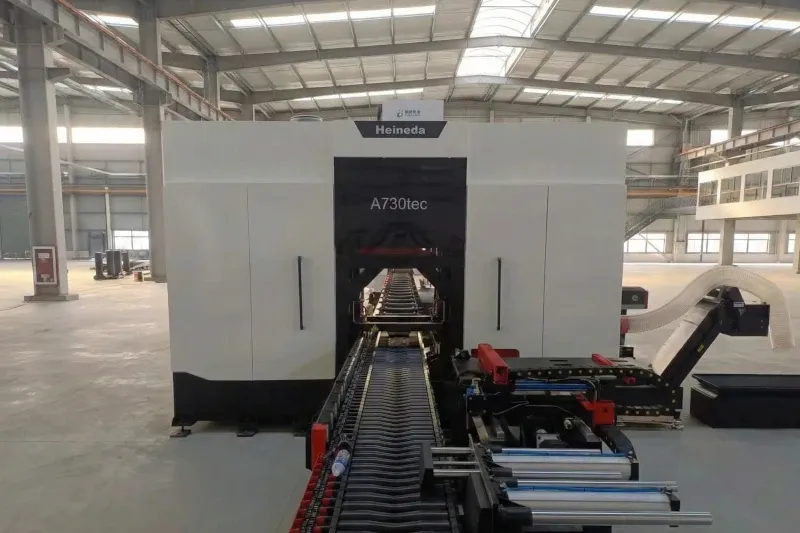
A fully automatic band saw machine feeds stock, clamps, cuts, measures the next cut length, and ejects chips — all without an operator touching the workpiece between cycles — delivering throughput that manual and semi-automatic saws cannot match.
Key Performance Stats
| Parameter | Heineda Specification |
|---|---|
| Cutting squareness (case reference) | ≤ 0.1 mm per 100 mm |
| Surface finish (case reference) | Ra < 25 μm |
| Daily aluminum billet capacity (case reference) | Up to 80 tons per day |
| Kerf width | ≤ 2 mm |
| Aluminum plate cutting accuracy (project-specific) | ± 0.3 mm |
| Max aluminum plate workpiece | 4000 mm × 4000 mm × 205 mm |
| CNC steel plate cutting accuracy (case reference) | ± 0.1 mm |
| CNC steel plate motor power | 26 – 30 KW (model-dependent) |
1. The End-to-End Cutting Cycle
The end-to-end cutting cycle of a fully automatic band saw machine is the sequence from raw material loading to finished cut part exiting the machine — with no manual intervention between steps.
Step 1 — Auto feed. A servo-driven vice or roller feed advances the bar, billet, or plate to the programmed cut length. The servo axis holds position accuracy to fractions of a millimeter, so every piece in a batch is the same length.
Step 2 — Clamping. Hydraulic or pneumatic clamps lock the workpiece against the fixed jaw. On double-column machines, a dual-column four-screw frame prevents any deflection of the saw head during the downstroke, preserving squareness ≤ 0.1 mm/100 mm even on large cross-sections.
Step 3 — Controlled descent. The saw head lowers at a feed rate set by the control system. For hard materials such as titanium alloy or age-hardened stainless, a Siemens-controlled servo adjusts the feed rate in real time against cutting load. For aluminum billets and round-bar bundles, the descent rate is optimized for blade life and surface finish (Ra < 25 μm).
Step 4 — Chip evacuation. A chip conveyor or coolant flush carries swarf away from the blade continuously. On aluminum plate saws, an air-bearing work table protects the surface while chips are evacuated, eliminating the scratching that occurs on roller-bed machines.
Step 5 — Part transfer. A discharge conveyor or pick-and-place unit moves the finished piece to the downstream accumulation table. The machine then resets the feed axis and starts the next cycle — no operator contact required.
2. Servo Control and Measurement Architecture
Servo control in a fully automatic bandsaw machine is a closed-loop positioning system where encoder feedback from the feed axis is compared to the programmed length target and corrected thousands of times per second.
On Heineda's CNC steel plate saw-milling machines, the Siemens control system handles three servo axes simultaneously: feed length, saw-head descent rate, and (on milling-capable models) the profile-milling head position. The result is cut accuracy of ± 0.1 mm — five to ten times tighter than a traditional manual band saw — on materials as demanding as titanium alloy and high-temperature stainless.
On aluminum plate cutting machines, auto nesting optimization runs on the same controller. The operator loads a cut list; the software arranges cuts on the sheet to maximize material yield and sequences them to minimize repositioning time.
What the operator actually does: Load the program, confirm the material is on the table, press cycle start, and monitor the HMI dashboard. The machine handles everything else.
3. Chip Evacuation and Surface Quality
Chip evacuation is the process of continuously removing metal swarf from the cutting zone so the blade does not re-cut chips, which degrades surface finish and accelerates blade wear.
On fully automatic double column bandsaw machines cutting steel billets, a chip conveyor running beneath the vice jaw removes swarf to a collection bin at the rear. Coolant is recirculated through a tank with a paper-band or magnetic separator to keep the cutting zone clean.
On aluminum billet lines, chip evacuation interacts directly with production throughput. Heineda's aluminum band saw achieves up to 80 tons of aluminum billet per day (case reference) in part because the chip path is unobstructed — the dual-column frame leaves the front of the machine open for a powered in-feed roller table and the rear open for an out-feed accumulation conveyor. The kerf width of ≤ 2 mm also means less aluminum becomes swarf per cut, directly improving material yield on high-volume billet operations.
Surface finish of Ra < 25 μm (case reference) is achievable at production rates precisely because chip re-cutting is prevented.
4. Production Monitoring and Throughput Calculation
Production monitoring on an auto feed band saw is the real-time collection of cycle count, cut length, blade hours, and fault events that allows a plant manager to calculate actual vs. planned throughput without walking the line.
Modern Heineda machines output OEE-relevant data through the HMI (Siemens on H-series and select models): pieces cut per shift, cumulative blade arc-length (for blade-change scheduling), coolant temperature, and fault codes. On networked installations, this data feeds a plant SCADA or MES via standard Ethernet.
Throughput per shift — worked example (aluminum billet line, case reference):
Throughput depends on billet diameter, alloy grade, and cut length. Contact Heineda for a throughput estimate based on your specific material and production setup.
- Rated daily capacity: 80 tons
For CNC steel plate applications, the ± 0.1 mm accuracy (stated) and high-efficiency carbide sawing on H-series models mean a single H-1510 or H-2610 can cover what might otherwise require multiple conventional saws while using one operator station.
Decision Engine: Which Configuration Do You Need?
| If your situation is... | Then choose... |
|---|---|
| High-volume aluminum billet or round bar, 24/7 production | Heineda aluminum band saw — dual-column rigidity, designed for continuous production |
| Large aluminum plate, 1xxx–7xxx alloys, up to 4000 × 4000 mm | Fully automatic aluminum plate cutting machine (E-6, E-10, or HL-12CNC) |
| Steel plate up to 1500 mm or 2600 mm wide, titanium or stainless | CNC steel plate saw-milling machine (H-1510 or H-2610) |
| Narrow steel plate or bar up to 700 mm, general metalworking | H-710 CNC saw-milling machine (26 KW) |
| Aerospace or mold materials where ± 0.1 mm is mandatory | H-series with Siemens full-auto servo feed (H-710 / H-1510 / H-2610) |
| Operator safety in a high-throughput unmanned cell | Aluminum band saw with light curtain protection |
Get a Quote for Your Cutting Line
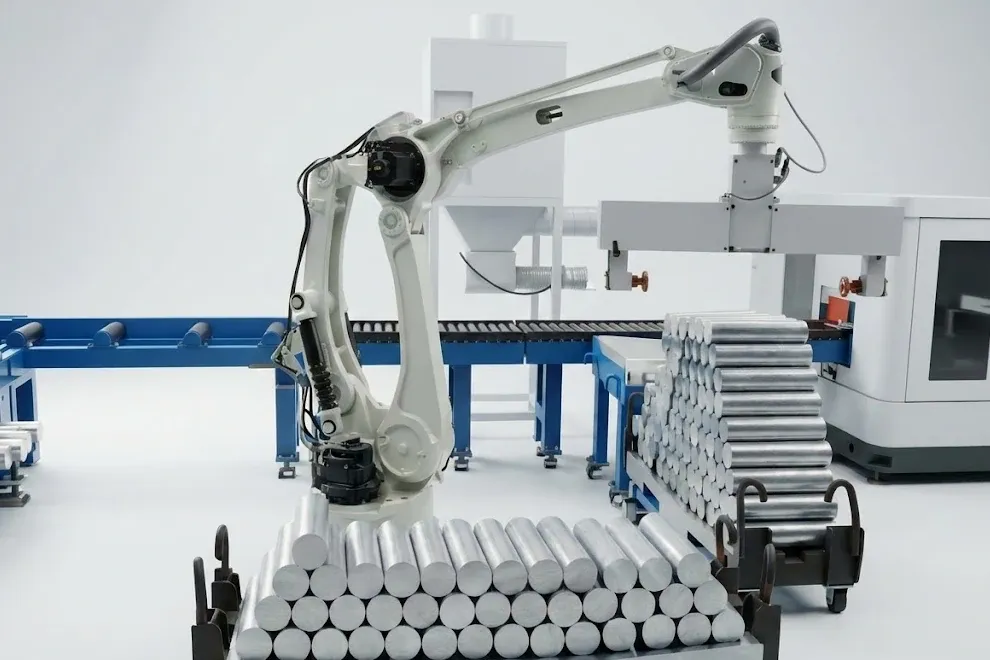
Heineda's engineering team sizes fully automatic band saw machines to your billet diameter, plate dimensions, alloy grade, and required cycle time — and provides throughput projections before you commit.
Or email: sales@heinedasaw.com with your material, cross-section, and daily tonnage target.
FAQ
Q: What is the difference between a semi-automatic and a fully automatic band saw machine?
A: A semi-automatic band saw completes the cut automatically but requires an operator to manually advance the material and reset the vice for each cycle. A fully automatic band saw machine uses a servo feed axis to advance the material to the programmed length automatically, so the operator only needs to load the raw material at the start of the batch and unload finished pieces from the discharge conveyor. Heineda's aluminum band saw and CNC saw-milling machines are both fully automatic in this sense.
Q: How does an auto feed band saw maintain cut length accuracy across a long batch?
A: The servo feed axis uses closed-loop encoder feedback. After each cut, the controller moves the feed vice exactly the programmed distance — there is no accumulated mechanical error because the encoder reads absolute position rather than counting motor revolutions. Heineda's CNC machines achieve ± 0.1 mm on steel plate and ± 0.3 mm on aluminum plate across the full batch.
Q: What throughput should I expect from a fully automatic double column bandsaw machine on aluminum billet?
A: Throughput depends on billet diameter, alloy hardness, and cut length. Contact Heineda for a throughput estimate based on your specific material and production setup. A dual-column machine with servo feeding and automated material handling can achieve consistent high-volume output in continuous operation.
Q: Can a fully automatic bandsaw machine handle mixed-batch production — different lengths in the same run?
A: Yes. On Heineda's CNC-controlled machines, the operator loads a cut program that specifies a sequence of different lengths. The servo feed axis advances to each programmed position in order. For aluminum plate, auto nesting software can arrange multiple part geometries on a single sheet when configured as part of an automation solution.
Q: What maintenance is required to sustain Ra < 25 μm surface finish?
A: The three main factors are blade condition, chip evacuation, and coolant quality. Blade hours should be tracked via the machine's HMI; Heineda recommends scheduling blade changes based on cumulative arc-length rather than calendar time. The chip conveyor and coolant separator must be cleared each shift. Coolant concentration should be checked weekly — degraded coolant causes thermal streaks on the cut face that increase roughness above the Ra < 25 μm threshold.
Q: Does the machine integrate with upstream loading and downstream conveying equipment?
A: Yes. Heineda's aluminum band saw is explicitly designed to support automation integration for loading, conveying, and unloading. The machine's in-feed and out-feed interfaces are configurable to match powered roller tables, bundle loaders, and downstream accumulation conveyors. For plate machines, the air-bearing work table allows heavy sheets to be positioned by overhead crane or gantry without surface damage.
Q: Which industries currently operate Heineda fully automatic band saw machines?
A: Heineda fully automatic band saw machines serve aluminum billet and plate operations, aerospace aluminum plate processing, aluminum extrusion cutting, and large aluminum billet production. The H-series CNC saw-milling machines serve aerospace, automotive, mold making, and metallurgy industries requiring ± 0.1 mm accuracy on hard materials.
If you remember one thing from this article: a fully automatic band saw machine does not just cut faster — it eliminates the manual reset between cycles, which is where most production time is lost on a conventional saw line.
Specify Your Fully Automatic Band Saw Machine
Send Heineda your workpiece dimensions, alloy or material grade, required accuracy, and daily tonnage. The team returns a machine recommendation with throughput projections and a formal quotation — typically within one business day.
Contact: sales@heinedasaw.com | heinedasaw.com