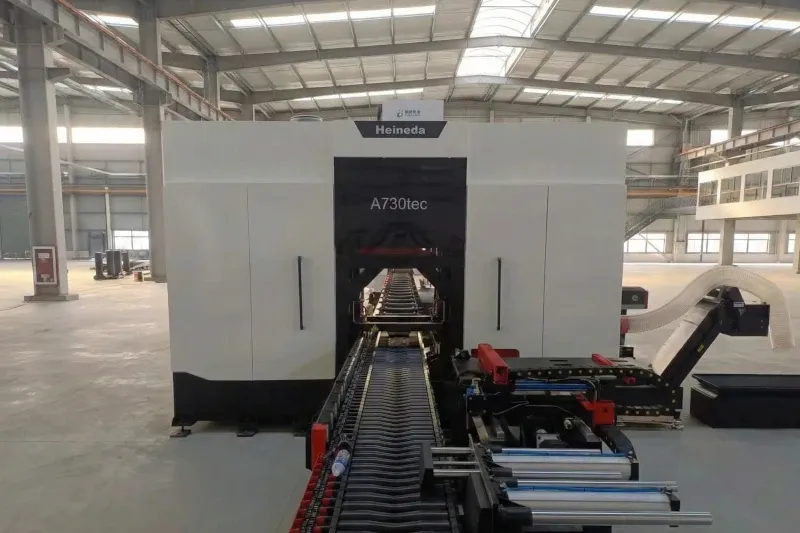
A double column band saw is the right choice when workpiece size, production throughput, or cutting accuracy exceeds what a single-column machine can reliably deliver — typically for workpieces wider than 400 mm, continuous-shift production runs, or applications requiring squareness within ±0.1 mm.
Key Performance Stats
| Metric | Double Column (Heineda) | Typical Single Column |
|---|---|---|
| Cutting squareness | ≤0.1 mm/100 mm (case reference) | ±0.3–0.5 mm/100 mm |
| Surface finish | Ra < 25 μm (case reference) | Ra 25–50 μm |
| Max workpiece (aluminum) | 4000 × 4000 × 205 mm | ~400 × 400 mm |
| Daily throughput (aluminum billets) | Up to 80 tons (case reference) | 10–20 tons typical |
| Kerf width | ≤2 mm | 2.5–3.5 mm |
| Structural columns | Dual-column + ball screw | Single column |
What Is a Double Column Band Saw?
A double column band saw (also called a dual column band saw or double column horizontal band saw) is a metal-cutting band saw where the saw head is guided by two vertical columns instead of one. The two-column frame eliminates the lateral flex that limits single-column machines, making the cutting head rigid under high feed forces and heavy workpieces. This structural difference is the root cause of every performance gap in the table above.
Heineda's aluminum band saw uses a dual-column + ball screw design — the lead screws distribute the clamping load symmetrically across both columns, keeping the blade perpendicular throughout the cut even when blade tension or material resistance changes.
Single Column vs. Double Column: The Core Trade-Offs
A single-column band saw is a cantilever structure: the saw head pivots on one column and the free end deflects under load. This is fine for occasional cutting of small cross-sections (under ~300 mm round bar or 250 × 300 mm rectangular). For anything larger or faster, deflection degrades squareness and finish.
A double column bandsaw machine constrains both ends of the saw head. Deflection under the same load drops by an order of magnitude. The practical consequences:
- Squareness: Heineda's dual-column aluminum band saw holds ≤0.1 mm/100 mm (case reference). Single-column machines in the same price bracket typically drift to 0.3–0.5 mm/100 mm when pushed.
- Surface finish: Ra < 25 μm (case reference) from the double column design vs. Ra 25–50 μm from a loaded single column. For aerospace billets or mold blanks, secondary facing operations can be eliminated.
- Kerf: The Heineda double column machine holds kerf ≤2 mm. A wandering blade on a single-column machine widens kerf to 2.5–3.5 mm — 25–75% more material lost per cut.
Fit Assessment: When a Double Column Machine Is Required
Use the decision table below to determine which machine class fits your application.
Decision Engine
| If your situation is… | Then choose… | Reason |
|---|---|---|
| Workpiece cross-section > 400 mm (round or rectangular) | Double column band saw | Single column lacks frame stiffness for large sections |
| Production > 30 tons/day of aluminum billets or plate | Heavy duty metal band saw — double column | Continuous-shift load requires rigid frame to maintain tolerance |
| Squareness requirement ≤ 0.15 mm/100 mm | Double column | Single column cannot hold this tolerance under load |
| Surface finish Ra < 30 μm required (no facing op) | Double column | Blade stability from dual columns achieves Ra < 25 μm |
| Automation integration (loading, conveying, unloading) | Double column | Single column machines typically lack mounting provisions |
| Cutting aluminum bundle round bars or irregular profiles | Double column | 4-screw clamping handles irregular section shapes |
| Occasional cutting, < 200 mm cross-section, low volume | Single column | Lower capital cost; adequate for light-duty intermittent use |
| Mixed small/medium workpieces, job shop | Single column or semi-auto double column | Depends on mix; evaluate throughput requirement first |
The threshold that tips most buyers toward a double column horizontal band saw is daily throughput combined with accuracy. A plant running one or two cuts per hour on 200 mm bar stock rarely justifies the capital. A plate service center, billet production line, or aerospace subcontractor running multiple shifts almost always does.
Production Volume: Where the Math Changes
At low volume, both machine types can hold adequate tolerance — the single-column machine is simply less loaded. The gap opens as feed rate and daily cut count rise.
Heineda's double column aluminum band saw is rated to 80 tons of aluminum billets per day (case reference). Achieving that throughput on a single-column machine would require running it at the edge of its mechanical envelope continuously, causing blade drift, accelerated guide wear, and tolerance blowout within a shift.
Real-world reference: high-volume billet operations require this level of output. The dual-column + ball screw frame is not over-engineering — it is the minimum structure that keeps squareness ≤0.1 mm/100 mm at that throughput.
Accuracy and Material Yield
The kerf and squareness specs interact directly with material yield — a factor often ignored when comparing machine classes.
Kerf yield loss example:
- A 6-meter aluminum billet cut into 50 mm blanks = 120 cuts
- At ≤2 mm kerf (double column): 240 mm lost to kerf = 4% of billet
- At 3 mm kerf (single column under load): 360 mm lost = 6% of billet
- Difference: 120 mm per billet = one additional blank recovered per billet on a double column machine
At 80 tons/day, that 2% kerf difference is significant. For high-value materials (7xxx aerospace aluminum, titanium, age-hardened stainless), the cost impact per ton makes the capital payback calculation straightforward.
Get a Quote for Your Application
Ready to evaluate a double column band saw for your production line? Heineda's engineering team will assess your workpiece dimensions, daily volume, and accuracy requirements — and recommend the right machine configuration.
Questions? Contact: sales@heinedasaw.com | heinedasaw.com
FAQ
Q: What is the main structural difference between a double column and single column band saw? A: A double column band saw uses two vertical guide columns to support both ends of the saw head, eliminating the cantilever flex that causes blade drift in single-column machines. The dual-column design keeps the blade perpendicular throughout the cut regardless of workpiece size or feed force.
Q: What workpiece size requires a double column band saw? A: As a practical threshold, workpieces with cross-sections larger than 400 mm (round or rectangular) or bundle cuts exceeding that envelope are better suited to a double column machine. Heineda's dual-column aluminum band saw handles workpieces up to 4000 × 4000 × 205 mm.
Q: Can a double column bandsaw machine hold tighter squareness than a single column? A: Yes. Heineda's double column band saw achieves ≤0.1 mm/100 mm squareness — two to five times tighter than a loaded single-column machine in the same size class. This is a direct result of the 4-screw dual-column frame eliminating saw-head deflection.
Q: What industries typically use a heavy duty metal band saw with double columns? A: Aluminum billet production lines, aerospace plate service centers, automotive aluminum supply chains, and mold/tool steel shops. Any application with large cross-sections, high throughput, or finish requirements that eliminate secondary facing operations.
Q: How does kerf width differ between double column and single column band saws? A: Heineda's double column machine holds kerf ≤2 mm. Single-column machines under production load typically run 2.5–3.5 mm kerf as blade drift widens the cut. On a 6-meter billet cut to 50 mm blanks, the difference recovers one additional blank per billet — measurable yield improvement on every run.
Q: Is automation integration easier on a double column horizontal band saw? A: Yes. The dual-column frame provides symmetrical mounting provisions for in-feed and out-feed conveyors, loading arms, and bundle handling systems. Heineda's aluminum band saw explicitly supports automation integration for loading, conveying, and unloading — this is rarely available on single-column machines without significant custom fabrication.
Q: When does a single column band saw remain the better choice? A: For intermittent production at low volume, workpieces under 200–300 mm cross-section, and applications where squareness tolerance of ±0.3 mm is acceptable. Single-column machines have lower capital cost and are appropriate for job shops or maintenance operations that cut infrequently.
If there is one thing to remember: when workpiece size, daily throughput, or accuracy requirements push past the limits of a single-column machine's rigid-body envelope, a double column band saw is not optional — it is the minimum structure that keeps the process in tolerance.
Start With the Right Machine Configuration
Heineda's engineering team has equipped billet production lines, plate service centers, and aerospace subcontractors globally. Tell us your workpiece dimensions and daily volume — we will recommend the correct dual column band saw configuration for your application.
Jiangsu Heineda Sawing Machinery Co., Ltd. | heinedasaw.com | sales@heinedasaw.com