Cutting large aluminum billets to ±0.1mm accuracy requires a combination of a sufficiently rigid machine frame, the correct blade tooth geometry and tension, controlled feed rates matched to cross-section area, and a clamping strategy that eliminates workpiece movement during the cut.
Key Stats: What the Numbers Actually Mean
| Parameter | Heineda Specification | Why It Matters |
|---|---|---|
| Band saw cutting squareness (case reference) | ≤0.1 mm/100mm | Defines the angular error per unit length — the foundation of dimensional control |
| H-series CNC saw milling cutting accuracy (case reference) | ±0.1mm | Absolute positional tolerance across the full cut face |
| H-series motor power | 26–30 KW | Sufficient spindle force to prevent deflection in large cross-sections |
| Band saw surface finish (case reference) | Ra < 25μm | Smooth finish eliminates secondary facing operations on precision billets |
| Band saw kerf width | ≤2mm | Narrow kerf reduces material loss per cut on expensive aluminum stock |
| Band saw daily throughput (case reference) | Up to 80 tons | Industrial-grade duty cycle — accuracy must hold across a full production shift |
Machine Stiffness: The Non-Negotiable Foundation
Machine stiffness is the structural resistance of the saw frame and column assembly to deflection under cutting load. When cutting large aluminum billets — cross-sections above 300mm × 300mm are common in aerospace and automotive billet supply — the blade experiences lateral forces that would cause a light-frame saw to flex, producing a cut face that is neither square nor flat.
Heineda's aluminum band saws use a dual-column + ball screw design. The dual-column architecture constrains the saw head on both sides simultaneously, preventing the rotational racking that causes squareness errors. The ball screw drive distributes vertical feed force evenly, so the head descends without canting. This design delivers the ≤0.1 mm/100mm squareness specification (case reference) even on large cross-sections where a single-column saw would drift.
For the widest cuts — up to 2600mm — the H-2610 CNC saw milling machine uses a 30KW motor and a full-width rigid bridge. The Siemens control system and full-auto servo feed eliminate operator-induced variation, which is the dominant error source on manually fed machines.
Rule of thumb: If your billet cross-section exceeds 200mm in any dimension, every kilogram of frame mass between the blade and the table is working in your favor. Do not sacrifice stiffness for machine cost savings and then attempt to recover accuracy through blade adjustments.
Blade Selection: Tooth Geometry and Tension for Aluminum
Blade selection is the process of matching tooth pitch, set geometry, and blade tension to the specific aluminum alloy and cross-section being cut. Aluminum is not a monolithic material — 1xxx series pure aluminum is soft and gummy; 7xxx series aerospace alloys are hard and abrasive. A blade spec that holds ±0.1mm on 6061-T6 round bar may drift by 0.3mm on the same cross-section of 7075-T651 thick plate.
Key principles for high precision aluminum cutting:
- Tooth pitch (TPI): Larger cross-sections require coarser pitch (fewer teeth per inch) to clear chips without packing. Chip packing causes the blade to track off-line, which directly degrades billet saw accuracy. For billets above 150mm, a 1–2 TPI variable-pitch blade is the standard starting point.
- Set geometry: A raker-set pattern distributes lateral cutting load evenly and produces a kerf that is consistent in width — Heineda's ≤2mm kerf specification is achievable with a properly set blade. Wavy-set blades cut faster but with wider, less consistent kerf.
- Blade tension: Under-tensioned blades bow under load and produce a convex cut face. Over-tensioned blades fatigue prematurely. Follow the blade manufacturer's tension specification and verify with a tension gauge — do not rely on feel or visual inspection.
- Blade speed (SFPM): Aluminum cutting tolerance degrades when surface footage is too high because heat builds up and the aluminum smears rather than chips cleanly. For large cross-sections, reduce blade speed by 15–20% from the maximum rated speed and compensate with feed rate.
Feed Rate Control: Matching Force to Cross-Section
Feed rate control is the management of how fast the blade advances into the workpiece, expressed as mm/min or inches/min. When cutting large aluminum billets, feed rate is the primary lever for managing both dimensional accuracy and blade life.
The relationship is not linear. A feed rate that produces ±0.1mm accuracy on a 100mm × 100mm billet will produce significantly larger errors on a 400mm × 400mm billet because the total blade load scales with cross-section area, not linearly with any single dimension.
Practical feed rate guidelines for high precision aluminum cutting:
- Small cross-section (up to 100mm): Full rated feed rate. The blade load is low enough that machine stiffness is not the limiting factor.
- Medium cross-section (100–300mm): Reduce feed rate by 20–30%. Monitor the cut for any bow or drift and adjust.
- Large cross-section (300mm+): Reduce feed rate by 40–50% from rated. Accept the longer cycle time — the alternative is scrapped billets.
- Servo feed advantage: The H-series CNC saw milling machines use full-auto servo feed, which maintains the programmed feed rate regardless of material resistance variations within a single billet. Manual and semi-automatic machines allow the operator to push through hard spots, which is a direct cause of positional error.
For the H-series, Siemens control system integration means feed rate profiles can be stored per material and cross-section. Once a feed rate recipe is validated for a given billet spec, it repeats with zero operator variability.
Fixture Strategy: Eliminating Workpiece Movement
Fixture strategy is the system of clamps, supports, and material handling that holds the billet stationary throughout the cut. Movement of the workpiece — even 0.05mm of shift — directly adds to the positional error of the cut face.
For large aluminum billets, fixture challenges include:
- Billet weight: A 6061-T6 billet measuring 400mm × 400mm × 3000mm weighs approximately 1,300 kg. The fixture must support this weight without deflecting the work table.
- Clamping pressure vs. surface damage: Aluminum is soft enough that aggressive clamping jaws mark the surface. Heineda's band saw design supports automation integration including loading, conveying, and unloading — the conveyor system positions the billet without manual repositioning, which eliminates the micro-movements introduced by operators adjusting the workpiece between cuts.
- Round bar bundles: When cutting multiple round bars in a bundle, a V-block or bundle support prevents the bars from rolling or shifting during the cut. A single shifted bar in a bundle causes all subsequent cuts in that batch to be out of tolerance.
- End support for long billets: For billets over 1500mm in unsupported length, add a steady rest or roller support at the far end. Without it, billet sag creates a moment that deflects the cut face.
The air-bearing work table on the E/HL series aluminum plate cutting machines is a fixture-adjacent feature: it floats the workpiece on a film of air, eliminating surface friction without eliminating positional control. This protects the aluminum surface while the nesting software optimizes cut sequence for maximum material yield.
Real-World Achievable Tolerances by Cross-Section
When customers ask what aluminum cutting tolerance is achievable in production — not in a test cut on a perfect billet — the honest answer depends on cross-section size, alloy, and the specific machine being used.
| Cross-Section | Machine Type | Achievable Tolerance | Notes |
|---|---|---|---|
| Up to 100mm (any profile) | Aluminum band saw | Achievable within ≤0.1mm/100mm squareness spec; contact Heineda for application-specific data. | Well within ≤0.1mm/100mm squareness spec |
| 100–300mm round or square | Aluminum band saw | At spec limit; achievable tolerance depends on blade selection, tension, and feed rate. Contact Heineda for application-specific data. | At the spec limit — requires correct blade tension and feed rate |
| 300–700mm | H-710 CNC saw milling | ±0.1mm (case reference) | H-series absolute accuracy spec; servo feed maintains this across shifts |
| 700–1500mm | H-1510 CNC saw milling | ±0.1mm (case reference) | Same absolute spec on wider stock |
| 1500–2600mm | H-2610 CNC saw milling | ±0.1mm (case reference) | Largest class; 30KW motor required to maintain positional accuracy |
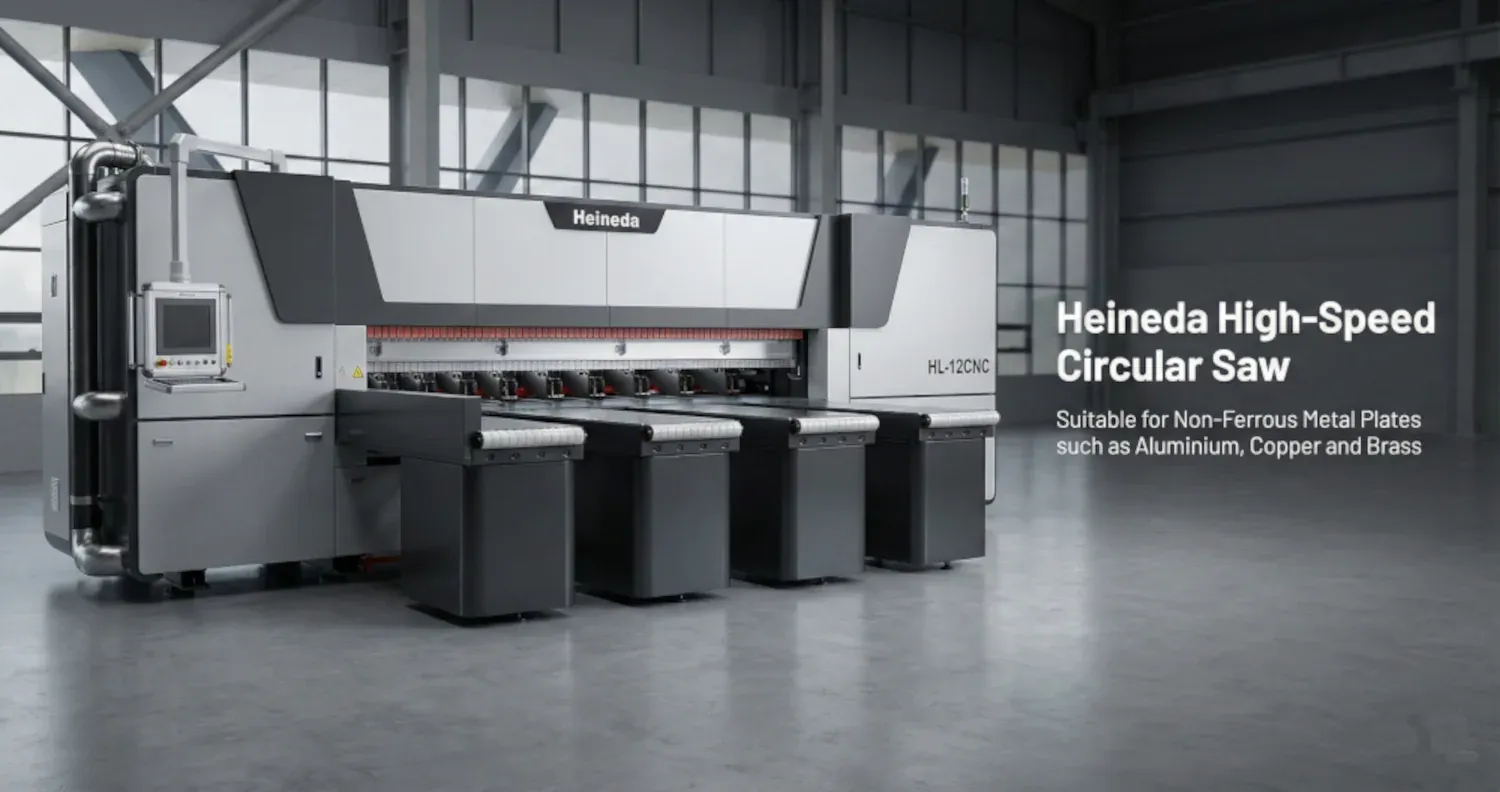
| Plate up to 4000mm × 4000mm | HL-12CNC aluminum plate saw | ±0.3mm (project-specific) | Accuracy tier appropriate for plate service center operations |
Contact Heineda for cross-section-specific accuracy reference data from production installations.
Large-volume operations require accuracy maintained across high daily throughput, not just in single-piece sampling.
If X → Choose Y: Decision Engine
| Situation | Recommended Machine | Reason |
|---|---|---|
| Billet cross-section ≤ 300mm, need ±0.1mm | Aluminum Band Saw (dual-column 4-screw) | Squareness ≤0.1mm/100mm, handles round bar bundles and irregular profiles |
| Billet or plate width up to 700mm, need ±0.1mm | H-710 CNC Saw Milling | 26KW, Siemens servo feed, 5–10× faster than band saw |
| Wide stock 700–1500mm, need ±0.1mm | H-1510 CNC Saw Milling | 30KW, same absolute accuracy on wider cross-section |
| Very wide stock up to 2600mm, need ±0.1mm | H-2610 CNC Saw Milling | Maximum width class with full servo accuracy |
| Large plate up to 4000mm, ±0.3mm acceptable | E-10 or HL-12CNC Aluminum Plate Saw | Air-bearing table, auto nesting, 30KW — optimized for plate service centers |
| High-throughput billet line needing automation | Aluminum Band Saw + conveyor integration | Loading/conveying/unloading automation supported; up to 80 tons/day |
| Titanium alloy or age-hardened stainless alongside aluminum | H-series CNC Saw Milling | H-series handles titanium alloy, high-temp stainless, and age-hardened stainless steel |
Get a Heineda Custom Quote — tell us your billet cross-section, alloy grade, and daily tonnage, and we will specify the machine configuration that achieves ±0.1mm in your production environment. 👉 Request Free Quote
FAQ
Q: What is the maximum cross-section for achieving ±0.1mm accuracy on a band saw? A: Heineda's dual-column aluminum band saws achieve ≤0.1mm/100mm squareness across the range of cross-sections the machine is rated for. For cross-sections beyond 300mm, the H-series CNC saw milling machines are the better choice — they deliver ±0.1mm absolute accuracy up to 2600mm width with Siemens servo feed control.
Q: Does aluminum alloy grade affect achievable cutting tolerance? A: Yes. Softer alloys (1xxx, 3xxx series) are more prone to gummy chip buildup, which can deflect the blade and degrade billet saw accuracy. Harder alloys (7xxx series) require slower feed rates to maintain ±0.1mm. The correct blade tooth pitch, set geometry, and blade speed must be matched to the specific alloy — the machine specification defines the upper bound of achievable accuracy, but blade and parameter selection determines whether you reach it.
Q: How does feed rate affect aluminum cutting tolerance in production? A: Feed rate is the primary operator-controlled variable in maintaining aluminum cutting tolerance. For large cross-sections (300mm+), reducing feed rate by 40–50% from the rated maximum is typical for ±0.1mm work. The H-series CNC saw milling machines eliminate this variability by storing feed rate recipes per material and cross-section in the Siemens control system.
Q: Can I achieve ±0.1mm accuracy on a bundle of round bars, not just a single billet? A: Yes, with proper fixturing. Heineda's aluminum band saws are specifically rated for round bar bundles. The requirement is a proper V-block or bundle support that prevents individual bars from rolling during the cut. A single shifted bar produces out-of-tolerance cuts for the entire bundle. The dual-column 4-screw frame maintains squareness; the fixture prevents movement — both are required simultaneously.
Q: What surface finish does the Heineda band saw produce on aluminum billets? A: The aluminum band saw produces a surface finish of Ra < 25μm. For most downstream processes — extrusion die entry, forging billet preparation, or machined component stock — this finish eliminates the need for a secondary facing operation, which is a significant cycle time saving on high-volume billet lines.
Q: How does the H-series CNC saw milling machine compare to a band saw for precision aluminum cutting? A: The H-series achieves ±0.1mm absolute accuracy and operates 5–10× faster than a traditional band saw for equivalent cross-sections. The Siemens control system and servo feed make it repeatable across an entire shift without operator adjustment. For cross-sections up to 2600mm and materials beyond aluminum — including titanium alloy and age-hardened stainless — the H-series is the correct platform. For smaller cross-sections, bundles, or irregular profiles, the aluminum band saw remains efficient and cost-effective. See the aluminum billet cutting product page for a side-by-side specification comparison.
Q: What is the difference between cutting accuracy and squareness, and which matters more? A: Cutting accuracy (±0.1mm) describes the positional error of the cut face relative to the programmed dimension — how close the finished length is to the target length. Squareness (≤0.1mm/100mm) describes the angular error of the cut face — whether the face is perpendicular to the billet axis. Both matter: a cut that is the right length but not square produces a part that rocks on a flat surface and cannot be stacked reliably. High precision aluminum cutting requires both specifications to be met simultaneously.
If you remember one thing from this article: achieving ±0.1mm accuracy when cutting large aluminum billets is not primarily a blade problem — it is a machine stiffness and feed rate control problem, and choosing a machine with a dual-column frame or full servo feed is the decision that makes everything else tractable.
Get a Heineda Custom Quote — Heineda machines are running in production globally; bring us your cross-section and we will show you the configuration that holds ±0.1mm across your full shift. 👉 Request Free Quote
For more on Heineda's aluminum billet cutting equipment, visit the aluminum billet cutting product page or contact the team directly to discuss your production requirements.