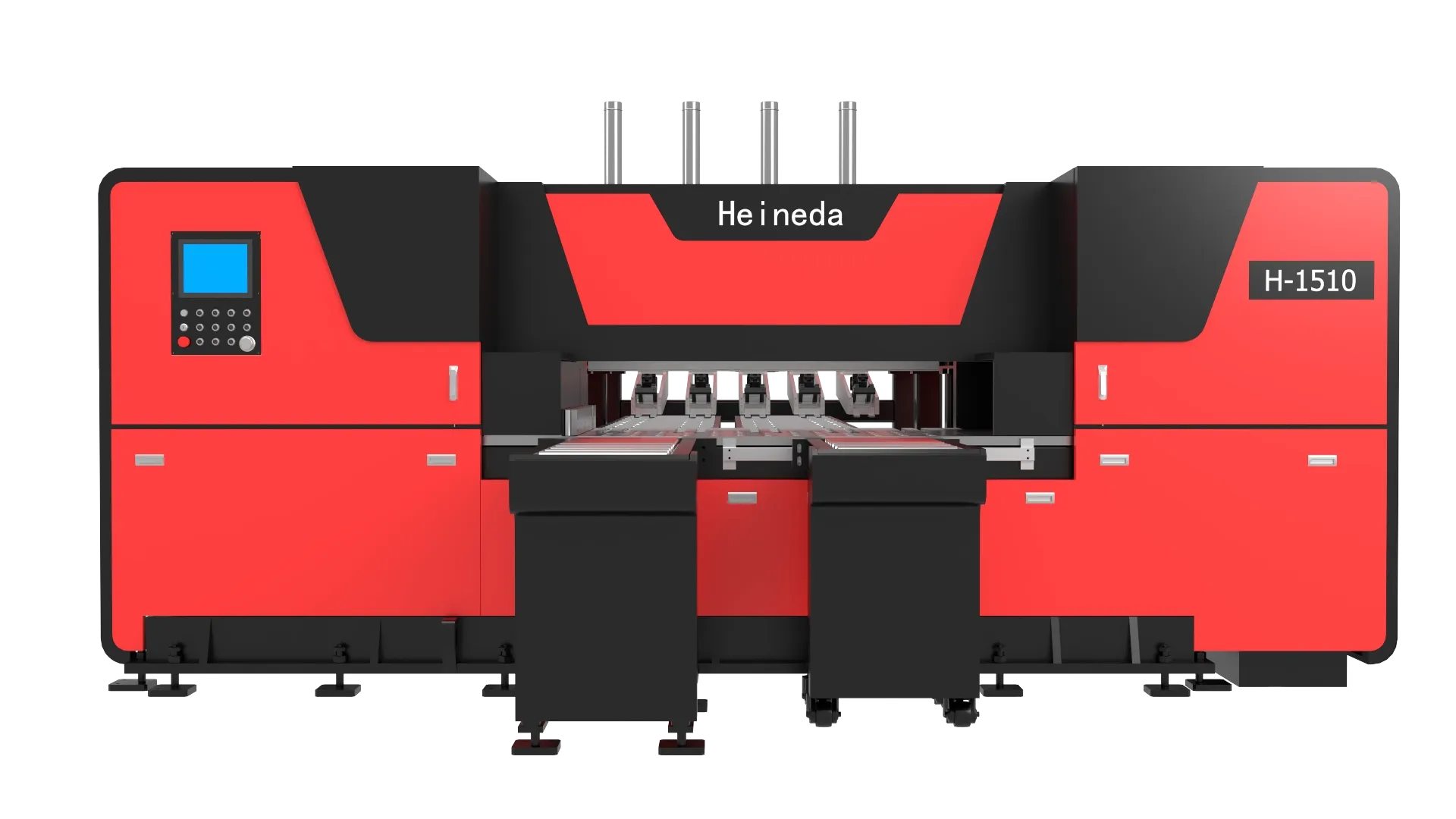
A CNC steel plate saw milling machine is a single-station cutting center that saws and mills a steel plate to final dimension in one automated pass, delivering ±0.1 mm accuracy at speeds 5–10× faster than a stand-alone band saw.
Key Specs at a Glance
| Specification | H-710 | H-1510 | H-2610 |
|---|---|---|---|
| Max workpiece width | 700 mm | 1500 mm | 2600 mm |
| Max workpiece height | 100 mm | 100 mm | 100 mm |
| Cutting accuracy | ±0.1 mm | ±0.1 mm | ±0.1 mm |
| Main motor power | 26 KW | 30 KW | 30 KW |
| Control system | Siemens | Siemens | Siemens |
| Speed vs. band saw | 5–10× faster | 5–10× faster | 5–10× faster |
What Is a CNC Steel Plate Saw Milling Machine?
A CNC steel plate saw milling machine is a machining center that integrates a circular saw unit and a milling spindle on a common servo-driven gantry, so one fixture cycle produces a cut surface that is flat, square, and dimensionally finished. Traditional workflows require two separate setups — a band saw rough-cut followed by a surface milling or grinding pass — consuming floor space, extra fixturing time, and operator hours. Combining those operations into one CNC pass eliminates the re-clamping error and compresses cycle time dramatically.
The Heineda H-series machines use a Siemens control system with full-auto servo feed. Once the operator keys in plate dimensions and cut count, the machine handles feed rate, saw-milling depth, and part ejection without further intervention. That level of automation makes the platform practical for both job shops running mixed materials and high-volume production lines cutting repetitive blanks.
Why Saw-Milling Combination Matters for Aerospace and Mold Shops
When a shop processes titanium alloy, high-temperature stainless, or age-hardened stainless steel, tool life and surface integrity are non-negotiable — and those factors are exactly where the cnc saw milling machine architecture earns its cost premium. Titanium work-hardens rapidly, so any dwell between a sawing pass and a separate milling pass allows the cut surface to develop a hardened layer that attacks the milling insert. Completing both operations in a single continuous pass avoids that dwell and extends insert life.
For aerospace metal cutting, dimensional traceability matters as much as cycle time. The ±0.1 mm accuracy of the H-series saw milling combination meets the blank tolerances required by frame and bracket programs, where incoming material must already be within spec before entering the machining cell. Mold shops face a similar constraint: a P20 or H13 plate arriving at the EDM station slightly out of square wastes hours of sink time. The steel plate cutting machine delivers the square blank the downstream process expects.
The single-pass saw milling combination also reduces material loss. Because the milling pass removes only the surface layer left by the saw, total kerf-and-face-cut stock allowance is smaller than a two-machine sequence, which matters most on expensive titanium cutting machine applications where raw material can exceed $50/kg.
Model Selection by Workpiece Width: H-710 vs H-1510 vs H-2610
Model selection for a CNC steel plate saw milling machine starts with the widest plate the shop will ever need to cut — not the average plate, but the maximum. The H-series lineup covers three distinct width classes:
H-710 (700 mm wide) is the entry model targeting mold base shops, precision machined parts suppliers, and tool room environments that process plates up to 700 mm. At 26 KW it draws less power than the larger models and fits a smaller footprint, making it practical for shops that cannot dedicate a large cell. Typical materials: P20 mold steel, S45C structural plate, 304 stainless.
H-1510 (1500 mm wide) covers the mid-range common in automotive die shops and aerospace substructure suppliers. A 1500 mm width accommodates most floor plate and rib stock programs without requiring the larger capital outlay of the H-2610. Motor steps up to 30 KW, matching the power of the H-2610, which means the H-1510 is not a compromised machine — it is the H-2610 architecture on a narrower bed.
H-2610 (2600 mm wide) is the wide-format model for plate service centers and OEM aerospace programs using large panel stock. At 2600 mm it handles the full-width plates commonly specified in wing-skin blank programs and large mold bases for automotive body panels. This model is also the natural choice for metallurgy and heavy industrial customers cutting wide structural profiles.
Decision Engine: Which Model Fits Your Application?
| If your situation is... | Choose |
|---|---|
| Max plate width ≤ 700 mm, tool room or mold base shop | H-710 |
| Max plate width 701–1500 mm, automotive die or aerospace substructure | H-1510 |
| Max plate width up to 2600 mm, plate service center or large OEM program | H-2610 |
| Primary material is titanium alloy or high-temp stainless | Any H-series (all three handle these materials) |
| Budget is the primary constraint; accuracy requirement is ±0.1 mm | H-710 (lower motor power = lower operating cost) |
| Mixed-width production with frequent changeovers | H-1510 (best balance of width coverage and footprint) |
| Downstream process requires square blank within ±0.1 mm, no secondary milling | Any H-series |
Get a Quote for Your Width Class
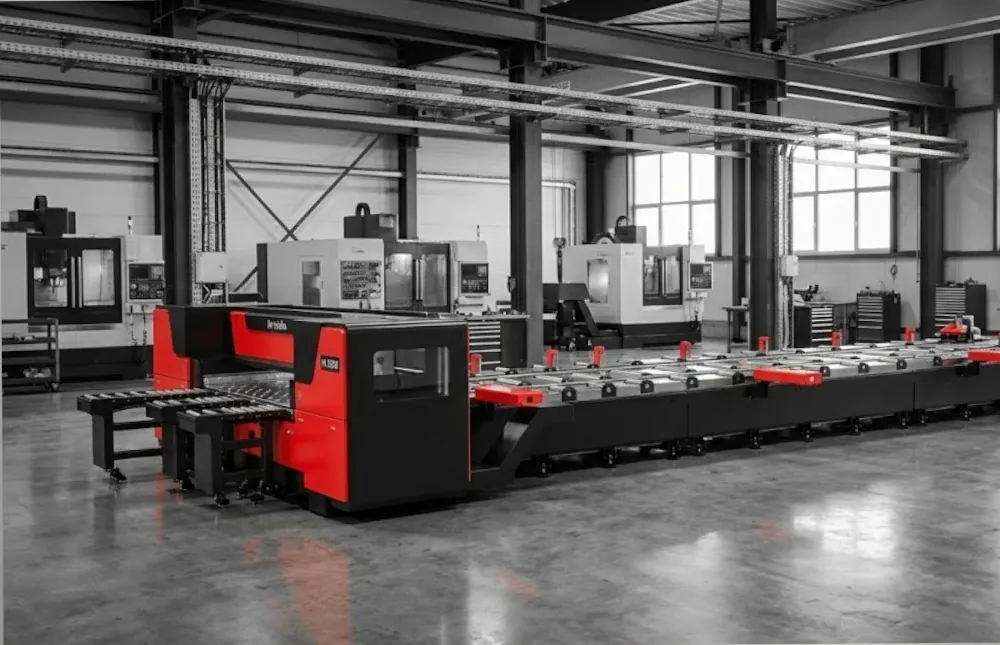
Ready to match a model to your plate program? The Heineda team configures each H-series machine to the workpiece envelope, material, and throughput target of your specific application.
Get a Quote for the H-Series Saw Milling Machine →
Material Compatibility: What the H-Series Handles
Material compatibility for a CNC steel plate saw milling machine determines whether a shop can consolidate its cutting floor around one platform or must maintain separate machines for different alloys. The H-series machines are rated for titanium alloy, high-temperature stainless, and age-hardened stainless — the three material families that defeat conventional cold-saw or band-saw workflows.
Titanium alloy presents two challenges: low thermal conductivity (heat concentrates at the cut zone) and high reactivity at elevated temperature. The H-series addresses both through the combined saw-mill pass that limits cumulative heat exposure and through the Siemens servo feed control that maintains consistent chip load without operator adjustment. High-temperature stainless (310, 330 series) work-hardens similarly to titanium and benefits from the same feed-rate stability. Age-hardened stainless (17-4 PH, 15-5 PH) is dimensionally sensitive after heat treatment — the ±0.1 mm accuracy of the H-series means a finished blank reaches the lathe already within tolerance, avoiding a face-milling correction pass.
For aerospace metal cutting programs, material traceability and process consistency are audit items. The Siemens controller logs feed parameters per cut, providing the data trail quality engineers need without additional manual recording.
FAQ
Q: What is the difference between a CNC saw milling machine and a band saw? A: A band saw uses a continuous flexible blade to rough-cut material, typically leaving a surface that requires a secondary milling or grinding pass to reach final dimension. A CNC saw milling machine combines the initial cut and the milling pass in one automated station, delivering ±0.1 mm accuracy directly off the machine — 5–10× faster than the two-step band saw workflow.
Q: Can the H-series cut titanium alloy? A: Yes. All three H-series models — H-710, H-1510, and H-2610 — are designed to handle titanium alloy, high-temperature stainless, and age-hardened stainless. The Siemens servo feed system maintains consistent chip load through the variable-hardness zones typical of these materials.
Q: What accuracy does the H-series steel plate cutting machine achieve? A: The H-series achieves ±0.1 mm cutting accuracy across all three models. That figure applies to the finished cut dimension after the combined saw-milling pass — no secondary operation required.
Q: How do I choose between the H-710, H-1510, and H-2610? A: Select by the widest plate your operation will ever process: H-710 covers up to 700 mm, H-1510 covers up to 1500 mm, H-2610 covers up to 2600 mm. All three share the same 100 mm max workpiece height, ±0.1 mm accuracy, and Siemens control platform, so the choice is purely a width-class decision.
Q: What control system does the H-series use? A: All H-series models use a Siemens control system with full-auto servo feed. Siemens was selected for its availability of spare parts in major industrial markets and its established presence in aerospace-tier manufacturing supply chains.
Q: What industries use a CNC steel plate saw milling machine? A: Primary applications are aerospace (blank preparation for structural parts and brackets), metallurgy, automotive die shops (mold base and die plate prep), and mold making. Any operation that currently sequences a band saw rough cut with a secondary milling pass is a candidate for consolidation onto the H-series.
Q: Is the H-2610 the right choice for a plate service center? A: For most plate service center applications — where incoming plate can be 2000 mm or wider and customers expect cut-to-size with a milled face — the H-2610 at 2600 mm max width is the correct model. The H-1510 covers the service center segment that predominantly processes narrower stock.
If you remember one thing from this article: a CNC steel plate saw milling machine cuts and mills a steel plate to ±0.1 mm in one pass — the H-710, H-1510, and H-2610 differ only in maximum workpiece width (700 / 1500 / 2600 mm), so model selection reduces to a single measurement.
Talk to a Specialist About Your Application
The H-series saw milling combination is engineered for aerospace, mold, and metallurgy shops processing difficult alloys. Tell the Heineda team your plate width, material, and annual tonnage and they will recommend the right model and configuration.
Request H-Series Specifications →