CNC sawing machine specifications define the physical and performance boundaries of a machine — cutting width, feed rate, servo positioning accuracy, and cycle time — and selecting the wrong spec for your application will cost you either throughput or precision before the first shift ends.
Key Specifications at a Glance
| Specification | Aluminum Band Saw | CNC Steel Plate Saw Mill | Auto Aluminum Plate Saw |
|---|---|---|---|
| Cutting accuracy | ≤0.1 mm/100 mm squareness | ±0.1 mm | ±0.3 mm |
| Max workpiece width | Round bar / billet bundles | 700 mm / 1500 mm / 2600 mm | 1600 mm / 3000 mm / 4000 mm |
| Max workpiece height | — | 100 mm | 200–205 mm |
| Kerf width | ≤2 mm | N/A (milling-grade cut) | N/A |
| Motor power | — | 26 KW (H-710) / 30 KW (H-1510, H-2610) | 30 KW |
| Surface finish | Ra < 25 μm | Milling-grade | Air-bearing protected |
| Daily throughput | Up to 80 tons aluminum billets | 5–10× faster than band saw | Auto nesting for max yield |
| Control system | Automation-ready | Siemens full-auto servo feed | CNC auto nesting |
What "Cutting Width" Actually Means for Production
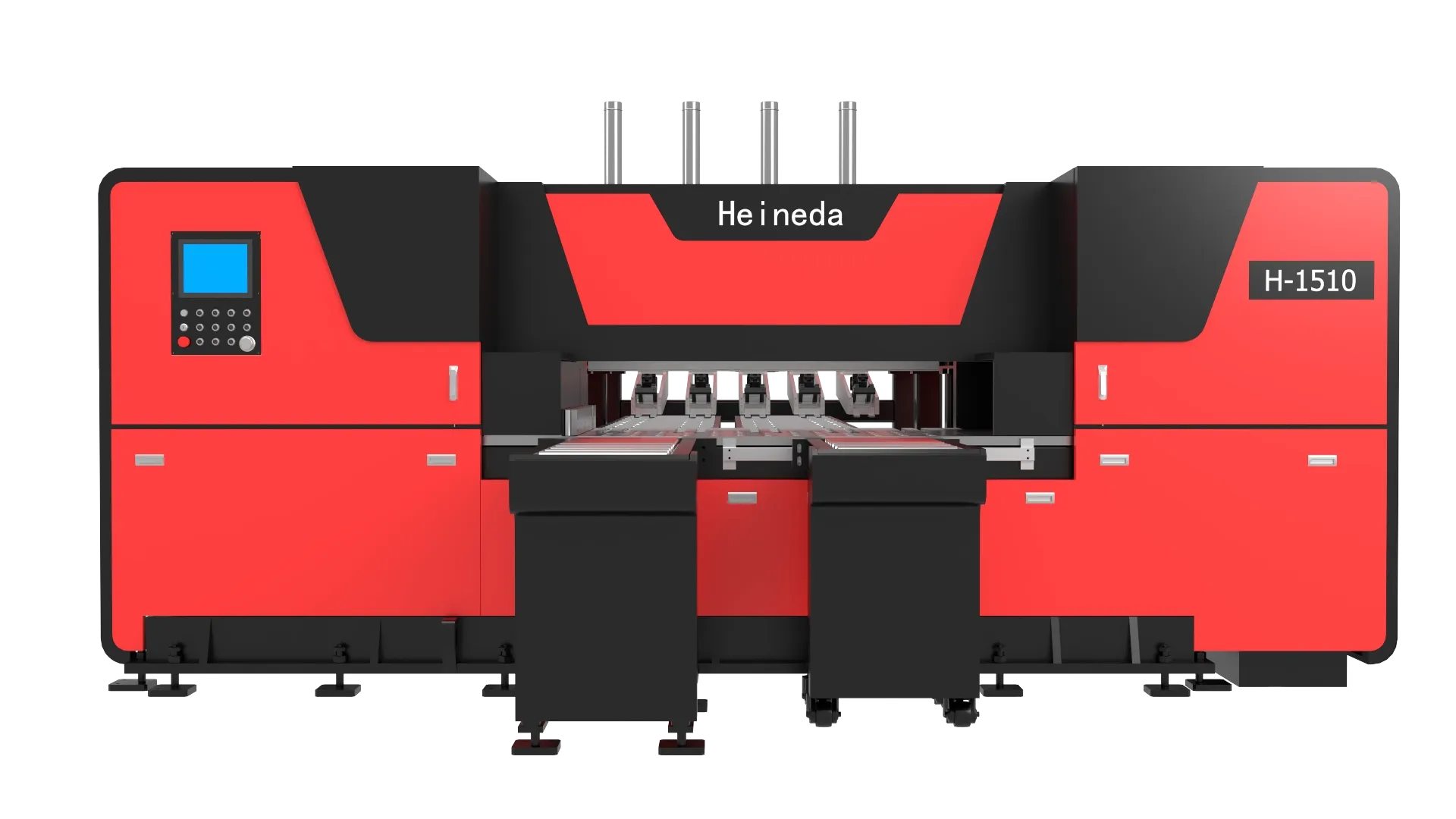
Cutting width is the maximum cross-section dimension a machine can sever in a single pass, and choosing a model that is even 1 mm under your largest workpiece forces manual repositioning, ruining cycle-time targets. On Heineda's CNC steel plate saw milling line the three model widths — 700 mm (H-710), 1500 mm (H-1510), and 2600 mm (H-2610) — map directly to plate service center tiers: small job shops, mid-volume steel distributors, and heavy-plate aerospace or mold shops respectively. For aluminum plate, the E-6 handles up to 1600 mm wide stock, the E-10 reaches 3000 mm, and the HL-12CNC tops out at 4000 mm × 4000 mm × 205 mm — a spec ceiling that satisfies virtually every structural aerospace panel format currently in production.
Minimum requirement by industry:
- Automotive body panels: 1500 mm minimum width
- Aerospace structural plate: 2600 mm or 3000 mm
- Mold steel blanks: 700–1500 mm depending on tonnage
- Aluminum extrusion billet: width is secondary; length and bundle diameter drive selection
How Feed Rate and Servo Accuracy Translate to Cycle Time
Feed rate is the linear speed at which the blade or cutter advances through the material, while servo accuracy is the positioning repeatability of the feed axis between cuts — and together they determine how many cuts per hour a machine actually delivers. On Heineda's CNC steel plate saw milling machines, full-auto Siemens servo feed achieves ±0.1 mm cut-to-cut accuracy, which is 5–10 times faster throughput than a conventional band saw operating on the same blanks. That gap matters most in aerospace and mold shops where a single titanium or age-hardened stainless plate may require 20–40 precision cuts per batch.
For automatic aluminum plate cutting, the CNC auto nesting software maximizes material yield before the first cut is made, which reduces total cycle time not by cutting faster but by eliminating re-setup between nested parts. The air-bearing work table eliminates surface drag, which in turn allows the 30 KW spindle to maintain consistent feed pressure across a 4000 mm × 4000 mm sheet without the surface scoring that interrupts inspection cycles.
Rule of thumb: For every 10% reduction in kerf width, you recover approximately 5–8% of material per ton at 80-ton daily throughput. Heineda's aluminum band saw holds kerf ≤2 mm — narrow enough to matter at scale.
Surface Finish Specifications and When They Gate Your Process
Surface finish is the measure of micro-texture roughness on a cut face, expressed as Ra (arithmetic mean roughness in micrometers), and it determines whether a cut part moves directly to the next operation or requires an intermediate grinding or milling step. Heineda's aluminum band saw delivers Ra < 25 μm — a finish clean enough to skip secondary deburring on most structural aluminum applications. For billet production lines, any rougher surface creates edge-crack initiation points during subsequent rolling or forging.
The CNC steel plate saw milling machine achieves a milling-grade cut face by combining a saw blade with a milling cutter in a single pass, removing the need for a separate face milling step on titanium alloy, high-temperature stainless, and age-hardened stainless workpieces. This spec effectively eliminates one full operation from the routing card.
Surface finish minimum requirements by application:
- Structural welding prep: Ra < 50 μm acceptable
- Aerospace bond-line surfaces: Ra < 25 μm required
- Mold parting faces before EDM: Ra < 25 μm, dimensional accuracy ±0.1 mm
- Aluminum billet for rolling: Ra < 25 μm, squareness ≤0.1 mm/100 mm
Automatic Sawing Machine Specifications: What "Fully Automatic" Actually Includes
Automatic sawing machine specifications describe more than motion control — fully automatic means the machine handles loading, positioning, cutting, unloading, and sometimes nesting without operator intervention between cycles. On Heineda's aluminum band saw, automation integration covers loading conveyors, cut-piece conveying, and unloading — enabling the 80-ton/day throughput figure without proportional labor scaling. On the fully automatic aluminum plate cutting machine, auto nesting optimization runs before the first cut, computing the highest-yield cut plan from the 4000 mm × 4000 mm stock sheet.
The dual-column 4-screw design on the aluminum band saw is a structural specification, not a marketing term: four screw columns constrain the cutting head in two planes simultaneously, which is why the squareness tolerance holds at ≤0.1 mm/100 mm even on thick round-bar bundle cuts where lateral forces are highest.
"If X → Choose Y" Decision Engine
| Your Requirement | Recommended Spec / Model |
|---|---|
| Aluminum billets, ≥50 tons/day | Aluminum Band Saw, dual-column, kerf ≤2 mm, Ra < 25 μm |
| Steel plate ≤700 mm wide, ±0.1 mm accuracy | H-710 (26 KW, Siemens servo) |
| Steel plate up to 1500 mm or 2600 mm wide | H-1510 or H-2610 (30 KW) |
| Titanium or age-hardened stainless, no secondary milling | CNC Steel Plate Saw Milling Machine (any H-series) |
| Aluminum plate up to 1600 mm wide | E-6 model |
| Aluminum plate up to 3000 mm wide | E-10 model |
| Aerospace / mold aluminum up to 4000 mm × 4000 mm × 205 mm | HL-12CNC |
| Surface-critical aerospace panel (Ra < 25 μm required) | Aluminum Band Saw or HL-12CNC with air-bearing table |
| Mixed alloy aluminum (1xxx–7xxx series) | Fully Automatic Aluminum Plate Cutting Machine |
Ready to match your production specs to the right machine? Heineda's engineering team reviews your cutting width, accuracy, and throughput targets and returns a model recommendation with cycle-time estimate — no obligation. Get a Quote →
FAQ
Q: What is a typical cutting accuracy for a CNC sawing machine? A: CNC sawing machine accuracy depends on the machine type and material. Heineda's CNC steel plate saw milling machines achieve ±0.1 mm — 5–10 times tighter than conventional band saws. Fully automatic aluminum plate cutting machines hold ±0.3 mm across sheets up to 4000 mm × 4000 mm. For squareness on aluminum billets, the aluminum band saw holds ≤0.1 mm per 100 mm of cut length.
Q: What does "servo feed" mean in CNC band saw machine specifications? A: Servo feed means the material feed axis is driven by a closed-loop servo motor rather than a hydraulic cylinder or manual advance. The servo motor receives position feedback every cycle, so cut-to-cut spacing is repeatable to the programmed tolerance — on Heineda H-series machines that is ±0.1 mm — without operator adjustment between cuts.
Q: How do I determine the right cutting width for my application? A: Measure your largest workpiece cross-section and add 10–15% for clamping clearance. Then match to model: H-710 for up to 700 mm, H-1510 for up to 1500 mm, H-2610 for up to 2600 mm in steel plate. For aluminum plate, E-6 covers 1600 mm, E-10 covers 3000 mm, and HL-12CNC covers 4000 mm. Never specify a machine at its rated maximum — run at 80–90% of rated width for consistent accuracy.
Q: What motor power is required for a CNC metal cutting machine handling titanium alloy? A: Titanium alloy and age-hardened stainless require higher spindle torque than structural steel. Heineda's H-710 runs 26 KW for widths up to 700 mm; the H-1510 and H-2610 step up to 30 KW for wider cuts and harder alloys. For aluminum, the fully automatic plate cutting machine also runs 30 KW, which handles all 1xxx–7xxx series alloys without spindle overload.
Q: What is kerf width and why does it matter in automatic sawing machine specifications? A: Kerf width is the material lost to the blade cut. A ≤2 mm kerf on Heineda's aluminum band saw means that on an 80-ton production day, less than 1.6% of input material becomes chips rather than sellable cut parts. At aluminum commodity prices, narrowing kerf from 3 mm to 2 mm on a 50-ton/day line recovers roughly half a ton of aluminum monthly.
Q: Can CNC sawing machines handle irregular profiles, not just flat plate? A: Yes. Heineda's aluminum band saw handles round bar bundles, irregular profiles, thick plate, and aluminum billets — not only rectangular stock. The dual-column 4-screw structure keeps the cutting head rigid regardless of workpiece geometry, maintaining the ≤0.1 mm/100 mm squareness spec across all profile types.
Q: What does "air-bearing work table" mean in CNC sawing machine specs? A: An air-bearing work table floats the workpiece on a thin film of compressed air, eliminating metal-on-metal friction during positioning. This protects the surface finish of aluminum plate — critical for aerospace panel applications where any surface scratch triggers inspection rejection — and allows the CNC axes to move large sheets (up to 4000 mm × 4000 mm) with low repositioning force.
If you remember one thing from this article: a CNC sawing machine specification sheet is a production contract — the cutting width, servo accuracy, and motor power numbers define your actual throughput ceiling, not a theoretical maximum, so match each spec to your largest, hardest workpiece before committing to a model.
Get the right spec for your production line. Share your workpiece dimensions, material, and daily volume with Heineda's engineers and receive a model-specific spec sheet with accuracy and cycle-time data. Request Your Spec Consultation →