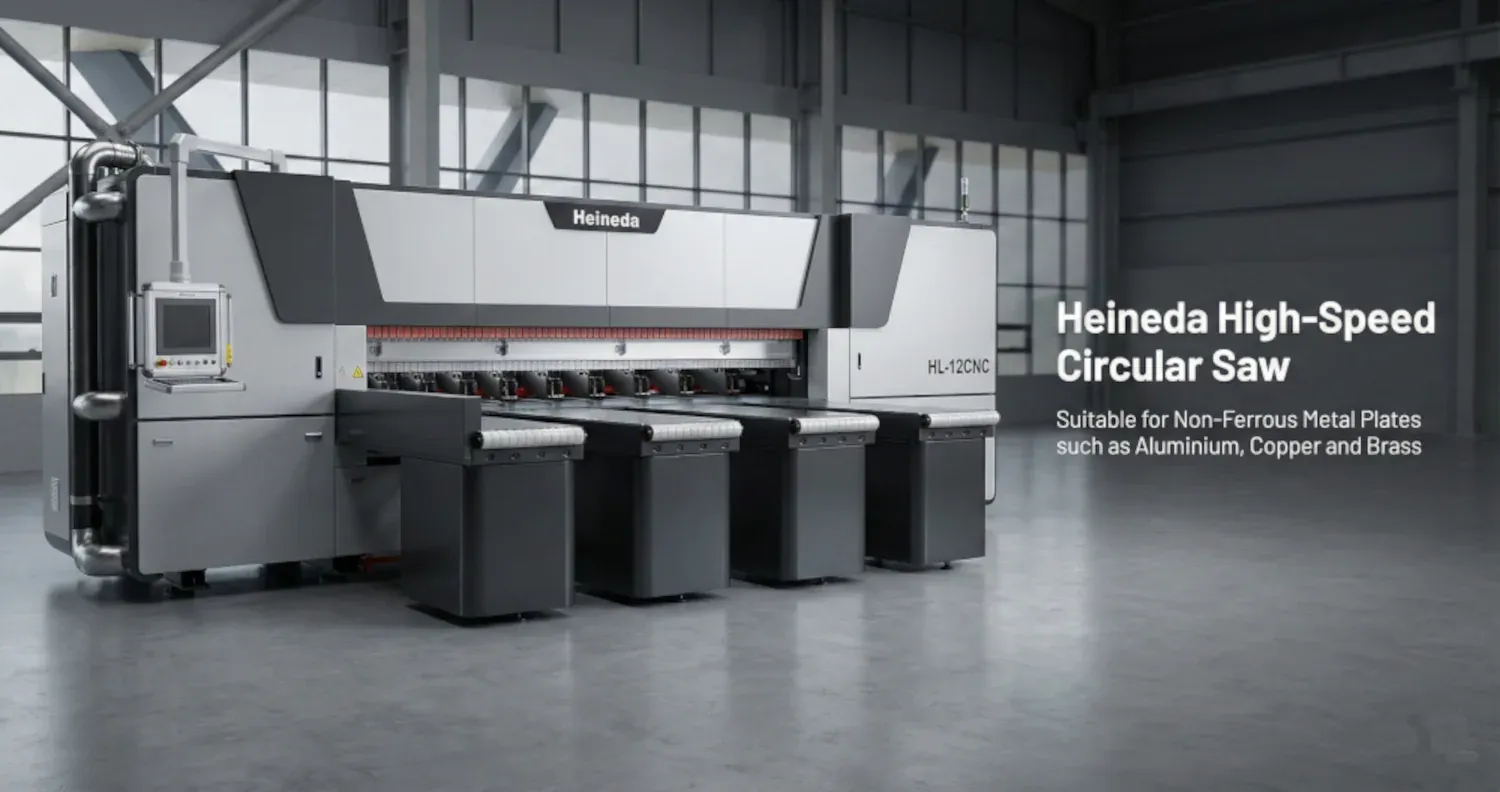
A CNC panel saw machine delivers programmable part programs and servo-driven positioning, reducing changeover time from 20–40 minutes to significantly shorter intervals per job — making it the right choice for shops running more than 15 distinct part numbers per shift.
Key Stats
| Metric | CNC Panel Saw Machine | Conventional Panel Saw |
|---|---|---|
| Cutting accuracy | ±0.3 mm(project-specific; subject to confirmed technical plan) (E-series) / ±0.1 mm(case reference) (H-series) | ±0.5–1.5 mm |
| Changeover time per job | Program-driven servo positioning | 20–40 min (manual fence reset) |
| Throughput advantage | Contact Heineda for throughput estimates based on your specific workpiece dimensions. | Baseline |
| Max workpiece (Heineda HL-12CNC) | 4000 mm × 4000 mm × 205 mm | Typically operator reach-limited |
| Motor power (Heineda E-10 / HL-12CNC) | 30 KW | 7–15 KW typical |
| Material yield improvement | available as a configurable option yield optimization | Manual layout, ~5–12% higher waste |
| Surface finish | — | Ra 50–100 μm typical |
| Kerf width | — | 3–5 mm typical |
What "CNC" Actually Changes on a Panel Saw
A CNC panel saw machine is a beam-type cutting center where all fence positions, backstop movements, and feed rates are driven by servo axes under program control rather than by manual wheel adjustments. The operator loads a cut list — or imports a nesting file — and the machine executes every dimension in sequence without pausing for measurement.
On a conventional panel saw, every dimension change requires the operator to loosen the fence lock, crank to a new position, read a tape or scale, and re-lock before the cut. That sequence takes 20–40 minutes across a mixed batch. On a CNC beam panel saw, the same 40-part variety run calls a stored program: the machine repositions via servo-driven axes, eliminating manual measurement variance.
The practical output difference is not marginal. At Heineda's installations in mold-making and aerospace supply chains, operators report that an automatic panel saw machine running CNC routines can process the same daily cut list in significantly fewer staffed hours compared to a conventional machine.
Accuracy and Why It Compounds
Accuracy on a CNC panel saw machine is a system property, not a one-time specification. Heineda's Fully Automatic Aluminum Plate Cutting Machine achieves ±0.3 mm(project-specific; subject to confirmed technical plan) across workpieces up to 4000 mm × 4000 mm × 205 mm, while the CNC Steel Plate Saw Milling series (H-710, H-1510, H-2610) holds ±0.1 mm(case reference) on steel, titanium alloy, and high-temperature stainless with Siemens control.
When accuracy compounds, it means each downstream operation inherits a tighter stack-up tolerance. A weld assembly built from ±0.1 mm blanks needs fewer shims and less rework than one built from ±1 mm blanks. For aerospace frames or aluminum structural panels, that stack-up difference is the margin between first-pass approval and a scrapped batch.
Conventional panel saws do not degrade in accuracy because the fence is crude — they degrade because the fence is reset by hand dozens of times per shift. Human repositioning variance of ±0.3–1 mm per reset is normal. The cnc panel cutter eliminates that variance source entirely through closed-loop servo feedback.
Programming Complexity: Realistic Learning Curve
Programming complexity is the most cited barrier to CNC panel saw adoption, and it is consistently overstated. Heineda's H-series panel cutting machines use a Siemens control system with full-auto servo feed. For the aluminum plate cutting series, CNC control systems are matched to application needs at the project stage. Cut programs can be entered as simple dimension tables — no G-code authorship required at the operator level.
A typical operator trained on a conventional beam saw learns basic CNC program entry in 1–3 days. Material yield optimization — where the machine calculates the most efficient cut sequence from a sheet to minimize offcuts — can be configured as a module option per project scope. The operator inputs stock size and required part dimensions; the machine outputs the cut sequence.
The real programming complexity surfaces at the supervisor level: maintaining a part library, setting kerf compensation, and integrating with upstream CAD/CAM. For job shops cutting fewer than 8–10 distinct part numbers per day, a conventional panel saw may be sufficient. For plate service centers, mold shops, or aerospace suppliers running 30–100 part numbers daily, the cnc beam panel saw eliminates the cognitive overhead of manual fence management entirely.
ROI Threshold by Production Volume
ROI threshold is the production volume at which the annual cost savings from a CNC panel saw machine exceed the financing cost of the price premium over a conventional machine. The threshold depends on three variables: labor cost per hour, number of setups per shift, and scrap rate.
A rough framework:
| Daily Setups (distinct part dimensions) | Conventional Panel Saw Viable? | CNC Panel Saw Machine ROI |
|---|---|---|
| < 8 | Yes — manual changeover cost is low | Payback > 4 years, low justification |
| 8–20 | Borderline — operator fatigue and error rate climb | Payback typically 2–3 years |
| 20–50 | No — changeover time consumes 30–50% of shift | Payback 12–18 months |
| > 50 | No — conventional machine becomes the bottleneck | Payback < 12 months; downtime cost dominates |
Material savings add a parallel ROI track. Heineda's material yield optimization features(available as a configurable option on E-6, E-10, and HL-12CNC models) reduce sheet waste. On high-value aerospace aluminum, minimizing scrap losses at the sawing stage provides meaningful annual savings.
If X → Choose Y: Decision Engine
| Your Situation | Recommended Choice |
|---|---|
| Cutting < 8 part numbers/day, low mix | Conventional panel saw — CNC payback too slow |
| Cutting 8–20 parts/day, labor cost pressure | Automatic panel saw machine — ROI in 2–3 years |
| Cutting > 20 parts/day, mixed batch | CNC panel saw machine — clear ROI under 18 months |
| Aerospace or mold tolerances required (±0.1 mm) | CNC panel cutter — (case reference), configured per project |
| Aluminum sheet up to 4000 × 4000 × 205 mm | Heineda HL-12CNC (beam saw CNC, 4000 mm capacity) |
| Steel, titanium, or high-temp stainless, up to 2600 mm wide | Heineda H-2610 CNC Saw Milling Machine(Siemens control) |
| Want to add robotic loading/unloading | CNC panel saw machine — available as a configurable option automation |
| High surface finish requirement | Heineda CNC aluminum line — available as a series option per project configuration (air-floating work table) |
Get a Quote for the Right CNC Panel Saw Machine
Heineda engineers can review your cut list, material spec, and daily volume to recommend the right model — E-6, E-10, HL-12CNC for aluminum, or H-710/H-1510/H-2610 for steel and hard alloys.
Get a Quote → heinedasaw.com/contact
Include workpiece dimensions, material grade, and daily cut volume for the fastest response.
FAQ
Q: What is the difference between a CNC panel saw machine and a beam saw CNC? A: The terms refer to the same machine category. A beam saw CNC or cnc beam panel saw positions the cutting head along a fixed beam above the workpiece; "panel saw" describes the workpiece format (large flat sheets or panels). CNC simply means the fence and feed movements are servo-controlled by a program rather than set manually. Heineda's HL-12CNC is a beam-type CNC panel saw handling sheets up to 4000 mm × 4000 mm.
Q: How accurate is a CNC panel saw machine compared to a manual one? A: Heineda's CNC steel plate saw milling machines hold ±0.1 mm(case reference) with Siemens control; the fully automatic aluminum plate cutting line holds ±0.3 mm(project-specific; subject to confirmed technical plan) across 4-meter sheets. A well-maintained manual panel saw typically achieves ±0.5–1.5 mm depending on fence design and operator skill. The CNC advantage is consistency — it holds its specified tolerance on the 500th cut the same as the first.
Q: What materials can a CNC panel saw machine cut? A: Depending on the model: aluminum alloys (1xxx–7xxx series), structural steel, titanium alloy, high-temperature stainless steel, and age-hardened stainless. Heineda's H-710/H-1510/H-2610 CNC saw milling series is specifically rated for titanium and high-temp alloys used in aerospace and mold making.
Q: How long does it take to learn to program a CNC panel saw machine? A: On Heineda's CNC-controlled machines, most operators trained on conventional saws learn basic program entry in 1–3 days. Material yield optimization can be configured as a module option per project — the operator enters part dimensions and the machine generates the cut sequence. Advanced features like kerf compensation and CAD/CAM integration typically require 1–2 weeks of supervised operation.
Q: What production volume justifies a CNC panel saw machine over a conventional one? A: The break-even point is generally around 15–20 distinct part dimensions per shift. Below that threshold, manual changeover cost is manageable. Above 20 setups per shift, CNC changeover time savings (< 3 min vs. 20–40 min per setup) typically deliver payback within 12–18 months. At > 50 setups per shift, the conventional machine becomes the production bottleneck regardless of cost.
Q: Can a CNC panel saw machine integrate with robotic loading systems? A: Yes. Heineda's automatic panel saw machines support automation integration including loading, conveying, and unloading systems. This is particularly relevant for plate service centers and high-volume aluminum processing lines where full lights-out operation is the target.
Q: What is the maximum sheet size a CNC panel saw machine can handle? A: Heineda's HL-12CNC model handles workpieces up to 4000 mm × 4000 mm × 205 mm, making it suitable for aerospace structural panels and large mold blanks. The E-6 handles up to 1600 mm wide and the E-10 up to 3000 mm wide. For steel and hard alloys, the H-2610 accommodates workpieces up to 2600 mm wide.
If you remember one thing from this article: a CNC panel saw machine pays for itself through changeover time savings — not cutting speed — and the ROI case becomes clear once you run more than 20 distinct dimensions per shift.
Talk to a Heineda Panel Saw Engineer
Send your cut list and material spec. Heineda's team will confirm which model fits your volume, material, and accuracy requirements — and provide a specification proposal within one business day.
Request a Quote → heinedasaw.com/contact