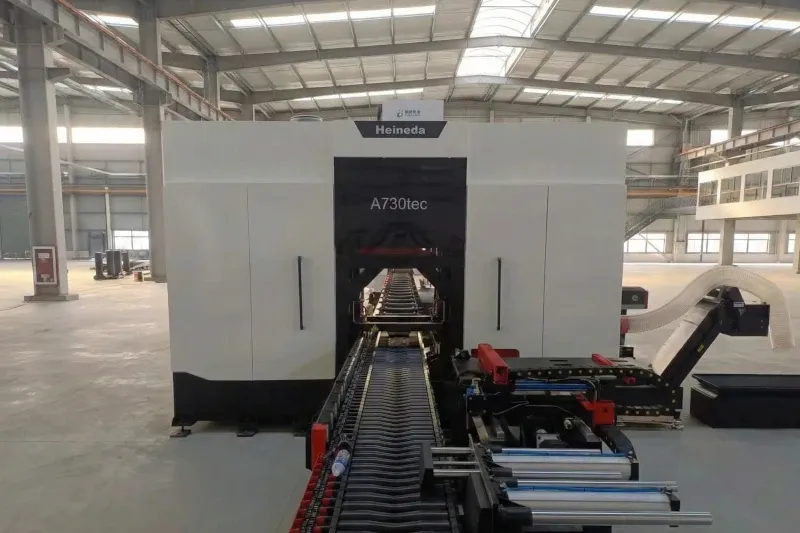
A CNC band saw is a computer-numerically-controlled cutting machine that uses a continuous toothed blade guided by servo motors and a programmable controller to deliver repeatable, high-accuracy cuts on metal stock — replacing manual feed adjustments with closed-loop automation that holds tolerance across an entire production shift.
Key Stats at a Glance
| Metric | Value | Source Machine |
|---|---|---|
| Cutting accuracy | ±0.1 mm (stated) | CNC Steel Plate Saw-Milling (H-series) |
| Cutting squareness | ≤0.1 mm / 100 mm | Aluminum Band Saw |
| Surface finish | Ra < 25 μm | Aluminum Band Saw |
| Kerf width | ≤2 mm | Aluminum Band Saw |
| Throughput | Contact Heineda for throughput estimates based on your specific material and production setup. | — |
| Speed advantage | Contact Heineda for cycle-time comparison data relevant to your workpiece dimensions. | — |
| Motor power | 26–30 KW | H-710 / H-1510 / H-2610 |
How a CNC Band Saw Works
A CNC band saw machine integrates four subsystems that operate in concert: the blade drive, the servo feed unit, the CNC controller, and the work-holding fixture.
The blade runs in a continuous loop between two or more guide wheels. Drive motor speed sets surface feet per minute (SFM), which the controller matches to material hardness. The servo feed unit advances the workpiece — or lowers the bow in a horizontal machine — at a rate calculated from the programmed cutting parameters. The CNC controller stores part programs, monitors torque feedback, and adjusts feed rate in real time to protect blade life. Work-holding uses hydraulic or pneumatic vises that clamp automatically before each cut, eliminating the manual clamping step that dominates cycle time on conventional saws.
The result: the operator loads a part program, places stock in the infeed magazine, and the machine runs unattended through a full batch.
Production Metrics a Metal Cutting Shop Should Track
Evaluating a CNC band saw requires measuring four categories of output before and after adoption.
Throughput is the primary metric. Automated CNC band saw lines can support continuous production — throughput depends on infeed configuration, blade selection, and conveyor integration. On steel plate work, the H-series CNC saw-milling machines are engineered for high-efficiency cycle times on the same cross-section.
Dimensional accuracy determines downstream scrap rate. The H-series holds ±0.1 mm accuracy under stated reference conditions. Cutting squareness of ≤0.1 mm/100 mm means parts enter the next process square, reducing fixturing rework.
Surface finish affects whether parts need deburring. A stated Ra < 25 μm finish from the saw is designed to be acceptable for structural aluminum billets and many mold blanks without additional face milling.
Material yield is where kerf width matters. A ≤2 mm kerf on aluminum billet work saves material compared with wider-kerf alternatives, which compounds across high-volume runs.
Choosing Between a CNC Horizontal Band Saw and a CNC Saw-Milling Machine
The two main cnc band saw configurations serve different workpieces, and selecting the wrong type is the most common specification error.
| If your work is... | Choose... | Reason |
|---|---|---|
| Round bar, tube, billet bundles | CNC horizontal band saw | Gravity feed, high-volume throughput, minimal footprint |
| Flat plate up to 2600 mm wide | CNC steel plate saw-milling machine | Wide-format capacity, ±0.1 mm over full width |
| Aluminum alloy plate (1xxx–7xxx) | Fully automatic aluminum plate cutting machine | Air-bearing table protects surface; auto nesting maximizes yield |
| Titanium, high-temp stainless, age-hardened steel | H-series saw-milling (30 KW) | High-torque motor handles hard materials without blade stall |
| Mixed batch, irregular profiles | CNC band saw with automation integration | Programmable vise spacing handles variable cross-sections |
The H-710 covers plates up to 700 mm wide; the H-1510 extends to 1500 mm; the H-2610 handles 2600 mm. All three hold ±0.1 mm and accept the Siemens control system, so part programs transfer between models without re-posting.
Automation Integration: What "Full CNC" Actually Means
CNC band saw automation spans a spectrum, and the label "CNC" alone does not specify the automation level.
At the minimum level, CNC means programmable feed rate and cut count — the operator still loads and unloads each piece. At the mid level, a servo-driven infeed magazine and auto-clamp handle unattended batch cutting. At the full level — as implemented on Heineda's aluminum billet line — the machine integrates with upstream loading conveyors and downstream unloading robots, runs a full shift without operator intervention, and logs cut data to an MES. The light curtain safety system halts the machine automatically if a person enters the work envelope, providing operator protection without hard guarding that limits access.
Shops evaluating a cnc band saw for sale should specify the required automation level upfront: it drives footprint, electrical demand (26–30 KW main motor plus conveyor drives), and integration scope with existing material handling.
Decision Engine: Which CNC Band Saw Fits Your Shop?
| Condition | Recommended configuration |
|---|---|
| Aluminum billet, >40 tons/day | Aluminum Band Saw with full automation (loading + conveying + unloading) |
| Steel / titanium plate, width ≤700 mm | H-710 CNC Saw-Milling Machine (26 KW) |
| Steel / titanium plate, 700–1500 mm | H-1510 CNC Saw-Milling Machine (30 KW) |
| Steel / titanium plate, 1500–2600 mm | H-2610 CNC Saw-Milling Machine (30 KW) |
| Aluminum plate up to 4000 × 4000 mm | HL-12CNC Fully Automatic Aluminum Plate Cutter |
| Aerospace / mold: surface finish critical | Aluminum Band Saw (Ra < 25 μm) or H-series (±0.1 mm) |
| Budget / smaller shop, plate ≤1600 mm | E-6 Fully Automatic Aluminum Plate Cutter |
Get a Quote for Your CNC Band Saw Application
Heineda engineers can configure the blade, feed rate, and automation level to your specific material and throughput target.
Request a CNC Band Saw Quote →
Contact: sales@heinedasaw.com
FAQ
Q: What is the difference between a CNC band saw and a conventional band saw? A: A conventional band saw requires the operator to set feed rate manually and monitor blade load throughout each cut. A CNC band saw machine stores cut parameters in a program, drives feed with a closed-loop servo, and adjusts automatically — delivering consistent ±0.1 mm accuracy across a full batch without operator intervention.
Q: How fast is a CNC band saw compared with a traditional saw? A: The H-series CNC saw-milling machines are engineered for high-efficiency cutting on steel plate — servo feed eliminates conservative manual feed rates and the machine does not pause between cuts, enabling faster cycle times than a conventional band saw on the same cross-section.
Q: What accuracy can I expect from a CNC band saw cutting machine? A: The H-series machines hold ±0.1 mm on steel, titanium, and stainless plate. The aluminum band saw holds cutting squareness of ≤0.1 mm/100 mm with a surface finish of Ra < 25 μm. These numbers come from the machine specifications, not marketing estimates.
Q: Can a CNC horizontal band saw handle titanium and high-temperature alloys? A: Yes. The H-1510 and H-2610 use 30 KW motors specifically sized for titanium alloy, high-temperature stainless, and age-hardened stainless. The Siemens control system monitors torque and can reduce feed automatically to protect the blade when cutting harder material.
Q: What does "cnc band saw for sale" typically include in terms of automation? A: Listings vary. Entry-level machines include CNC feed rate control only. Mid-range machines add servo infeed magazines and auto-clamping. Full production systems — like Heineda's aluminum billet line — integrate upstream loading and downstream unloading conveyors, light curtain safety, and MES data logging. Specify your required automation level before comparing prices.
Q: How wide a plate can a CNC band saw cutting machine handle? A: Heineda's H-series covers up to 2600 mm wide with the H-2610 model. For aluminum plate, the HL-12CNC handles workpieces up to 4000 mm × 4000 mm × 205 mm. Both lines hold ±0.1 mm or ±0.3 mm accuracy respectively (stated under reference conditions).
Q: What is the kerf width on a CNC band saw? A: The aluminum band saw produces a kerf of ≤2 mm. Narrower kerf directly reduces material waste — on high-value aluminum billet, each millimeter saved per cut compounds significantly across high-volume production.
If you remember one thing about a CNC band saw: the machine's accuracy (±0.1 mm for H-series under stated conditions), throughput, and surface finish (Ra < 25 μm) are only achievable when the automation level — from servo feed to full conveyor integration — is matched to your actual production volume and material type before the purchase order is placed.
Talk to a CNC Band Saw Engineer
Heineda's application team can match blade specification, automation level, and machine model to your throughput target and material mix.
Jiangsu Heineda Sawing Machinery Co., Ltd. | heinedasaw.com | sales@heinedasaw.com