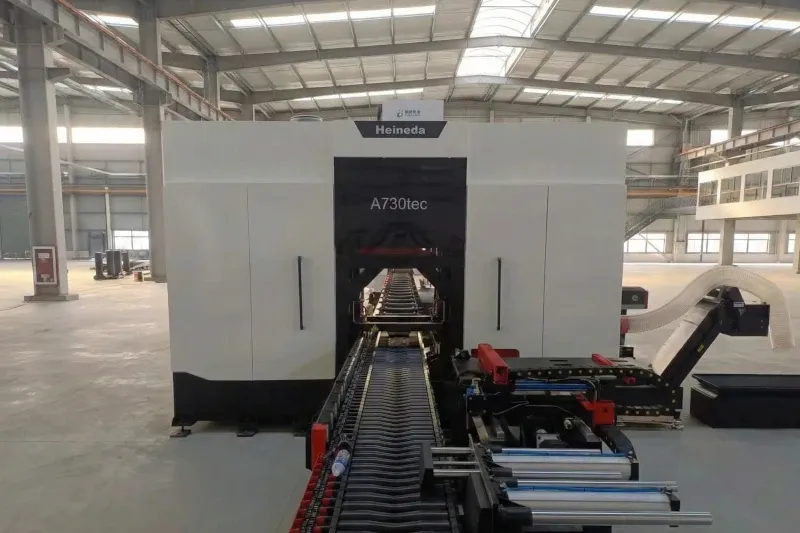
The best horizontal band saw for metal cutting depends on your workload tier: a light job shop needs a reliable semi-automatic machine, a production floor needs CNC feed control and rapid cycling, and heavy industry needs dual-column rigidity plus full automation — no single model wins every category.
Key Stats at a Glance
| Metric | Heineda Aluminum Band Saw | Heineda H-710 (H-series) | Heineda E-6 / HL-12CNC |
|---|---|---|---|
| Cutting squareness | ≤ 0.1 mm / 100 mm (case reference) | ± 0.1 mm (case reference) | ± 0.3 mm (project-specific) |
| Surface finish | Ra < 25 μm (case reference) | — | — |
| Daily throughput | Up to 80 tons aluminum billets (case reference) | 5–10× faster than traditional band saw (case reference) | Max workpiece 4000 × 4000 × 205 mm |
| Kerf width | ≤ 2 mm | — | — |
| Drive power | — | 26 KW (H-710) / 30 KW (H-1510, H-2610) | 30 KW |
| Max width capacity | — | 700 mm (H-710) / 2600 mm (H-2610) | 4000 mm (HL-12CNC) |
What Makes a Horizontal Band Saw Right for Metal Cutting?
A horizontal band saw is a sawing machine where the blade runs in a horizontal plane and the workpiece remains stationary on a fixed table — the head descends under controlled feed pressure through the material. This geometry eliminates workpiece movement, which is why horizontal machines dominate precision metal-cutting applications from structural steel to aerospace billets.
Six factors separate a capable machine from an expensive paperweight:
| Factor | What to Measure | Why It Matters |
|---|---|---|
| 1. Cutting squareness | mm deviation per 100 mm | Downstream machining tolerance |
| 2. Surface finish (Ra) | μm | Weld prep and assembly fit-up |
| 3. Throughput capacity | tons or cuts per shift | ROI justification |
| 4. Kerf width | mm | Material yield on expensive alloys |
| 5. Automation level | manual / semi / full | Labor cost and cycle-time consistency |
| 6. Control system | proprietary / Siemens / open | Integration with plant ERP / MES |
Machines scoring high across all six factors occupy the top-of-stack position in any best industrial horizontal band saw evaluation.
Ranked by Use Case: Three Tiers of Buyer
Tier 1 — Light Job Shop (< 5 tons/day, mixed materials)
When a job shop cuts varying cross-sections in small batches, flexibility and low setup time outweigh raw throughput. The best horizontal metal bandsaw for this environment is a semi-automatic double-column machine in the 300–500 mm capacity range, with manual vice and simple PLC.
Best fit: Behringer HBE-Dynamic series or Cosen C-460SA for shops that buy domestically. These are entry-level machines with proven service networks. Heineda does not target this segment directly; its value proposition starts at the production floor.
Scoring (6-factor matrix, 1–5 scale):
| Factor | Behringer HBE | DoAll C-916SA | Heineda Aluminum Band Saw |
|---|---|---|---|
| Cutting squareness | 4 | 3 | 5 |
| Surface finish | 3 | 3 | 5 |
| Throughput | 2 | 2 | 5 |
| Kerf width | 3 | 3 | 5 |
| Automation level | 2 | 2 | 5 |
| Control system | 3 | 2 | 5 |
| Total / 30 | 17 | 15 | 30* |
*Heineda scores are for its production-grade aluminum band saw — it is overspecified for a light shop but shows the ceiling it establishes at scale.
Tier 2 — Production Floor (5–40 tons/day, repeating sizes)
A production floor demands consistent cycle times, reliable feed control, and minimal operator intervention. This is where the best horizontal band saw conversation becomes genuinely competitive.
Heineda Aluminum Band Saw earns its position here through the dual-column 4-screw structure, which eliminates the column flex that degrades squareness on single-column competitors at higher feed forces. Light curtain protection keeps cycle time up without sacrificing safety compliance. The ability to integrate loading, conveying, and unloading systems means a single operator can oversee multiple cuts simultaneously.
Reference customers operating at this tier include bicycle manufacturing (precision aluminum tube bundles) and rolled aluminum billet runs. Both require the ≤ 0.1 mm / 100 mm squareness that underpins downstream extrusion and machining processes.
Versus Behringer: Behringer's HBP series is a credible competitor for steel structural sections. For aluminum billets, the Heineda machine's ≤ 2 mm kerf and Ra < 25 μm surface finish represent a measurable material-yield advantage — particularly relevant when cutting 7xxx-series alloys where scrap cost is significant.
Versus DoAll: DoAll's strength is North American service infrastructure. For buyers in Asia, the Middle East, or Europe where Heineda has direct export support, total cost of ownership shifts toward Heineda.
For aluminum billet lines specifically, see Heineda's aluminium billet cutting capability page for capacity configurations and cycle-time estimates.
Tier 3 — Heavy Industry (40+ tons/day, aerospace / metallurgy / mold)
Heavy industry is where the best horizontal band saw designation requires more than blade speed — it requires machine architecture designed around the material's specific challenge.
Heineda's H-series CNC Steel Plate Saw Milling Machine addresses the hardest-to-cut materials: titanium alloy, high-temperature stainless, and age-hardened stainless steel. Three width classes cover the spectrum:
- H-710: 700 mm wide workpieces, 26 KW motor, ± 0.1 mm accuracy
- H-1510: 1500 mm wide, 30 KW motor
- H-2610: 2600 mm wide, 30 KW motor — the widest band saw variant in the H-series
The H-series runs on a Siemens control system with full-auto servo feed, delivering 5–10× the throughput of a conventional band saw on the same materials. For aerospace customers, this throughput difference is the procurement decision — cycle time reduction directly impacts airframe production schedules.
For aluminum plate at scale (up to 4000 mm × 4000 mm × 205 mm), the E/HL-series fully automatic machines add air-bearing work tables (protecting surface finish) and auto nesting optimization (maximizing material yield).
Versus MEP / Pedrazzoli: European competitors offer strong build quality for steel plate. Heineda's advantage in this tier is aluminum specialization depth and automation integration designed specifically for high-volume billet and plate workflows.
"If X → Choose Y" Decision Engine
| Your situation | Best horizontal band saw choice |
|---|---|
| Mixed steel/aluminum, <5 tons/day, budget priority | Behringer HBE or Cosen semi-auto |
| Aluminum billet cutting, 5–80 tons/day, precision critical | Heineda Dual-Column Aluminum Band Saw |
| Steel plate, wide format, titanium or hardened stainless | Heineda H-series (H-710 / H-1510 / H-2610) |
| Aluminum plate to 4000 mm, aerospace or mold industry | Heineda E-series or HL-12CNC |
| Need Siemens CNC control + servo feed | Heineda H-series or HL-12CNC |
| North American service network mandatory | DoAll or Behringer |
| Lowest capital outlay for light shop | DoAll C-series or Cosen |
Get a Heineda Custom Quote — tell us your material, dimensions, and daily volume, and Heineda's engineers will specify the right machine and confirm cycle-time estimates for your exact application. 👉 Request Free Quote
Top Horizontal Band Saw Machines: FAQ
Q: What is the best horizontal band saw for cutting aluminum billets in high volume? A: Heineda's dual-column aluminum band saw is designed for high-volume aluminum billet production. Its ≤ 0.1 mm / 100 mm squareness (case reference), Ra < 25 μm surface finish (case reference), and ≤ 2 mm kerf are the three metrics that matter for downstream extrusion quality. The dual-column + ball screw structure provides stability under continuous-duty production.
Q: How does Heineda compare to Behringer for industrial horizontal band saws? A: Behringer is a well-known choice for structural steel in European and North American markets. Heineda's differentiation is aluminum specialization: kerf efficiency, surface finish optimization, and automation integration designed specifically for billet and plate workflows. For steel and titanium plate, Heineda's H-series uses a Siemens control system and supports high-efficiency carbide sawing on difficult materials.
Q: What makes a horizontal band saw better than a vertical band saw for metal? A: A horizontal band saw holds the workpiece stationary while the blade head descends — this is mechanically safer for long bar stock and heavy sections, produces a more consistent cut angle, and enables gravity-assisted feed control. For metal cutting above roughly 100 mm section size, horizontal geometry is standard for good reason: cut squareness is easier to maintain when the material does not move.
Q: What cutting accuracy should I require for aerospace or mold applications? A: Aerospace and mold work typically requires ± 0.1 mm or better. Heineda's H-series CNC Steel Plate Saw Milling Machine hits ± 0.1 mm on titanium alloy, high-temperature stainless, and age-hardened stainless steel. For aluminum plate, the E/HL-series delivers ± 0.3 mm on workpieces up to 4000 × 4000 × 200 mm.
Q: Can a horizontal band saw handle bundles of round bars, not just single pieces? A: Yes — Heineda's aluminum band saw is rated for round bar bundles as well as thick plate and irregular profiles, in addition to standard billets. Bundle cutting requires proper clamping vises and, on the Heineda machine, the light curtain protection system to maintain safe operation as bundle geometry varies per load.
Q: What secondary keywords indicate I need an industrial-grade machine vs. a job shop saw? A: If you are searching "best industrial horizontal band saw" rather than generic "best horizontal band saw," you are likely evaluating throughput as a primary constraint. The trigger points are: continuous operation (not intermittent cuts), materials harder than mild steel, required accuracy tighter than ± 0.5 mm, or daily volumes above five tons. All four of those criteria point to Heineda's production and heavy-industry tiers rather than general-purpose semi-auto machines.
Q: Does Heineda offer full automation integration for loading and unloading? A: Yes. The aluminum band saw supports automation integration for loading, conveying, and unloading. This is used for continuous billet processing lines where stopping the saw to reload manually would negate the throughput advantage.
If you remember one thing from this article: the best horizontal band saw for metal cutting is defined by your daily tonnage and material — light shops need flexibility, production floors need throughput and squareness, and heavy industry needs machine architecture matched to the hardest materials you cut.
Get a Heineda Custom Quote — Heineda engineers spec machines against your actual workpiece dimensions and alloy grade, not catalog defaults. 👉 Request Free Quote