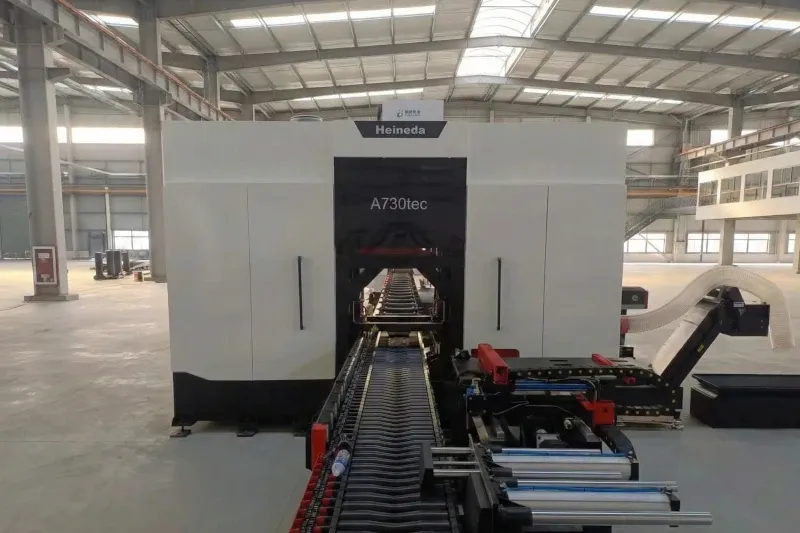
A band saw uses a continuous loop blade running at low speed to produce narrow, precise cuts with minimal heat, while a circular saw uses a rotating disc blade running at high speed to cut quickly — but with a wider kerf, more noise, and higher material waste.
Key Performance Comparison
| Metric | Band Saw | Circular Saw |
|---|---|---|
| Kerf width | ≤2 mm | 3–6 mm (typical cold saw) |
| Cutting squareness | ≤0.1 mm/100 mm | 0.2–0.5 mm/100 mm |
| Surface finish (Ra) | < 25 μm (no secondary op needed) | 40–80 μm (often needs deburring) |
| Daily throughput (aluminum billets) | Up to 80 tons/day | 30–50 tons/day (blade wear limits) |
| Motor power (industrial models) | 30–55 KW | 26–30 KW |
| Blade life | Long (low heat, continuous loop) | Short (high friction, segment wear) |
What Is Tooth Geometry and Why It Changes Everything
Tooth geometry is the shape, pitch, and rake angle of the teeth on a saw blade, and it directly controls heat generation, chip evacuation, and surface quality on the cut face.
Band saw blades use a variable-pitch tooth geometry — alternating tooth heights evacuate chips continuously from the kerf so heat never accumulates at the cut zone. The rake angle is typically positive (5–12°), which shears metal rather than scraping it. This geometry is why a band saw can hold ≤0.1 mm/100 mm squareness on aluminum billets without coolant flooding.
Circular saw blades — including cold saw discs and carbide-tipped blades — use a fixed-pitch geometry with flat or alternating top bevel (ATB) teeth. The rotating disc geometry produces a short, interrupted cut stroke on each tooth, generating more heat per pass and depositing that heat into the workpiece. For materials like titanium alloy, high-temperature stainless, or age-hardened stainless steel, this heat buildup is not acceptable and causes work hardening at the cut edge.
How Kerf Width Affects Material Waste at Scale
When cutting production volumes, kerf width is a direct line item in your material cost, and a 1 mm difference compounds across thousands of cuts.
A band saw running a ≤2 mm kerf on aluminum billet removes only 2 mm of material per cut. At 80 tons per day throughput, reducing kerf from a 4 mm circular saw to a 2 mm band saw saves roughly 2 mm × (number of cuts) of billet length per shift. Across a billet production line supplying a downstream extrusion press, that difference adds up to measurable recovered material each month.
For plate cutting operations, this effect is amplified. On a 4,000 × 4,000 mm aluminum plate, nesting optimization software combined with a narrow-kerf band saw preserves more usable area per sheet. Heineda's fully automatic aluminum plate cutting machines use onboard auto-nesting to maximize material yield — a critical factor for aerospace and mold manufacturing customers sourcing 2xxx or 7xxx alloy plate.
Speed, Noise, and Operator Safety
Speed and noise are two dimensions where band saw and circular saw diverge sharply, and both affect the total cost of ownership in ways that don't appear in the purchase price.
Cutting speed: Circular saws are faster on thin sections. A cold saw cutting 50 mm round bar in mild steel completes the stroke in seconds. Band saws running the same bar diameter at low blade speed take longer per piece — but that speed gap narrows significantly on thick sections, bundles, and non-round profiles where the continuous loop blade geometry maintains chip load evenly across the profile.
Noise: Circular saw blades generate tonal noise from the rotating disc — typically 90–100 dB at the machine. Band saws run quieter (75–85 dB) because the blade moves in a single direction without the resonance of a spinning disc. Heineda's aluminum band saw integrates a light curtain protection system that allows the machine to run within open production cells without full enclosures, which is not possible with unguarded circular saws.
Vibration and workpiece damage: The impact geometry of circular saw teeth creates micro-vibration that can crack brittle profiles or loosen fixtures on thin-wall sections. Band saws apply a consistent downward cutting force with negligible vibration, protecting surface finish on finished aluminum extrusions.
Maintenance Cost Over a Production Year
Maintenance cost for a metal cutting saw includes blade consumables, spindle/bearing replacement, coolant system upkeep, and unplanned downtime — and the balance shifts significantly between band and circular designs.
Circular cold saws require dedicated saw blades that are regrindable but wear faster on abrasive alloys (titanium, stainless, hardened tool steel). Regrinding services add lead time; blade inventory ties up capital. The motor runs at high RPM continuously, loading bearings and increasing seal wear rates.
Band saws consume blade coil stock, which is purchased in bulk and welded to length in-house or supplied as pre-welded loops. The blade runs at low speed, reducing heat stress on the drive components. The dual-column 4-screw structure on Heineda's aluminum band saw maintains frame rigidity over years of production without bed deflection — a common failure mode on single-column circular saw frames under high feed force.
For heavy-industrial operations running two or three shifts, the lower consumable cost and longer component service intervals of a band saw reduce total cost of ownership compared to circular saw alternatives at equivalent throughput.
Decision Matrix: Band Saw vs Circular Saw by Use Case
| Scenario | Recommended Saw | Reason |
|---|---|---|
| Aluminum billet cutting, high volume | Band saw | Narrow kerf, 80 t/day capacity, automation-ready |
| Thin mild steel bar, high speed required | Circular (cold saw) | Faster cycle time on small cross-section |
| Titanium alloy or hardened stainless plate | Band saw (CNC) | Low heat, no work hardening at cut edge |
| Irregular profiles, bundle cutting | Band saw | Continuous blade adapts to profile geometry |
| Mold plate blanking (2600 mm wide) | CNC band saw / saw milling | ±0.1 mm accuracy, handles thick plate to 100 mm |
| Short run, job shop, mixed materials | Circular (semi-auto) | Lower capital cost, acceptable precision for one-offs |
| Aerospace-grade aluminum plate nesting | Automatic aluminum plate saw | Auto nesting maximizes yield |
| Noise-sensitive open production cell | Band saw | 75–85 dB vs 90–100 dB circular; light curtain safe |
Get a Quote for Your Cutting Application Heineda builds band saws for aluminum billet, steel plate, and precision alloy cutting. Tell us your material, cross-section, and daily volume — we'll recommend the right model. Request a Quote → heinedasaw.com/contact?utm_source=blog&utm_medium=organic&utm_campaign=seo-band-saw-vs-circular-saw&utm_content=cta-mid
FAQ
Q: What is the main difference between a band saw and a circular saw for metal cutting? A: A band saw uses a continuous loop blade at low speed for narrow kerf (≤2 mm), low heat, and high squareness (≤0.1 mm/100 mm). A circular saw uses a rotating disc at high speed for faster cycle times on thin sections but with wider kerf (3–6 mm), more heat, and higher noise.
Q: Which saw produces less material waste — band saw or circular saw? A: A band saw produces less waste. The ≤2 mm kerf from an industrial band saw removes roughly half the material that a 4 mm cold saw disc would remove per cut. On high-volume billet or plate cutting operations this difference compounds into measurable material savings per shift.
Q: Can a band saw cut titanium and high-temperature stainless steel? A: Yes, using rigid machine platforms with controlled feed rates. Heineda's H-series CNC Steel Plate Saw Milling Machine (a circular saw platform with Siemens servo feed) is specifically designed for titanium alloy, high-temperature stainless, and age-hardened stainless steel. The controlled feed and rigid spindle geometry prevent the work hardening that conventional tools can induce in these materials.
Q: How does the circular saw vs band saw comparison change for aluminum specifically? A: For aluminum, band saws are the dominant industrial choice. The ≤2 mm kerf preserves expensive alloy material, the Ra < 25 μm surface finish eliminates secondary operations, and the continuous blade geometry handles round bar bundles and irregular extrusion profiles that circular saws cannot grip cleanly.
Q: What is the noise difference between a band saw and a circular saw? A: Industrial band saws typically operate at 75–85 dB. Circular cold saws run at 90–100 dB due to disc resonance. The lower noise of a band saw allows open-cell installation with light curtain guarding rather than full sound enclosures.
Q: Is a band saw or circular saw better for large plate cutting? A: For large aluminum plate (up to 4,000 × 4,000 × 205 mm), a band-based automatic aluminum plate cutting machine is better. It combines ±0.3 mm accuracy, auto-nesting optimization, and an air-bearing work table that protects the plate surface — none of which a circular saw can match at that scale.
Q: Which saw has lower maintenance cost in continuous production? A: Band saws have lower maintenance cost in continuous production. They run at low blade speed, reducing heat stress on bearings and drive components. Blade stock is purchased in bulk and welded to length, lowering consumable cost compared to regrindable cold saw discs that require external service.
Q: What does "difference band saw circular saw" mean in industrial spec sheets? A: In industrial spec sheets, the key differentiators listed are: kerf width, cutting squareness tolerance, surface finish (Ra), blade speed (m/min), noise level (dB), and supported material range. Band saws lead on squareness and surface finish; circular saws lead on cycle time for small cross-sections.
If you remember one thing from this article: for any metal cutting operation where material yield, surface quality, or alloy sensitivity matters — aluminum billet, titanium, hardened stainless, or large plate — a band saw delivers lower kerf, lower heat, and lower total cost than a circular saw at equivalent throughput.
Ready to Specify the Right Saw for Your Line? Heineda supplies aluminum band saws, CNC steel plate saw milling machines, and fully automatic aluminum plate cutting systems for industrial metal cutting applications across aerospace, metallurgy, automotive, and mold sectors. Get a Quote → heinedasaw.com/contact?utm_source=blog&utm_medium=organic&utm_campaign=seo-band-saw-vs-circular-saw&utm_content=cta-end Questions? Email sales@heinedasaw.com