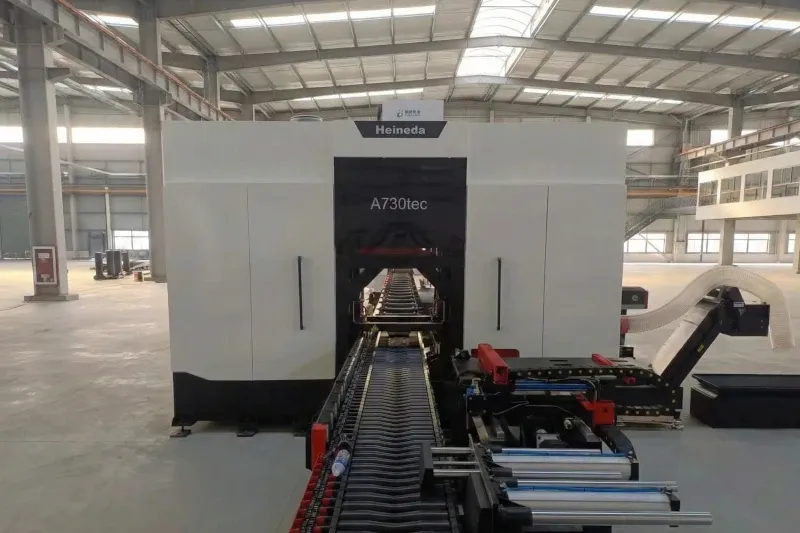
A band saw machine for metal cutting uses a continuous toothed blade looped between two or more wheels to slice through steel, aluminum, titanium, and stainless steel with straight, repeatable cuts at lower noise and kerf loss than circular or cold-saw alternatives.
Key Specs at a Glance
| Spec | Aluminum Band Saw | CNC Steel Plate Saw Milling (H-710 / H-1510 / H-2610) | Auto Aluminum Plate Saw (E-6 / E-10 / HL-12CNC) |
|---|---|---|---|
| Cutting accuracy | ≤0.1 mm/100 mm squareness (case reference) | ±0.1 mm (case reference) | ±0.3 mm (project-specific) |
| Max workpiece width | Round bar / billet bundles | 700 mm / 1500 mm / 2600 mm | 1600 mm / 3000 mm / 4000 mm |
| Max workpiece height/thickness | — | 100 mm | 200 mm (E-6, E-10) / 205 mm (HL-12CNC) |
| Kerf width | ≤2 mm | — | — |
| Motor power | — | 26 kW (H-710) / 30 kW (H-1510, H-2610) | 30 kW |
| Daily throughput | Up to 80 tons of aluminum billets (case reference) | 5–10× faster than traditional band saw (case reference) | Auto nesting, full 4000 × 4000 mm sheets |
| Surface finish | Ra < 25 μm (case reference) | — | Air-bearing table protects surface |
1. What "Band Saw Machine for Metal Cutting" Actually Means
A metal band saw machine is a sawing system that stretches a thin, continuous blade — typically 0.9–1.6 mm thick — across two drive wheels. The blade passes through the workpiece in one direction, which keeps cutting forces low and heat generation minimal compared to reciprocating or rotary blade methods. The practical result is straighter cuts, longer blade life, and less material lost to swarf.
The term covers a wide family: manual bench saws for job-shop use, semi-automatic horizontal machines for structural steel, fully automatic CNC systems for plate processing, and high-throughput billet saws for foundry or extrusion lines. Each tier solves a different production constraint.
2. The 7 Specs That Separate a Good Machine from a Poor One
When evaluating any metal cutting band saw machine, these seven parameters determine whether it will meet your process requirements:
1. Cutting accuracy. Tight-tolerance work (aerospace, mold making) demands ±0.1 mm or better. General structural cutting can tolerate ±0.3 mm. Accuracy is a function of frame rigidity, blade tension, and feed-servo precision.
2. Kerf width. Every millimeter of kerf is scrap. A kerf of ≤2 mm — achievable on a purpose-built aluminum band saw — reduces material waste meaningfully on high-value billets. Circular saws typically lose 3–5 mm per cut.
3. Surface finish (Ra). If cut faces feed directly into welding or bonding without secondary machining, Ra < 25 μm prevents rework. Verify the Ra spec under full production load, not just at slow demonstration speeds.
4. Max workpiece envelope. Plate saws are specified by width × height. Match the machine's rated capacity to your largest expected workpiece with margin — running a saw at its structural limit accelerates wear and degrades accuracy.
5. Throughput (tons/hour or cuts/hour). A CNC steel plate saw milling machine can run 5–10× faster than a traditional band saw on the same material. That multiplier changes the payback period of automation investment dramatically.
6. Drive motor and control system. 26–30 kW servo-driven machines with Siemens CNC controls (available on H-series models) maintain constant blade speed under variable material hardness. Underpowered motors stall on titanium alloy or age-hardened stainless, causing blade breakage.
7. Automation integration. Modern industrial metal cutting band saws can connect to loading robots, conveyor systems, and MES platforms. If your line is partially or fully automated, confirm the saw's I/O protocol before specifying.
3. Four Machine Tiers by Production Volume
Industrial band saw machine selection is primarily a volume decision — the right tier depends on how many tons or cuts per shift you need to process.
Tier 1 — Job shop / maintenance (< 5 cuts/hour). A semi-automatic horizontal machine with manual vice and gravity feed. Low capital cost. Operator-dependent accuracy. Not suitable for tight-tolerance or high-volume work.
Tier 2 — Small batch production (5–30 cuts/hour). A programmable automatic band saw machine with servo feed and NC length stop. Handles structural steel, bar stock, and tubing. Suitable for steel service centers and contract manufacturers.
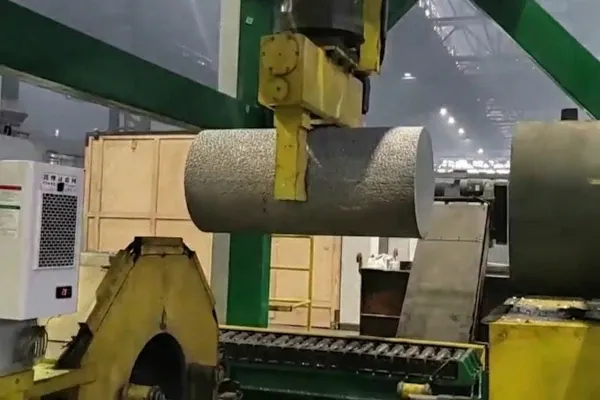
Tier 3 — High-volume aluminum billet cutting (up to 80 tons/day). A dual-column 4-screw aluminum band saw with light curtain protection and automation integration. Delivers squareness ≤0.1 mm/100 mm and surface finish Ra < 25 μm. Designed for extrusion plants, plate mills, and foundry lines where continuous throughput determines plant economics.
Tier 4 — Large-format plate processing. A CNC steel plate saw milling machine or fully automatic aluminum plate cutting machine. Workpiece up to 4000 × 4000 × 205 mm. Auto nesting optimization maximizes material yield. Air-bearing work tables protect surface finish on high-value aluminum alloys.
4. Materials That Require Specific Machine Configurations
Steel cutting band saw machine selection must account for material metallurgy, not just dimensions. Different metals behave differently under blade load.
| Material | Challenge | Machine requirement |
|---|---|---|
| Structural mild steel | High volume, long sections | Auto servo feed, coolant flood |
| Stainless steel (standard) | Work hardening | Reduced blade speed, higher feed force |
| Age-hardened / high-temp stainless | Rapid blade wear | CNC saw milling with 30 kW spindle |
| Titanium alloy | Heat generation, galling | CNC saw milling, constant chip evacuation |
| 1xxx–7xxx aluminum alloys | Surface sensitivity | Air-bearing table, Ra < 25 μm blade spec |
| Aluminum billet bundles | Bundle shifting | Light curtain + clamping vice automation |
Heineda's CNC Steel Plate Saw Milling Machine was specifically developed to handle titanium alloy, high-temperature stainless, and age-hardened stainless — materials that wear out standard band saw blades in a fraction of normal service life.
5. Questions to Ask Before You Buy
When selecting a metal bandsaw machine, ask the supplier these questions before you sign a purchase order:
Q: What is the guaranteed cutting accuracy under full production load? Spec sheets quote best-case numbers. Request a witnessed acceptance test at rated feed rate and material hardness.
Q: What is the blade life in your application? Blade cost is often the largest ongoing operating expense. Ask for reference data from installations cutting your specific material and thickness.
Q: Does the control system support your automation protocol? Siemens, Fanuc, and Mitsubishi controllers each have different PLC integration paths. Clarify compatibility before delivery.
Q: What is the lead time for spare blades and wear parts? A machine that runs 80 tons/day cannot afford a week of downtime waiting for a blade shipment.
Q: Is the machine the first of its kind, or does the supplier have documented reference installations? Jiangsu Heineda specializes in aluminum sawing equipment with automation integration — ask any supplier for an equivalent reference list.
Decision Engine: "If X → Choose Y"
| Your situation | Recommended machine type |
|---|---|
| Cutting aluminum billets, > 40 tons/day | Heineda Aluminum Band Saw (dual-column 4-screw) |
| Cutting steel / stainless plate, width ≤ 700 mm | CNC Steel Plate Saw Milling H-710 |
| Cutting steel / stainless plate, width 700–1500 mm | CNC Steel Plate Saw Milling H-1510 |
| Cutting titanium alloy or age-hardened stainless | CNC Steel Plate Saw Milling (H-1510 or H-2610, 30 kW) |
| Cutting aluminum plate, sheet up to 3000 mm wide | Fully Auto Aluminum Plate Saw E-10 |
| Cutting aluminum plate, sheet up to 4000 mm wide | Fully Auto Aluminum Plate Saw HL-12CNC |
| High-mix, lower volume structural steel | Semi-auto or programmable automatic band saw |
| Integrating into fully automated line | Any Heineda model with automation I/O — confirm protocol |
Ready to match your material and volume to the right machine? Heineda's application engineers size machines against your exact billet dimensions, daily tonnage, and accuracy requirements — no generic spec sheets. Get a Quote →
FAQ
Q: What is the difference between a metal band saw machine and a cold saw? A: A metal band saw machine uses a thin continuous blade running at low speed, producing minimal heat and a narrow kerf (≤2 mm on dedicated aluminum saws). A cold saw uses a circular toothed disc that transfers heat into the chip rather than the workpiece but generates more noise, a wider kerf, and higher blade cost per cut. Band saws are preferred for large-section or bundle cutting; cold saws are used for small-diameter bar stock where cycle time per cut is critical.
Q: How accurate is a band saw machine for metal cutting? A: Accuracy depends on the machine class. A purpose-built aluminum band saw achieves squareness ≤0.1 mm/100 mm. A CNC steel plate saw milling machine delivers ±0.1 mm on steel and stainless. A fully automatic aluminum plate cutting machine holds ±0.3 mm across sheets up to 4000 × 4000 mm. General-purpose semi-automatic machines typically hold ±0.5–1.0 mm depending on material and operator setup.
Q: Can a band saw machine cut titanium alloy? A: Standard band saws struggle with titanium because the metal generates high cutting heat and galls blade teeth rapidly. Heineda's CNC Steel Plate Saw Milling Machine (H-1510 and H-2610, 30 kW) is rated for titanium alloy, high-temperature stainless, and age-hardened stainless, with constant chip evacuation and servo-controlled feed to manage heat buildup.
Q: What daily throughput can I expect from an industrial metal cutting band saw? A: A high-throughput aluminum band saw can process up to 80 tons of aluminum billets per day. A CNC steel plate saw milling machine runs 5–10× faster than a traditional band saw on the same steel or stainless workpiece. Actual throughput depends on material, cut length, and automation level — request application-specific sizing from the supplier.
Q: What aluminum alloys can be cut on a band saw? A: Heineda's fully automatic aluminum plate cutting machine handles the full 1xxx through 7xxx series aluminum alloys, including aerospace-grade 2xxx and 7xxx. The air-bearing work table prevents surface scratching on high-value alloys. Maximum workpiece is 4000 mm × 4000 mm × 200 mm on the HL-12CNC model.
Q: How does blade kerf width affect my material cost? A: On a ≤2 mm kerf band saw versus a 4 mm kerf circular saw, each cut saves 2 mm of material. On a 6-meter aluminum billet cut into 100-mm sections, that means 60 cuts × 2 mm = 120 mm of billet recovered per bar — roughly one additional finished piece per bar. At high aluminum prices and large volumes, kerf reduction has a measurable ROI.
Q: What is the typical lead time for a CNC band saw machine from China? A: Lead time depends on configuration; contact Heineda for current estimates. Confirm lead time against your production start date before order placement, and clarify which spare parts ship with the machine.
If you remember one thing from this article: match the machine tier to your daily tonnage and tightest tolerance requirement first — accuracy spec, width capacity, and automation level follow from those two numbers.
Compare models or get a spec for your exact application. Heineda supplies aluminum sawing and automation solutions globally — request the same application review for your line. Request Specs →