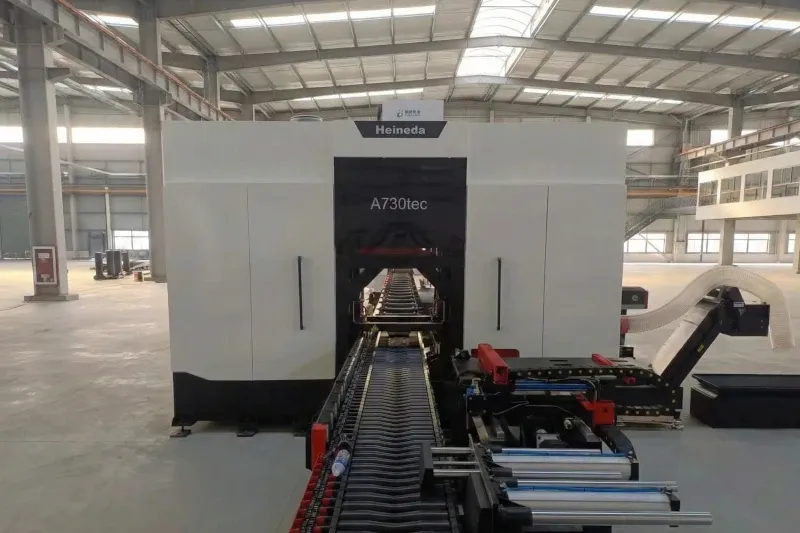
A band saw configured for aluminum requires lower TPI (tooth pitch), higher cutting speed, and flood coolant compared to a steel-cutting setup — and choosing the wrong spec combination produces built-up edge, poor finish, and blade failure within hours.
Key Performance Stats
| Spec | Heineda Aluminum Band Saw |
|---|---|
| Cutting squareness (case reference) | ≤0.1 mm/100 mm |
| Surface finish (case reference) | Ra < 25 μm |
| Kerf width | ≤2 mm |
| Daily throughput (case reference) | Up to 80 tons of aluminum billets |
| Alloy range (plate saw) | 1xxx – 7xxx series |
| Max workpiece (plate saw) | 4000 mm × 4000 mm × 205 mm |
| Cutting accuracy (plate saw, project-specific) | ±0.3 mm |
Why Aluminum Demands Different Band Saw Settings Than Steel
Aluminum is a fundamentally different cutting material from steel, and cutting aluminum on a bandsaw with steel-optimized parameters guarantees poor results. Steel is hard and abrasion-resistant; aluminum is soft, gummy, and highly thermally conductive. The gumminess causes aluminum chips to weld to blade teeth — a phenomenon called built-up edge (BUE) — if tooth pitch is too fine, surface speed too slow, or coolant absent. Conversely, too coarse a pitch on thin profiles causes chatter and rough finish. Getting the spec matrix right is the only path to consistent cuts at scale.
Blade TPI for aluminum: For most aluminum billets and thick plate (25 mm and above), 2–4 TPI is the working range. Finer pitches (6–10 TPI used in steel cutting) pack chips into the gullet before they clear the cut, generating heat and BUE. Coarser pitches (1–1.5 TPI) are reserved for very large cross-sections (diameter > 300 mm) where chip volume is high. For aluminium band saw work on round bar bundles or irregular profiles, variable-pitch blades (e.g., 2/3 TPI) reduce harmonic vibration at the entry point.
Cutting speed: Aluminum allows — and requires — much higher band speeds than steel. Steel band sawing runs at 50–100 m/min; aluminium cutting band saw applications typically target 300–600 m/min. Higher surface speed keeps chips thin and continuous, shearing cleanly rather than tearing. Heineda's aluminum band saw structure uses a dual-column + ball screw design to maintain rigidity at these speeds, preventing blade drift that would undercut the ≤0.1 mm/100 mm squareness spec.
Coolant: Flood coolant with a water-soluble, aluminum-specific emulsion (typically 5–8% concentration) is non-negotiable for production aluminium cutting band saw work. Oil mist is insufficient at 300+ m/min — it cannot carry heat away fast enough. Dry cutting is feasible only for very thin extrusions at low feed rates and short runs. For 80-ton-per-day billet operations, coolant recirculation and chip separation are part of the system design.
Alloy-Series Decision Matrix: Which Spec Changes With Alloy?
Aluminum alloys are not interchangeable when specifying an aluminium band saw, and the alloy series determines both blade selection and machine rigidity requirements. The 1xxx series (commercially pure aluminum) is the softest and most prone to built-up edge — use the lowest feed rate within the TPI range. The 2xxx series (copper-alloyed, used in aerospace) and 7xxx series (zinc-alloyed, used in aerospace and tooling) are significantly harder and can sustain higher feed rates without BUE, but they are more prone to work-hardening if the blade dwells — so continuous, steady feed is critical.
| Alloy Series | Typical Applications | Relative Hardness | Recommended TPI Range | Key Risk |
|---|---|---|---|---|
| 1xxx | Electrical busbars, foil stock | Very soft | 2–3 | Built-up edge, poor finish |
| 2xxx | Aerospace structure, forgings | Medium-hard | 3–4 | Work-hardening if feed stops |
| 5xxx | Marine, pressure vessels | Medium | 2–3 | Gummy chips, heat |
| 6xxx | Extrusions, automotive | Medium | 3–4 | Profile distortion on thin walls |
| 7xxx | Aerospace tooling, molds | Hard | 3–5 | Work-hardening, blade fatigue |
Heineda's fully automatic aluminum plate cutting machine explicitly covers all 1xxx–7xxx series, with an air-bearing work table that protects surface finish on soft alloys during sheet repositioning — a detail that matters for 2xxx and 7xxx precision plate where scratches on the reference face create downstream tolerance issues.
Band Saw for Aluminum vs Band Saw for Steel: Side-by-Side
Comparing band saw for aluminum against steel-optimized band saw operation clarifies where shared equipment fails and where dedicated machines pay off. The table below covers the five parameters that most operators get wrong when running aluminum on a machine spec'd for steel.
| Parameter | Steel Band Saw | Aluminum Band Saw | Why It Matters |
|---|---|---|---|
| Band speed | 50–100 m/min | 300–600 m/min | Aluminum needs shear, not abrasion |
| TPI | 6–14 | 2–5 | Gullet clearance; prevents chip packing |
| Coolant type | Sulfur-based cutting oil | Water-soluble aluminum emulsion | Sulfur stains and corrodes aluminum |
| Blade tooth form | Positive rake, fine | Hook or skip tooth, coarse | Chip curl control in soft material |
| Feed force | High | Low-to-medium, steady | Aluminum work-hardens if feed hesitates |
| Structural rigidity | Standard | Dual-column preferred | High speed increases vibration loads |
Running a steel-spec band saw on aluminum at the wrong speed with the wrong coolant does not just produce bad parts — it destroys blades at 3–5x the normal rate and creates a false impression that "band saws can't cut aluminum well." The right machine with the right parameters cuts aluminum cleaner, faster, and cheaper than alternatives such as circular cold saws or abrasive cut-off wheels for cross-sections above 100 mm.
"If X → Choose Y" Decision Engine
| If your situation is… | Then choose… |
|---|---|
| Billet line, round bar bundles, 1xxx–6xxx alloys, >10 tons/day | Heineda aluminum band saw (dual-column, coolant, automation-ready) |
| Precision aluminum plate, 1xxx–7xxx, large format up to 4000×4000 mm | Heineda fully automatic aluminum plate cutting machine (air-bearing table, ±0.3 mm) |
| Mixed production: some aluminum, some mild steel, low volume | Retrofit existing horizontal band saw with aluminum-spec blade + flood coolant; accept lower throughput |
| Titanium, high-temp stainless, age-hardened steel alongside aluminum | Separate machines; Heineda CNC steel plate saw milling machine for non-aluminum materials |
| 7xxx aerospace plate requiring ≤0.1 mm flatness and Ra < 25 μm | Heineda aluminum band saw with dual-column rigidity and light-curtain safety integration |
| Prototype shop, <500 kg/day, budget constrained | Standard horizontal band saw, 3 TPI bi-metal blade, manual flood coolant |
Get the Right Aluminum Band Saw Configuration
Heineda engineers aluminum band saws for production environments — billet lines, plate service centers, and aerospace suppliers. The dual-column + ball screw structure holds ≤0.1 mm/100 mm squareness at full production speed, and automation integration (loading, conveying, unloading) supports up to 80 tons of aluminum billets per day without operator bottlenecks.
Get a Quote for Your Aluminum Cutting Application →
FAQ
Q: What TPI blade should I use for cutting aluminum on a bandsaw? A: For most aluminum cross-sections between 25 mm and 150 mm, a 2–4 TPI hook-tooth or skip-tooth blade is the correct starting point. Thinner profiles (under 25 mm) can use 4–6 TPI to avoid chatter. Going finer than 6 TPI on aluminum causes chip packing in the gullet, heat buildup, and rapid BUE formation on the tooth face.
Q: Can a standard steel band saw cut aluminum? A: Technically yes, but practically it performs poorly unless you change the blade to aluminum spec (coarse TPI, hook tooth), reduce the sulfur-based coolant and substitute aluminum emulsion, and increase band speed significantly. Running aluminum on a steel-configured band saw at steel speeds produces torn surfaces, rapid blade wear, and inconsistent squareness. For any volume above a few cuts per day, a dedicated aluminium cutting band saw setup is more cost-effective.
Q: What cutting speed is correct for an aluminium band saw? A: 300–600 m/min is the production range for most aluminum alloys. Softer alloys (1xxx, 5xxx) run toward the lower end with moderate feed; harder alloys (2xxx, 7xxx) can sustain higher speeds with steady feed. Running at steel speeds (50–100 m/min) on aluminum allows chips to compress and weld to the tooth, drastically shortening blade life.
Q: Do I need coolant when cutting aluminum with a band saw? A: Yes, for any production volume. Water-soluble aluminum-specific emulsion at 5–8% concentration applied as flood coolant is the standard. Coolant performs two jobs: it carries chips out of the cut, and it prevents the thermal buildup that causes aluminum to anneal locally and gum up the blade. Dry cutting is acceptable only for very thin extrusions at slow feeds and short run durations.
Q: What is the surface finish achievable with a band saw on aluminum? A: On a properly configured production aluminum band saw, Ra < 25 μm is achievable — which is the spec Heineda's aluminum band saw delivers. This finish is adequate for most billet-to-billet, plate-to-plate, and profile cross-section operations. If downstream operations require a milled or polished surface, the band saw finish provides a clean starting point with minimal stock removal needed.
Q: How does alloy series affect aluminum band saw setup? A: Alloy series affects hardness, chip character, and work-hardening tendency. Soft 1xxx alloys produce long, gummy chips and are most prone to built-up edge — use lower feed, flood coolant, and ensure blade sharpness. Hard 7xxx aerospace alloys are more brittle and work-harden rapidly if the feed pauses — use steady, continuous feed and monitor blade tension. The 6xxx series (most common extrusion alloy) is the most forgiving and the best starting point for initial parameter setting.
Q: What is the maximum aluminum plate size Heineda can cut? A: The Heineda fully automatic aluminum plate cutting machine (model HL-12CNC) handles workpieces up to 4000 mm × 4000 mm × 205 mm, covering the full 1xxx–7xxx alloy range. Cutting accuracy is ±0.3 mm with an air-bearing work table that protects surface finish during repositioning.
If you remember one thing from this article: aluminum band sawing fails when configured for steel — match TPI, speed, coolant, and machine rigidity to aluminum's properties, and the band saw becomes the most efficient cross-section cutting method available for billets and plate above 100 mm.
Cut Aluminum Right — Talk to a Heineda Engineer
Heineda has supplied aluminum band saws to multiple billet and plate operations globally. Tell us your alloy series, cross-section range, and daily tonnage target — we will specify the right machine and blade parameters.
Request a Free Technical Consultation →