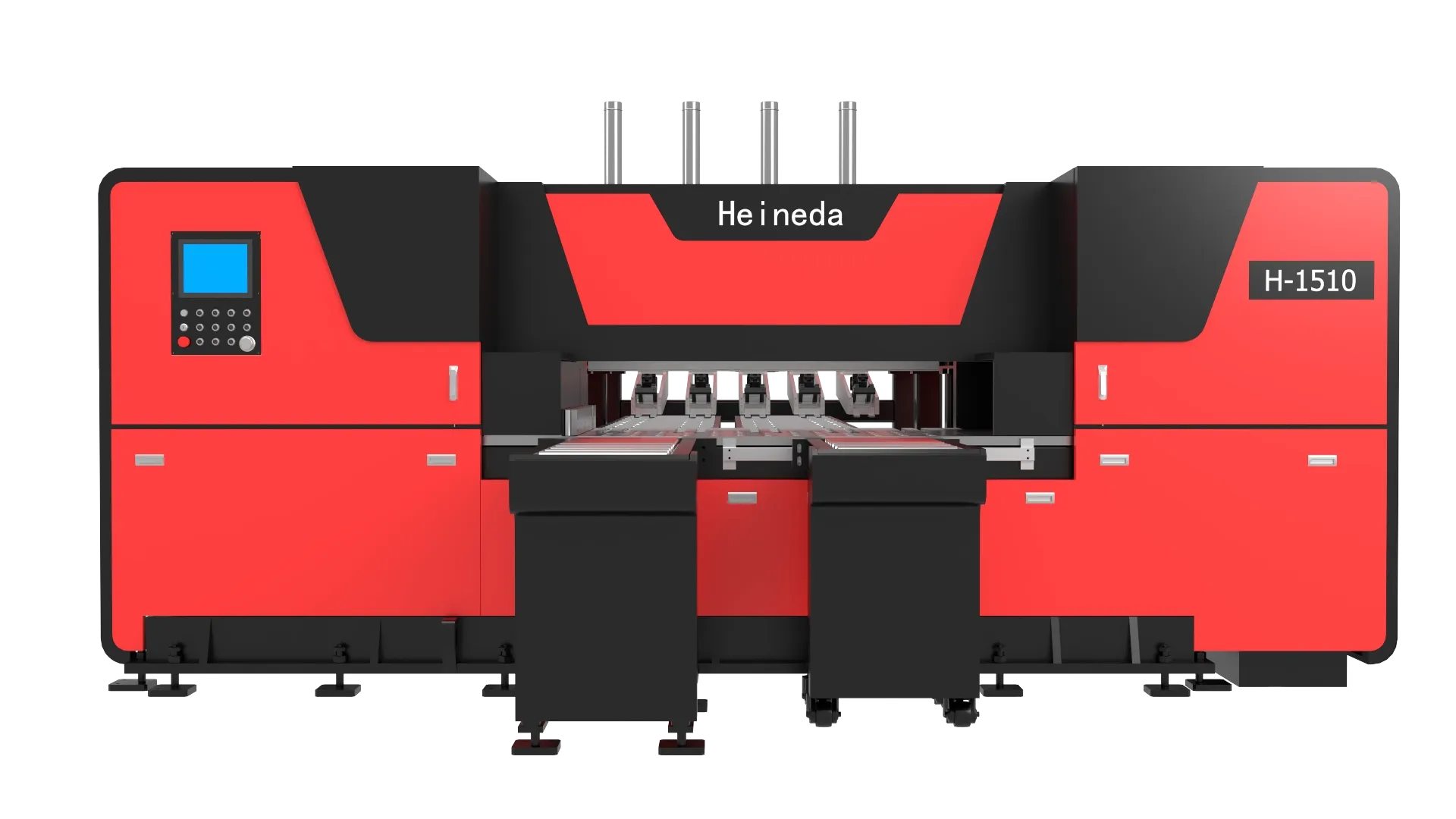
An automatic steel plate circular sawing machine is a CNC-driven cutting system that uses a rotating circular blade and servo-controlled feed to section steel plate to length at tolerances of ±0.1 mm — typically 5–10× faster than a band saw on the same material.
Key Stats
| Metric | Value |
|---|---|
| Cutting accuracy (H-series) | ±0.1 mm (stated) |
| Speed advantage over band saw | 5–10× faster |
| Motor power (H-710) | 26 KW |
| Motor power (H-1510 / H-2610) | 30 KW |
| Max workpiece height | 100 mm |
| Widest model (H-2610) | 2600 mm plate width |
What an Automatic Steel Plate Circular Sawing Machine Is
An automatic steel plate circular sawing machine is a metal-cutting platform built around a large-diameter carbide or cermet circular blade that plunges through a flat steel workpiece while a servo-actuated clamping and feed system positions the plate automatically between cuts. Unlike a manual circular saw, every axis — clamp pressure, feed rate, cut depth, and part indexing — is managed by a Siemens PLC or CNC controller so an operator only needs to input the cut list.
The defining characteristic is the blade geometry: the rigid circular disc resists deflection far better than a flexible band-saw blade, which is why kerf straightness and squareness remain consistent across a full production shift rather than drifting as the blade fatigues.
Heineda's H-series — the H-710, H-1510, and H-2610 — is the production implementation of this principle, sized for plate widths from 700 mm to 2600 mm. Full details on the steel plate cutting category are at heinedasaw.com/steel-plate-cutting.
Circular Saw vs. Band Saw for Steel Plate: The Core Difference
When a buyer is choosing between a steel plate circular saw and a band saw for steel plate, the decision pivots on two variables: cut rate and blade rigidity.
A band saw cuts at low surface feet per minute with a thin, flexible blade that wraps around two wheels. That flexibility is an asset in structural cutting (profiles, tube bundles) where the blade must navigate complex cross-sections. For flat steel plate, it becomes a liability: the blade can bow under feed pressure, degrading squareness, and the interrupted tooth engagement limits how aggressively you can push feed rate.
A circular sawing machine drives a rigid disc at high RPM directly into the plate face. The blade does not flex. Feed rates on the H-series reach 5–10× the throughput of a conventional band saw on identical steel plate — a verified figure from Heineda's own production testing. The trade-off is blade diameter limits maximum cut height; the H-series caps at 100 mm workpiece height. For plate or bar stock within that envelope, a circular saw dominates on throughput.
| Factor | Circular Saw (H-series) | Band Saw |
|---|---|---|
| Cut speed | 5–10× faster | Baseline |
| Squareness | ±0.1 mm | Blade-condition dependent |
| Max height (steel) | 100 mm | Higher, varies by model |
| Best for | Plate, flat bar, mold steel | Profiles, bundles, large cross-sections |
| Automation depth | Full-auto servo, Siemens CNC | Semi- to full-auto |
When Circular Saw Throughput Wins
When a facility runs repetitive cut-to-length operations on steel plate — mold blanks, aerospace structural panels, automotive tooling plates — the circular sawing machine's throughput advantage compounds across a shift.
Consider a plate service center cutting 100 pieces per day from titanium alloy or high-temperature stainless. A band saw might require 3–4 minutes per cut; the H-series completes the same cut in 30–45 seconds at full servo feed. Over an eight-hour shift that gap translates directly to machine utilization, labor cost, and delivery lead time.
The automatic steel cutting machine architecture of the H-series adds a second throughput multiplier: zero manual intervention between cuts. The Siemens controller reads the full cut list, the servo feed indexes the plate, the clamp cycles, and the blade advances — without the operator repositioning or re-measuring. That automation is what differentiates the H-series from older NC circular saws that still require manual length setting.
H-Series Model Selection by Plate Width
When choosing among H-710, H-1510, and H-2610, the primary selector is your maximum plate width, not the steel grade.
H-710 (700 mm capacity) The entry model for precision steel plate cutting. At 26 KW it handles typical mold steel blanks and automotive structural plate up to 700 mm wide. The lower power budget suits facilities where the full 30 KW draw of the larger models would require electrical infrastructure upgrades.
H-1510 (1500 mm capacity) The volume workhorse. At 30 KW and 1500 mm width it covers the majority of aerospace and metallurgy applications — standard aerospace aluminum tooling plate runs 1000–1250 mm; the H-1510 clears that envelope with margin.
H-2610 (2600 mm capacity) The wide-format model for large mold plates and heavy metallurgy blanks. Same 30 KW motor as the H-1510; the additional width comes from an extended bed and clamping system rather than a larger drive. This is the CNC circular saw for steel operations where plate width exceeds what any band saw in the same power class can handle.
All three models share the same Siemens control platform and full-auto servo feed, so operational procedure and programming are identical — a single operator can run any model after training on one.
The cnc circular saw steel capability across all three models extends to titanium alloy, high-temperature stainless, and age-hardened stainless steel — materials that are difficult for band saws to cut repeatably at speed.
Decision Engine: Circular Saw or Band Saw?
| If your application is... | Choose... |
|---|---|
| Flat steel plate, cut-to-length, high daily volume | H-series circular sawing machine |
| Steel plate ≤700 mm wide, mold or automotive | H-710 |
| Steel plate up to 1500 mm, aerospace or metallurgy | H-1510 |
| Steel plate up to 2600 mm, large mold or structural | H-2610 |
| Structural profiles, tube bundles, large cross-sections | Band saw |
| Mixed plate + profile production, moderate volume | Band saw with circular saw for plate line |
| Titanium alloy or age-hardened stainless at volume | H-series (all models) |
| Budget or space constrained, low daily volume | Semi-auto band saw |
Get a Heineda Custom Quote — the H-series is available in three widths (700 mm to 2600 mm); Heineda will match the model to your plate dimensions and daily cut volume at no charge. 👉 Request Free Quote
FAQ
Q: What is an automatic steel plate circular sawing machine? A: An automatic steel plate circular sawing machine is a CNC-controlled cutting system that uses a rigid circular blade and a servo-driven feed to cut steel plate to precise lengths. The controller manages clamping, feed rate, and indexing automatically between cuts; the operator only loads the cut list. Heineda's H-series achieves ±0.1 mm accuracy at 5–10× the speed of a comparable band saw.
Q: How does a circular saw differ from a band saw for steel plate cutting? A: A band saw uses a flexible looped blade that can bow under feed pressure, limiting both speed and squareness on flat plate. A circular saw uses a rigid disc that does not deflect, enabling higher feed rates and consistent ±0.1 mm squareness regardless of shift length. The H-series circular sawing machine runs 5–10× faster than a band saw on the same steel plate cross-section.
Q: Which H-series model should I choose for my plate width? A: Select by maximum plate width: H-710 for plates up to 700 mm, H-1510 for plates up to 1500 mm, H-2610 for plates up to 2600 mm. All models cap at 100 mm workpiece height. If your width requirement sits between two models, always step up — running at the top of a machine's envelope degrades blade life and accuracy faster than running at mid-range.
Q: Can the H-series cut titanium alloy and hardened stainless steel? A: Yes. The H-series is validated for titanium alloy, high-temperature stainless steel, and age-hardened stainless steel. These are the materials most likely to cause premature blade failure or dimensional drift on band saws. The rigid circular blade geometry and Siemens-controlled feed rate make the H-series the preferred automatic steel cutting machine for these alloys in aerospace and mold-making environments.
Q: What control system does the H-series use? A: All H-series models use a Siemens CNC control system with full-auto servo feed. The Siemens platform supports full cut-list programming, feed-rate override, and diagnostic logging. Spare parts and service technicians for Siemens controls are available globally, which matters for facilities in North America, Europe, and Southeast Asia.
Q: How does the H-series compare to competitors like Behringer or MEP? A: Behringer and MEP produce quality circular saws for the European market. The H-series offers Siemens controls commonality and a wider plate capacity at the H-2610 tier. For buyers evaluating automation integration, the Siemens-based architecture provides standardized connectivity that simplifies MES and ERP integration.
Q: What industries are the primary users of the H-series steel plate circular saw? A: Aerospace (structural panels, titanium blanks), metallurgy (plate service centers, mill-adjacent cut-to-length lines), automotive tooling (die blanks, fixture plates), and mold making (P20, H13, S7 mold steel plates).
If you remember one thing from this article: for flat steel plate cut-to-length at production volume, a circular sawing machine running the H-series platform will outrun a band saw by 5–10× while holding ±0.1 mm — and Heineda sizes that platform from 700 mm to 2600 mm plate width so there is a model for almost every plate service center or aerospace shop.
Get a Heineda Custom Quote — tell Heineda your plate width, daily volume, and steel grade and receive a model recommendation. 👉 Request Free Quote
Related: Steel Plate Cutting Machines — Full Category Guide · Contact Heineda