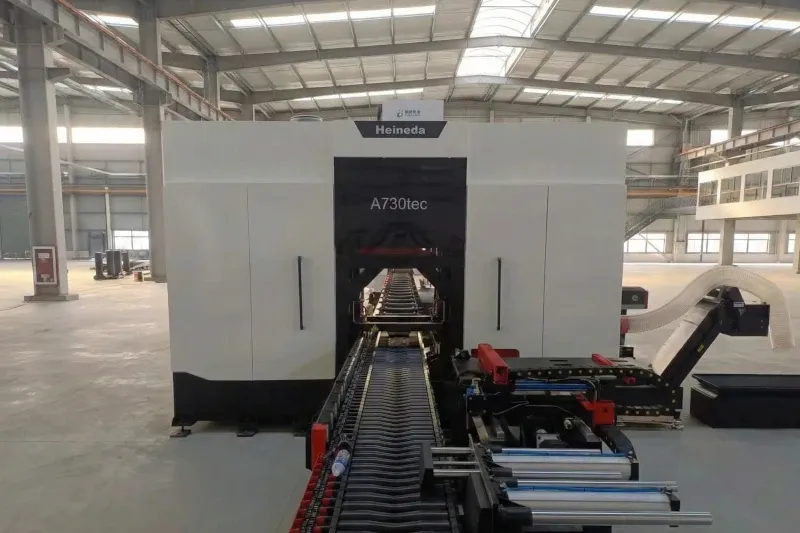
An automatic band saw machine feeds, clamps, cuts, and advances material without operator intervention between cycles — the right automation tier depends on your daily tonnage, labor cost, and acceptable payback window.
| Specification | Value |
|---|---|
| Cutting squareness (aluminum band saw, case reference) | ≤ 0.1 mm / 100 mm |
| Surface finish (case reference) | Ra < 25 μm |
| Max daily capacity (case reference) | 80 tons aluminum billets |
| Kerf width | ≤ 2 mm |
| CNC saw-mill accuracy (H-series, case reference) | ± 0.1 mm |
| Fully automatic plate cutting accuracy (project-specific) | ± 0.3 mm |
| Max workpiece (HL-12CNC) | 4000 mm × 4000 mm × 205 mm |
| Speed advantage vs. traditional band saw (case reference) | 5 – 10× faster |
What Separates Manual, Semi-Auto, and Fully Automatic Band Saw Machines
A manual band saw machine requires an operator to position each piece, start the cut, and remove the workpiece. Feed rate and cut depth are set by hand. Cycle time depends entirely on operator pace, and accuracy varies with fatigue.
A semi-automatic band saw automates the down-feed (the blade descends under hydraulic or servo control at a preset rate) but the operator still loads and unloads stock. Most semi-auto machines return the head automatically after each cut. This tier handles intermittent production runs of 5 – 30 pieces per batch without dedicated material handling equipment.
A fully automatic band saw machine — also called an auto feed band saw — integrates a servo-driven vice feed, automatic clamping, programmable length stops, and (in higher-end configurations) automatic loading conveyors and unloading chutes. The operator enters a cut list; the machine executes it. Heineda's aluminum band saw supports full automation integration across loading, conveying, and unloading stages, and can sustain up to 80 tons of aluminum billet throughput per day.
Production Volume Thresholds: When Each Tier Makes Sense
Production volume is the clearest trigger for an upgrade decision.
Below 500 kg/day, a manual machine typically has sufficient capacity and the capital cost of automation is hard to recover in under four years. From 500 kg to 5 t/day, a semi-automatic band saw reduces operator fatigue and improves length consistency, usually recovering its premium in 18 – 30 months through labor savings and reduced scrap.
Above 5 t/day — the threshold where a fully automatic horizontal bandsaw or a CNC saw-mill becomes the standard choice — manual intervention becomes the production bottleneck. At 80 t/day, a single Heineda aluminum band saw running fully automated replaces 4 – 6 operator positions, and the kerf width of ≤ 2 mm directly reduces material waste at scale: on a 5,000-ton annual run of aluminum billet, every 0.5 mm of unnecessary kerf represents roughly 10 – 25 tons of lost material.
ROI Calculation Framework
Return on investment for an automatic band saw machine has three primary drivers: labor displacement, scrap reduction, and throughput uplift.
Step 1 — Labor cost baseline. Count the operators currently attending the saw station across all shifts. Multiply by annual fully-loaded labor cost (salary + benefits + overhead).
Step 2 — Scrap reduction. Compare current average kerf width against the Heineda spec of ≤ 2 mm. Every millimeter saved across annual throughput is quantifiable material yield.
Step 3 — Throughput uplift. If the saw is the line bottleneck, faster cycle time translates directly to additional billable output. Heineda's CNC steel plate saw-mill (H-series) runs 5 – 10× faster than a traditional band saw on hard materials. Even at 3× throughput, a shift that previously produced 20 cuts/hour produces 60, freeing downstream capacity.
Simple payback = Machine price ÷ (Annual labor saving + Annual scrap saving + Annual throughput revenue gain). Actual payback period depends on labor cost, shift count, and material value. Contact Heineda for a project-specific ROI estimate.
Material and Application Fit
Material compatibility determines which automatic band saw configuration applies to your process.
For aluminum billets, thick plate, round bar bundles, and irregular profiles, the Heineda aluminum band saw is the primary fit. Its dual-column + ball screw structure maintains rigidity under eccentric loads, and light curtain protection is available. It handles the full 1xxx–7xxx aluminum alloy series.
For hard materials — titanium alloy, high-temperature stainless, age-hardened stainless — the CNC saw-mill (H-710, H-1510, H-2610) is the correct choice. These machines use a Siemens control system with full-auto servo feed and reach cutting accuracy of ± 0.1 mm, making them suitable for aerospace, mold-making, and metallurgical applications.
For large aluminum plate up to 4000 × 4000 × 205 mm, the fully automatic aluminum plate cutting machine (E-6, E-10, HL-12CNC) adds auto nesting optimization and an air-bearing work table that protects surface finish — critical for aerospace and automotive panel supply chains.
Decision Engine: Which Tier to Choose
| If your situation is… | Choose this tier |
|---|---|
| < 500 kg/day, prototype or job-shop work | Manual band saw |
| 500 kg – 5 t/day, repeating batch sizes | Semi-automatic band saw |
| > 5 t/day, aluminum billet or bar stock | Fully automatic band saw (Heineda aluminum band saw) |
| Hard alloys (titanium, high-temp stainless), aerospace/mold | CNC saw-mill H-series (± 0.1 mm, 5–10× speed) |
| Large aluminum plate ≥ 1600 mm wide, sheet metal service center | Fully automatic plate cutting machine (E-6 / E-10 / HL-12CNC) |
| Existing line is the throughput bottleneck | Upgrade to auto feed band saw regardless of current volume |
| Labor cost is primary pain point | Fully automatic horizontal bandsaw with auto loading/unloading |
Get a configuration recommendation for your production volume. Heineda's engineering team reviews your daily tonnage, material grade, and length program — then recommends the right automatic band saw machine tier with a projected ROI estimate. Request a Quote → heinedasaw.com/contact?utm_source=blog&utm_medium=organic&utm_campaign=seo-automatic-band-saw-machine&utm_content=cta-mid
FAQ
Q: What is the difference between a semi-automatic and a fully automatic band saw machine? A: A semi-automatic band saw automates the blade down-feed but requires an operator to load and unload each piece. A fully automatic band saw machine — also called an auto feed band saw — handles clamping, feeding, cutting, and workpiece advance without operator intervention between cycles.
Q: At what production volume should I upgrade to a fully automatic horizontal bandsaw? A: The practical threshold is around 5 tons per day of cut material. Below that, semi-automatic machines typically deliver adequate throughput. Above 5 t/day, manual loading becomes the bottleneck and a fully automatic horizontal bandsaw recovers its cost premium through labor savings and higher utilization. Actual payback period depends on labor cost, shift count, and material value. Contact Heineda for a project-specific ROI estimate.
Q: How accurate is a fully automatic band saw machine on aluminum? A: Heineda's aluminum band saw achieves cutting squareness of ≤ 0.1 mm per 100 mm (case reference), surface finish of Ra < 25 μm (case reference), and kerf width of ≤ 2 mm, which minimizes material loss on high-value aluminum billet and bar stock.
Q: Can a fully automatic band saw machine handle titanium or high-temperature stainless? A: Standard fully automatic band saws are optimized for aluminum and mild steel. For titanium alloy, high-temperature stainless, and age-hardened stainless, Heineda's CNC saw-mill (H-series) with full-auto servo feed and Siemens control is the correct choice, delivering ± 0.1 mm accuracy at 5 – 10× the throughput of a conventional band saw.
Q: What is the maximum workpiece size a fully automatic aluminum plate cutting machine can handle? A: Heineda's HL-12CNC model accepts workpieces up to 4000 mm × 4000 mm × 205 mm and handles all 1xxx–7xxx series aluminum alloys. Smaller configurations (E-6 at 1600 mm wide, E-10 at 3000 mm wide) cover most plate service center requirements.
Q: Does a fully automatic band saw machine require special operator training? A: Heineda's H-series and select fully automatic machines use a Siemens control system with a standard HMI. Operators typically require 1 – 2 days of training to run cut programs independently. The light curtain safety system and automatic clamping reduce the skill demands of the manual loading step that remains in semi-automatic configurations.
Q: How do I calculate ROI for upgrading to an automatic band saw? A: Add annual labor savings (displaced operators × fully-loaded cost) + annual scrap savings (kerf reduction × material price × annual throughput) + throughput revenue gain (if the saw is the bottleneck). Divide total machine price by that annual benefit. Actual payback period depends on labor cost, shift count, and material value. Contact Heineda for a project-specific ROI estimate.
If there is one thing to remember: the right automatic band saw machine tier is determined by daily tonnage and material grade — above 5 t/day on aluminum or any volume on hard alloys, a fully automatic machine pays for itself; below that threshold, semi-automatic is often the better capital decision.
Ready to calculate your exact payback period? Send Heineda your cut program — material, daily volume, length tolerance — and receive a machine recommendation with ROI estimate within 24 hours. Get a Quote → heinedasaw.com/contact?utm_source=blog&utm_medium=organic&utm_campaign=seo-automatic-band-saw-machine&utm_content=cta-end Jiangsu Heineda Sawing Machinery Co., Ltd. heinedasaw.com | sales@heinedasaw.com