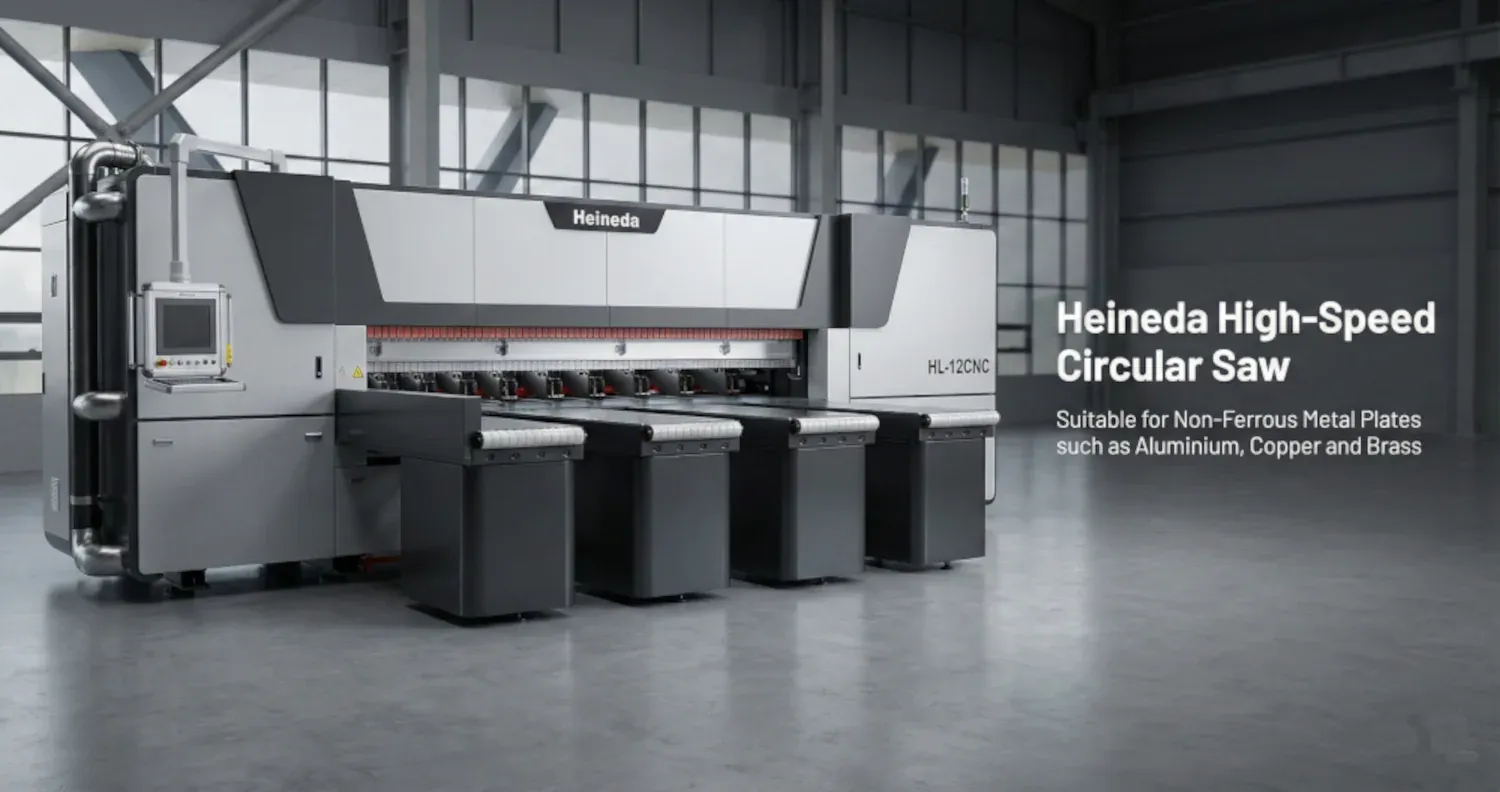
An aluminum plate cutting machine is a production saw or cutting system designed specifically to cross-cut, rip, or nest-cut flat aluminum sheet and plate stock to precise dimensions — and the right machine type depends on plate thickness, alloy series, required surface finish, and throughput target.
Key Specs at a Glance
| Specification | Fully Automatic Aluminum Plate Cutting Machine | Aluminum Band Saw | CNC Plate Saw Milling Machine |
|---|---|---|---|
| Cutting accuracy | ±0.3 mm(project-specific; subject to confirmed technical plan) | ≤0.1 mm / 100 mm(case reference) | ±0.1 mm(case reference) |
| Max workpiece size | 4000 × 4000 × 205 mm (HL-12CNC) | Thick plate, billets, bundles | Up to 2600 mm wide, 100 mm tall |
| Kerf width | — | ≤2 mm | — |
| Surface finish | Air-floating work table available as a series option per project configuration | Ra ≤25 μm(case reference) | Saw + milling combined |
| Daily capacity | High-volume nesting runs | Contact Heineda for throughput estimates based on your specific plate size and alloy. | Determined by model, plate size, and automation configuration. |
| Motor power | 30 KW | — | 26–30 KW |
| Alloy range | 1xxx–7xxx series | Billets, thick plate, round bar | Contact Heineda for alloy-specific recommendations. |
What Is an Aluminum Plate Cutting Machine?
An aluminum plate cutting machine is any powered saw or cutting system engineered to process flat aluminum plate stock — typically from sheet gauge (under 6 mm) through thick structural plate (up to 200 mm) — with repeatable dimensional accuracy and a surface finish that does not require secondary rework. The term covers three distinct machine families that share the end goal (a square, clean cut in aluminum) but differ fundamentally in mechanism, kerf loss, achievable tolerance, and ideal application band.
Why Aluminum Demands Dedicated Equipment
When cutting aluminum with machinery designed primarily for steel, three problems appear: chip adhesion to saw teeth (aluminum's low melting point causes re-welding), surface smearing that degrades flatness tolerances, and resonance vibration from aluminum's high strength-to-weight ratio. Dedicated aluminum plate saws address all three through carbide or bi-metal tooth geometry, rigid column structures, and controlled feed rates — none of which general-purpose metal saws provide.
Circular Saw vs Band Saw vs Waterjet: The Core Comparison
When selecting a machine to cut aluminum plate, buyers typically evaluate three primary technologies — circular (panel) saw, band saw, and waterjet — each of which occupies a distinct niche.
Circular / Panel Saw (CNC Panel Cutting Machine)
A CNC panel cutting machine uses a large-diameter circular blade rotating at high RPM to cross-cut or rip aluminum sheet and plate in a single straight pass. It excels at high-volume rectangular nesting — the basis of automatic panel saw and fully automatic aluminum cutting machine designs. Heineda's fully automatic aluminum plate cutting machine achieves ±0.3 mm accuracy ((project-specific; subject to confirmed technical plan)) on workpieces up to 4000 × 4000 × 205 mm (HL-12CNC). The series can be equipped with an air-floating work table to protect surface finish. Module options include loading/unloading systems, dust collection, and chip briquetting — scope defined at the project stage to maximize material yield. Models span 1600 mm (E-6), 3000 mm (E-10), and 4000 mm (HL-12CNC) working widths. This technology suits plate service centers, aerospace blanking, and automotive structural panel production.
Best for: High-volume straight cuts, large-format plate, 1xxx–7xxx alloys, nest-cutting to maximize yield.
Band Saw (Aluminum Plate Saw)
An aluminum plate saw running a continuous band blade applies a much lower cutting force than a circular saw, which makes it the preferred choice for thick billet cross-cutting, round-bar bundles, and irregular profile stacks where a circular saw cannot reach. Heineda's dual-column 4-screw aluminum band saw delivers cutting squareness ≤0.1 mm / 100 mm and a surface finish of Ra ≤25 μm in specific project configurations — both tight enough to skip secondary facing in many applications. Kerf width is ≤2 mm, meaningfully reducing material waste on expensive aerospace-grade plate. The band saw supports full automation integration (loading, conveying, unloading) as a configurable option — scope defined at project stage.
Best for: Thick plate, billets, bundles, irregular stacks; maximum surface quality; automation integration.
Waterjet
Waterjet cutting uses a high-pressure water and abrasive stream to erode material without heat, making it suitable for heat-sensitive alloys or contoured cuts that no saw can produce. However, waterjet is slow (cut speed measured in mm/min versus m/min for a saw), expensive to operate (abrasive consumption), and leaves a tapered edge that typically requires machining. For straight-line plate blanking at production volume, waterjet is rarely the economic choice.
Best for: Complex contours, heat-sensitive alloys, one-off prototypes; not production-volume straight cuts.
Application Fit Matrix
When choosing between machine types, map your production scenario to the technology with the best fit:
| Scenario | Best Machine Type | Heineda Product |
|---|---|---|
| High-volume rectangular blanks, 1×–7xxx plate | Fully automatic aluminum plate cutting machine | E-6 / E-10 / HL-12CNC |
| Thick billet cross-cut, round-bar bundles | Aluminum band saw | Dual-column band saw |
| Mixed materials: aluminum + titanium + stainless | CNC saw milling machine | H-710 / H-1510 / H-2610(Siemens control system) |
| Plate up to 205 mm (HL-12CNC), aerospace tolerances | Fully automatic + air-bearing table | HL-12CNC |
| Inline automation, billet line | Band saw with auto loading/unloading | Automation-ready band saw |
| Contoured cuts, prototypes | Waterjet | (third-party, out of scope) |
Get a Quote for Your Plate Cutting Project
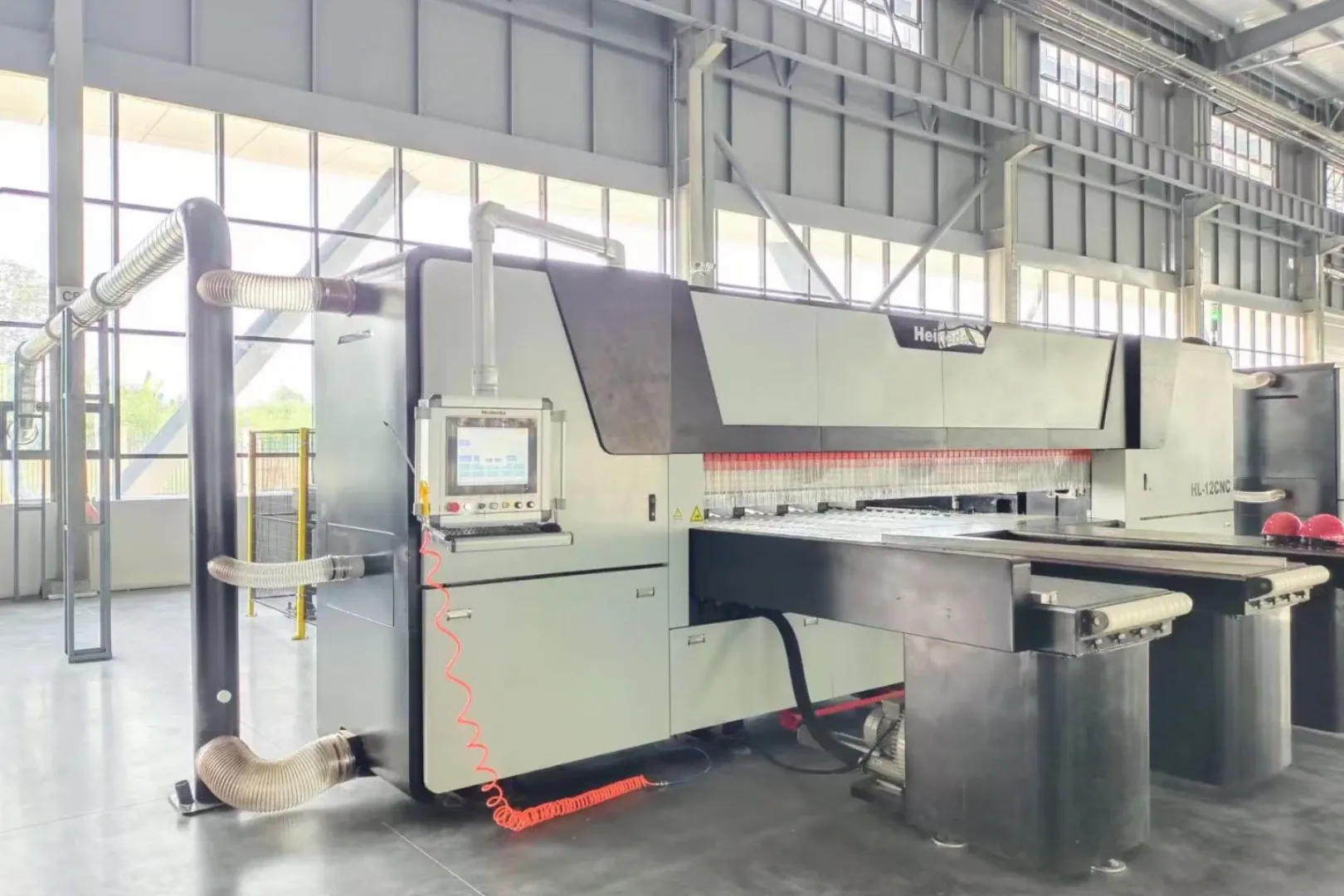
Jiangsu Heineda specializes in aluminum sawing equipment and automated sawing production lines. Tell us your plate size, alloy, and daily volume and we'll match you to the right model. Request a Quote →
How CNC and Automation Change the Equation
A fully automatic aluminum cutting machine is not simply a manual saw with a CNC controller bolted on — it is a system where servo-driven feed, auto-nesting software, and an integrated work-holding fixture work together to replace manual layout, manual feeding, and manual measurement. Heineda has focused on aluminum plate sawing equipment development, and the design philosophy runs through every current model: the 30 KW motor maintains blade speed under load; the air-floating work table (series feature, configured per project) lifts the workpiece on a film of air so the surface never contacts a metal rail; and dual servo feeding with magnetic scale positioning(available as a series option per project configuration)provides repeatable cut accuracy.
For buyers comparing an automatic panel saw to a manually-fed circular saw: the automatic version eliminates three operator touchpoints per cycle — positioning, clamping, and measuring — which on a 200-piece/shift run translates directly to cycle-time reduction and reduced scrap from measurement error.
FAQ
Q: What is the difference between an aluminum plate cutting machine and a general metal band saw? A: A general metal band saw is designed for a range of materials. An aluminum plate cutting machine — whether circular saw or band saw — uses tooth geometry, feed rates, and structural rigidity tuned for aluminum's low melting point and high gumminess. The result is a cleaner kerf, longer blade life, and a surface finish (Ra ≤25 μm on Heineda's band saw, (case reference)) that often eliminates secondary facing.
Q: What cutting accuracy can I expect from a fully automatic aluminum plate cutting machine? A: Heineda's fully automatic aluminum plate cutting machine achieves ±0.3 mm ((project-specific; subject to confirmed technical plan)) across workpieces up to 4000 × 4000 × 205 mm. For tighter tolerances on narrower plate, the H-series CNC saw milling machine achieves ±0.1 mm ((case reference)) — with faster cutting throughput than a traditional band saw at the same tolerance.
Q: Can one machine handle both thin sheet and thick plate? A: The HL-12CNC handles up to 205 mm plate height with a 4000 mm working width — covering both structural plate and thicker tooling blocks. For material thinner than standard sheet gauge, a dedicated CNC panel cutting machine with a scoring blade is often a better fit. Contact Heineda's applications team with your exact thickness range for a recommendation.
Q: What aluminum alloys are supported? A: Heineda's fully automatic aluminum plate cutting machine covers the full 1xxx through 7xxx series. This spans commercially pure aluminum (1050, 1100), common structural alloys (6061, 6063), and aerospace-grade alloys (7075, 2024). The CNC saw milling machine also handles titanium alloy, high-temperature stainless, and age-hardened stainless for shops running mixed-material programs.
Q: How does an air-bearing work table protect aluminum surface finish? A: An air-bearing work table lifts the aluminum plate on a thin film of pressurized air rather than allowing it to slide on metal rails. This eliminates the scratching and smearing that occurs when soft aluminum alloys drag across a steel work surface — a critical requirement for aerospace and automotive finish-quality plate that must arrive at the next operation with no surface defects.
Q: What daily billet cutting performance can a Heineda band saw deliver? A: The dual-column 4-screw structure maintains cutting squareness (≤0.1 mm / 100 mm, (case reference)), and the ≤2 mm kerf width minimizes material loss on high-value billet stock. Actual throughput depends on billet diameter, cutting length, and production setup. Contact Heineda for a project-specific estimate.
Q: Is automation integration available for plate saws? A: Yes. Heineda's band saw supports full automation integration including automated loading, conveying, and unloading — scope defined at project stage. The aluminum plate cutting machine series can integrate dual servo feeding and mechanical grippers for automated loading/unloading as module options. Both machine families are designed for inline installation in manufacturing cells — not just standalone floor machines.
If you remember one thing from this article: the right aluminum plate cutting machine is determined by plate size and alloy first, tolerance second, and throughput third — and each of those dimensions maps cleanly to a different machine family (fully automatic panel saw, band saw, or CNC saw milling machine).
Match Your Application to the Right Machine Heineda's engineering team has configured aluminum cutting lines across aerospace, automotive, mold, and mechanical manufacturing sectors. Share your plate dimensions, alloy grade, and target cycle time — we'll specify the right model. Get a Free Quote → Jiangsu Heineda Sawing Machinery Co., Ltd. | heinedasaw.com | sales@heinedasaw.com