A complete aluminum extrusion cutting solution combines dedicated band saw systems with automation integration to handle mixed profiles, irregular cross-sections, and high-volume billet preparation — delivering cut squareness of ≤0.1 mm/100 mm(case reference) and surface finish Ra < 25 μm(case reference). Daily throughput depends on billet diameter, automation level, and shift pattern(subject to confirmed technical plan).
Key Performance Stats
| Metric | Specification |
|---|---|
| Cut squareness | ≤0.1 mm / 100 mm(case reference) |
| Surface finish | Ra < 25 μm(case reference) |
| Kerf width | ≤2 mm |
| Daily billet throughput | Determined by billet diameter, cutting length, and automation configuration. |
| Cutting accuracy (plate line) | ±0.3 mm(project-specific; subject to confirmed technical plan) |
| Max workpiece size (plate) | 4000 mm × 4000 mm × 205 mm |
Why Extrusion Plants Need a Dedicated Cutting Workflow
An aluminum extrusion cutting solution is a structured sequence of sawing, handling, and quality-control steps tuned specifically for extrusion feedstock — billets, thick bar bundles, and finished profiles — rather than a single machine purchase.
Extrusion plants face three simultaneous pressures that generic cutting equipment cannot resolve together:
1. Mixed profile geometry. A single production run may include round billets, rectangular bar bundles, hollow structural profiles, and irregular decorative sections. Each geometry loads a blade differently. 2. Surface and squareness requirements. Billets fed into an extrusion press must have flat, square faces. Any out-of-square face transfers directly into die wear and press cycle inefficiency. 3. Volume. High-volume plants running continuous casting lines need a cutting station that keeps pace without becoming the bottleneck. Heineda's aluminum band saw is designed for high-throughput billet production with a dual-column 4-screw structure to maintain squareness under load.
Getting all three right requires matching the right machine type to each task, then linking those machines with conveyors, sensors, and controls.
Billet Prep: The Foundation of the Extrusion Cutting Solution
Billet preparation is the stage where raw cast aluminum log is sawn into press-ready billets, and it sets the dimensional tolerance floor for everything downstream.
For this stage, a dual-column band saw built for aluminum is the standard choice. The dual-column, 4-screw frame provides the structural rigidity needed to hold ≤0.1 mm/100 mm squareness(case reference) across a full range of billet diameters — from small-diameter bar bundles up to large-format round logs. A narrow kerf of ≤2 mm directly reduces material lost per cut; at high daily throughput, that saving compounds quickly.
Key integration points at the billet prep stage:
- Log infeed conveyor — meters logs to the saw at a controlled rate, reducing manual handling and supporting automated workflow.
- Billet outfeed roller table — carries cut billets to a weighing or stacking station without operator contact.
- Light curtain protection — available as a series option per project configuration chip safety curtain with rotation/lift, halting the blade if a person or foreign object enters the cutting zone, meeting applicable safety standards.
Because the saw supports automation integration at both loading and unloading ends, billet prep can run as a fully automatic cell within the plant layout.
Profile Cutting: Handling Mixed Cross-Sections
Profile cutting is the downstream stage where finished or semi-finished extrusions are cut to delivery length, and it presents the greatest geometric variability in any aluminum extrusion cutting solution.
Irregular cross-sections — I-beams, T-slots, hollow rectangles, thin-wall architectural profiles — cannot be clamped and cut the same way a solid round billet can. Band saw systems handle this variability better than circular saws because the band applies a continuous, low-force cut rather than an intermittent impact, reducing the risk of profile distortion or burr formation on thin walls.
Practical guidelines for mixed-profile cutting:
| Profile Type | Challenge | Mitigation |
|---|---|---|
| Hollow rectangular | Wall collapse under vice pressure | Use form-matched jaw inserts |
| Thin-wall architectural | Burr on inner channels | Reduce feed rate; increase blade tooth pitch |
| Round billet bundle | Bundle shift during cut | Use bundle-clamping vice |
| Irregular decorative section | Unstable seating | Nest in V-block or custom fixture |
Surface finish Ra < 25 μm(case reference) — achievable on Heineda's aluminum band saw in specific project configurations — means profiles cut for visible architectural applications may require no secondary deburring before anodizing.
High-Volume Plate and Sheet Cutting
When an extrusion plant also processes aluminum plate or sheet — for tooling, mold blanks, or automotive body panels — a dedicated aluminum profile cutting machine for plate stock fills a different role in the overall solution.
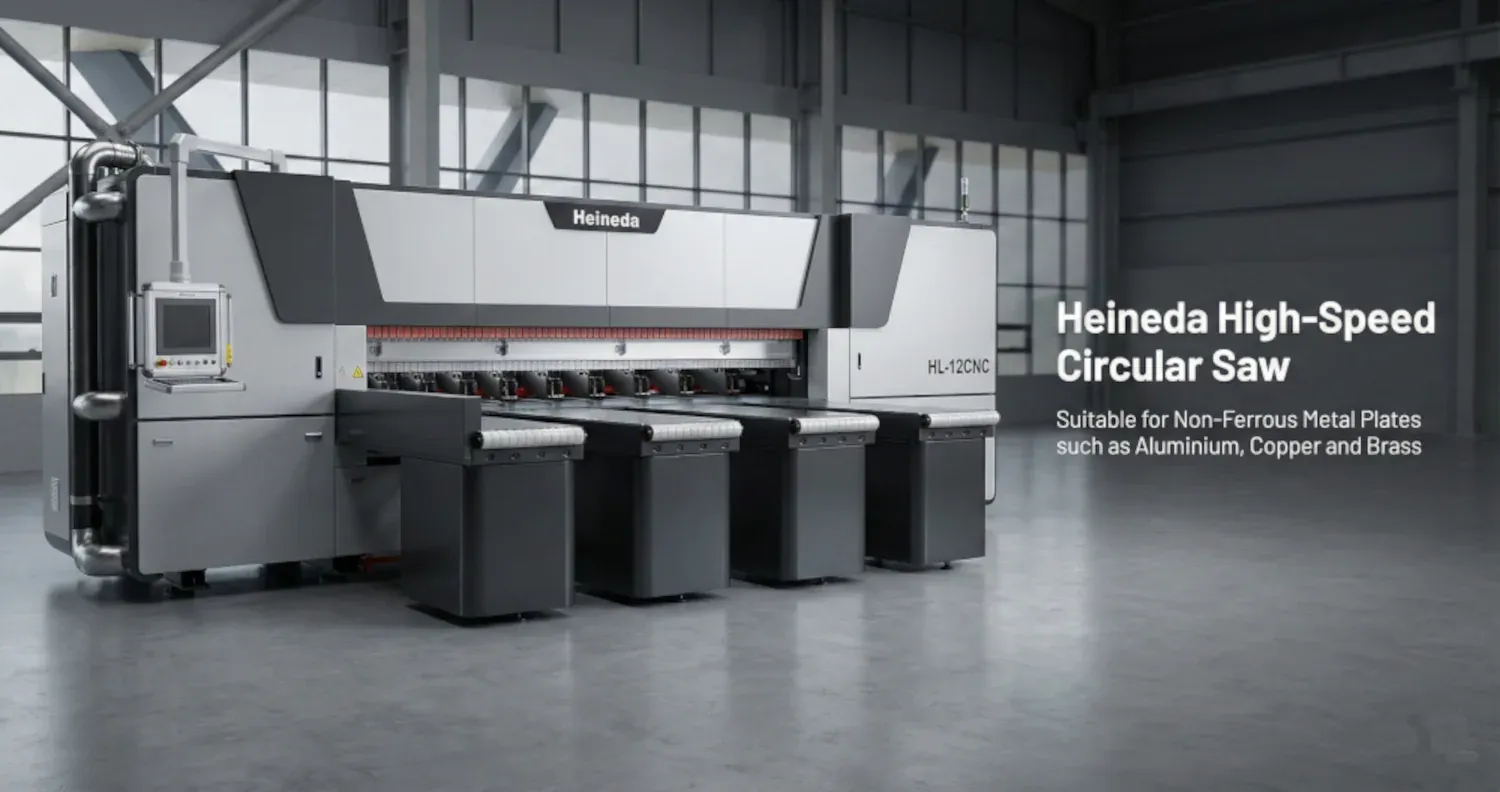
Heineda's Fully Automatic Aluminum Plate Cutting Machine handles 1xxx–7xxx series alloys. The air-floating work table(available as a configurable option) protects surface finish while moving large sheets. The HL-12CNC model accepts workpieces up to 4000 mm × 4000 mm × 205 mm, covering the largest standard mill-finish plates.
Cutting accuracy of ±0.3 mm(project-specific; subject to confirmed technical plan)across full sheet width means downstream milling allowances can be reduced, compressing total cycle time per part.
Automation Integration: Connecting the Cutting Cells
A true end-to-end aluminum extrusion cutting solution is not a collection of standalone machines — it is a connected workflow where each station hands off to the next without manual intervention.
When designing the automation layer, three integration levels are common:
Level 1 — Semi-automatic. Operator loads bundles or logs manually; saw feeds, cuts, and ejects automatically. Suitable for low-to-medium volume plants or those cutting highly variable batch sizes.
Level 2 — Cell automation. Infeed conveyor + saw + outfeed roller table controlled by a shared PLC. Operator monitors from a control panel. Throughput scales to match billet production line demands.
Level 3 — Full lights-out. Crane or gantry robot loads logs from storage; vision system confirms diameter and alloy tag; saw cuts to scheduled billet length program; outfeed system stacks billets by batch. Operators intervene only for blade changes and scheduled maintenance.
Heineda's band saw for aluminum profiles supports integration at all three levels via standard I/O and fieldbus interfaces, allowing plants to start at Level 1 and upgrade the automation layer without replacing the core machine.
"If X → Choose Y" Decision Engine
| Plant Scenario | Recommended Solution |
|---|---|
| High-volume billet prep, round logs | Aluminum band saw, full infeed/outfeed automation (Level 2–3) |
| Mixed irregular profiles, architectural sections | Aluminum band saw with form-matched clamping fixtures |
| Plate and sheet stock, 1xxx–7xxx series | Fully Automatic Aluminum Plate Cutting Machine (E-6, E-10, or HL-12CNC) |
| Mixed billet + plate in one facility | Band saw cell for billets + plate saw cell for sheet; shared outfeed conveyor |
| Tight squareness tolerance, ≤0.1 mm/100 mm required | Dual-column 4-screw aluminum band saw |
| Thin-wall hollow profiles, burr-sensitive | Band saw at reduced feed rate; do not use circular cold saw |
| Lights-out operation target | Band saw with PLC-integrated infeed/outfeed conveyor + light curtain |
Get a Cutting Solution Assessment
Heineda engineers specify band saw systems for extrusion plants daily — billet prep lines, profile cutting cells, and fully automated turnkey workflows.
Request a Solution Assessment →
Share your profile types, daily tonnage target, and current bottleneck — you will receive a machine selection, automation level recommendation, and layout sketch within two business days.
FAQ
Q: What is the difference between an aluminum extrusion cutting solution and a single band saw purchase? A: A single band saw handles the cut itself. An aluminum extrusion cutting solution encompasses the full workflow: infeed handling, clamping strategy for mixed profiles, the saw, outfeed conveyance, and quality control — all configured to your plant's volume and profile mix. Heineda supplies the machines and the integration architecture.
Q: Can one band saw handle both billet prep and finished profile cutting? A: Yes, with fixture changes. The aluminum band saw's dual-column 4-screw structure accommodates round logs, rectangular bar bundles, and irregular extrusion profiles in the same machine. For plants running very high billet volumes alongside finished profile cutting, two dedicated cells prevent scheduling conflicts and maximize uptime.
Q: What surface finish can I expect on cut billet faces? A: Heineda's aluminum band saw delivers Ra < 25 μm(case reference) on cut faces. This is smooth enough for direct extrusion press loading without secondary facing in many applications, and it meets the surface requirement for architectural profiles going to anodizing without deburring.
Q: How do I cut thin-wall hollow profiles without distorting them? A: Use form-matched jaw inserts that cradle the profile's outer geometry, reducing vice pressure on thin walls. Reduce the feed rate relative to solid-section cuts and use a blade with a higher tooth pitch to lower the per-tooth chip load. The band saw's continuous cutting action has a lower lateral force than circular saws, making it the preferred industrial metal cutting equipment for hollow sections.
Q: What daily throughput can Heineda's aluminum band saw sustain? A: Determined by billet diameter, cutting length, and automation configuration.. Actual throughput depends on billet diameter, automation level, and shift pattern. Plants running smaller-diameter bar will see more cuts per ton; plants running large-diameter logs will see fewer cuts but each cut removes more volume per cycle. Contact Heineda with your billet specs for a project-specific throughput estimate.
Q: Is the band saw compatible with Industry 4.0 or factory MES systems? A: Yes. The machine supports standard I/O and fieldbus interfaces for PLC integration. Cut count, blade hours, and fault codes can be fed to a plant MES or SCADA system. Heineda's engineering team can specify the integration protocol during the solution assessment phase.
Q: Which aluminum alloy series does the plate cutting machine support? A: The Fully Automatic Aluminum Plate Cutting Machine handles the full 1xxx–7xxx series, covering commercially pure aluminum through high-strength 7075 aerospace alloy. The air-bearing work table protects surface finish regardless of alloy hardness.
If you remember one thing from this article: an aluminum extrusion cutting solution is a workflow, not just a machine — match the band saw type and automation level to your billet volume and profile mix, and you eliminate the squareness and throughput bottlenecks that limit press productivity.
Talk to a Heineda Cutting Systems Engineer
Heineda has rich project experience in aluminum automated sawing production lines. Whether you are upgrading a billet prep line or designing a fully automated extrusion cutting cell from scratch, the engineering team can size the right band saw for aluminum profiles and specify the automation level that fits your volume.
Contact: sales@heinedasaw.com | heinedasaw.com