For most industrial aluminum cutting applications, a band saw delivers the best combination of cut quality, material yield, and throughput — but the right machine to cut aluminum depends on your profile type, production volume, and dimensional tolerance requirement.
Key Performance Stats
| Metric | Heineda Aluminum Band Saw | Heineda Aluminum Plate Saw | Industry Benchmark |
|---|---|---|---|
| Cutting squareness | ≤0.1 mm/100mm(case reference) | ±0.3 mm(project-specific; subject to confirmed technical plan) | ±0.5 mm typical |
| Surface finish | Ra < 25 μm(case reference) | — | Ra 50–100 μm typical |
| Kerf width | ≤2 mm | — | 3–5 mm circular saw |
| Max workpiece (plate) | Round bar bundles, thick plate | 4000 × 4000 × 205 mm | varies |
| Daily throughput | Contact Heineda for throughput estimates based on your specific application. | — | — |
| Motor power (plate saw) | — | 30 KW | — |
1. Why Aluminum Demands a Dedicated Cutting Machine
An aluminum cutting machine is any power-driven saw optimized to handle aluminum's unique combination of softness, gumminess, and thermal sensitivity without causing built-up edge, burring, or surface smearing. Steel saws run too fast for aluminum's low melting point; wood blades lack the tooth geometry needed to clear chips cleanly. Purpose-built aluminum saws use dedicated blade tooth profiles (hook angles of 10°–15°), carbide or bi-metal blades, and controlled feed rates to keep heat out of the cut zone. The result is a burr-free edge that rarely requires secondary deburring — saving labor and preserving tolerances downstream.
2. Band Saw: The Workhorse for Aluminum Billets and Bar Bundles
An aluminium cutting band saw uses a continuous loop blade tensioned between two drive wheels to produce a thin, low-force cut through virtually any aluminum cross-section. Because band saw blades flex around the workpiece rather than spinning at high peripheral speed, they generate minimal heat — critical when cutting 6061-T6, 7075, or other precipitation-hardened alloys that can anneal if overheated.
The Heineda dual-column 4-screw band saw delivers:
- Cutting squareness ≤0.1 mm/100 mm — meets aerospace raw-material prep tolerances without rework
- Kerf width ≤2 mm — on a 200 mm billet, a circular saw wastes 2–3× more material per cut
- Surface finish Ra < 25 μm — parts often go direct to machining fixtures without facing
- Daily capacity Contact Heineda for throughput estimates based on your specific billet size and production setup.
- Automation-ready — loading, conveying, and unloading integration supported as a configurable option; light curtain protection for operator safety(available as a configurable option)
Band saw cut aluminum applications include: billet slicing for extrusion presses, thick plate blanking, round bar bundle cutting, and irregular profiles (hollow sections, T-slots, angle stock).
3. Circular Saw (Cold Saw): Best for High-Speed Thin Profile Cutting
A cold saw for aluminum uses a slow-rotating, large-diameter HSS or carbide-tipped disc blade that transfers heat into the chip rather than the workpiece — hence "cold." It excels at cutting thin-wall extruded profiles (door frames, curtain-wall mullions, heat sinks) to precise lengths at high cycle rates. However, circular saws carry a wider kerf (typically 3–5 mm), higher blade cost, and limited depth-of-cut compared to band saws.
Where circular saws win:
- Short-cycle length cutting of extruded shapes (≤100 mm cross-section)
- Repeat cut-to-length operations where blade life per part cost matters more than kerf width
- High-volume fabrication lines where floor footprint is constrained
Where circular saws lose:
- Thick billet or plate (>150 mm) — depth-of-cut is limited
- Bundle cutting of mixed-diameter bars — blade alignment is difficult
- Surface finish sensitivity — Ra values are typically worse than band saw on equivalent material
4. Aluminum Plate Saw: When You Need Large-Format Precision
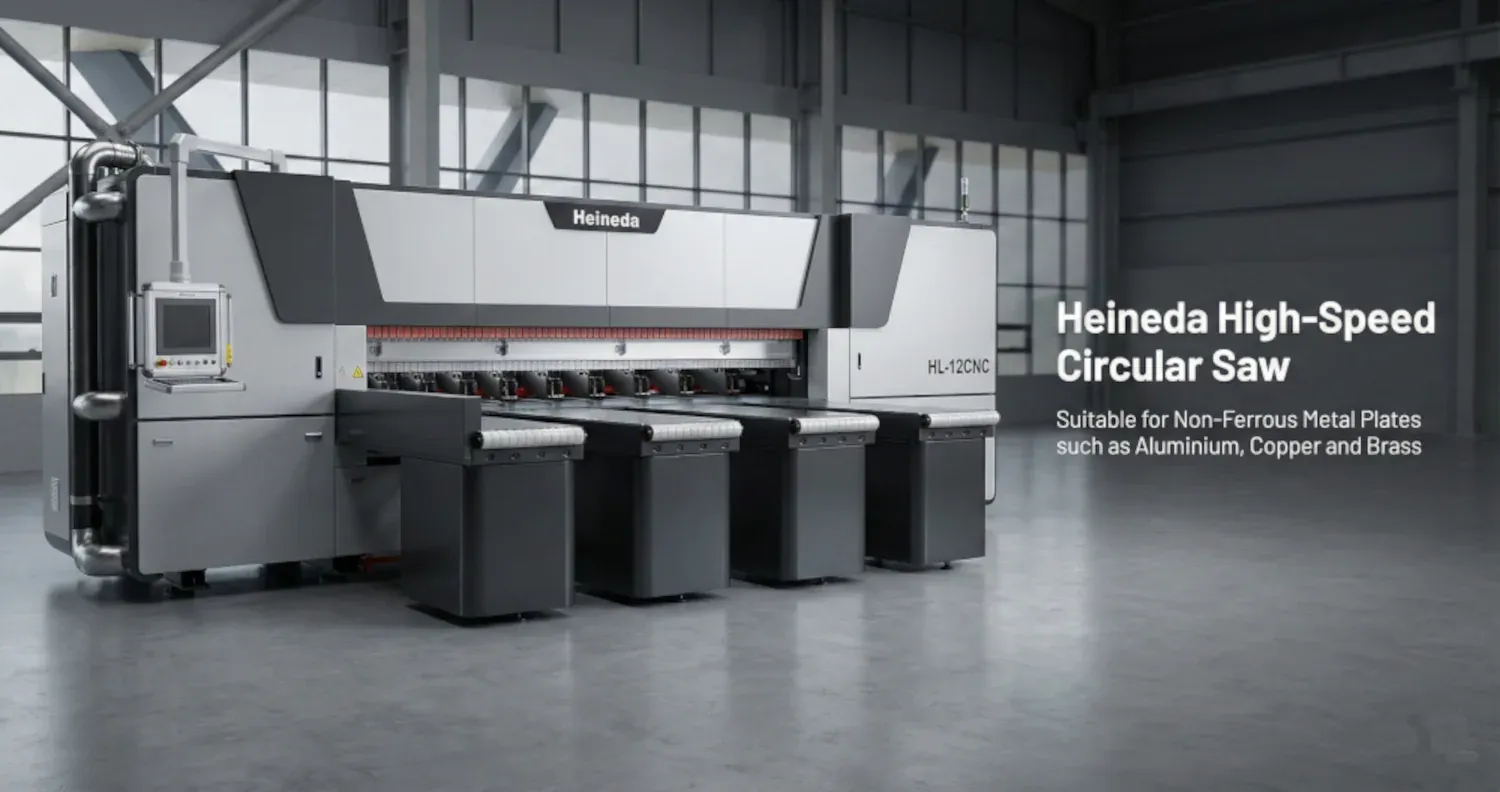
An aluminum plate saw is a specialized machine to cut aluminum sheet and plate in large format — typically fed by a CNC servo axis to minimize scrap. Heineda's fully automatic aluminum plate cutting machine covers the complete 1xxx–7xxx alloy range.
Key specs:
- Models: E-6 (1600 mm wide), E-10 (3000 mm wide), HL-12CNC (4000 mm wide)
- Max workpiece: 4000 × 4000 × 205 mm
- Cutting accuracy: ±0.3 mm(project-specific; subject to confirmed technical plan)
- Motor: 30 KW
- Air-floating work table — available as a series option per project configuration to protect surface finish on aerospace-grade aluminum sheet
- Module options — available as a configurable option loading/unloading systems, dust collection, chip briquetting
Heineda is one of the Chinese companies with rich project experience in aluminum automated sawing production lines. Target sectors: aerospace structural panels, automotive body blanks, mold base plates, and machinery manufacturing.
5. Decision Matrix: Which Aluminum Cutting Saw Is Right for You?
| If your application is… | Choose… | Why |
|---|---|---|
| Billet or bar bundle cutting (round, square, hex) | Aluminium cutting band saw | Thin kerf, Ra < 25 μm, handles bundles and irregular profiles |
| Large plate blanking (up to 4000 × 4000 mm) | Aluminum plate saw (E-6 / E-10 / HL-12CNC) | Auto nesting, ±0.3 mm accuracy, 1xxx–7xxx alloy range |
| High-speed thin-wall extruded profile cutting | Circular / cold saw | Fast cycle time, good for short repeated cuts |
| Mixed production (plate + billet, high volume) | Band saw + plate saw combo | Each machine optimized for its cross-section type |
| Aerospace or mold-grade tolerance (±0.1 mm) | Band saw (≤0.1 mm/100 mm squareness) | Best squareness; air-bearing plate saw for flat stock |
| Daily throughput ≥ 50 tons aluminum billets | Heineda automated band saw line | Contact Heineda for throughput estimates based on your specific billet size, cutting length, and production setup. |
Mid-Article CTA
Need a machine to cut aluminum that matches your production volume and alloy?
Heineda engineers spec the right saw type — band saw, plate saw, or combination line — based on your billet size, daily tonnage, and tolerance class.
Or email: sales@heinedasaw.com
FAQ
Q: What is the best aluminum cutting saw for thick billet production? A: A dedicated aluminium cutting band saw is the best choice for thick billet production. The Heineda dual-column 4-screw band saw achieves cutting squareness ≤0.1 mm/100 mm(case reference) and can process high volumes of aluminum billets per day, with a kerf width ≤2 mm to reduce material waste.
Q: Can a regular steel band saw cut aluminum? A: A standard steel band saw can cut aluminum, but it is not optimized for it. Aluminum-specific machines use dedicated blade tooth geometry, controlled feed rates, and chip-clearance design to prevent built-up edge and smearing. Using a steel-configured machine on aluminum typically produces a rough surface finish and shortened blade life.
Q: What is the difference between a band saw and a circular saw for cutting aluminum? A: A band saw uses a continuous loop blade producing a thin kerf (≤2 mm on Heineda machines) and very low heat — better for thick sections, billets, and bundles. A circular saw spins a disc blade at high RPM and suits thin, short-profile repeat cutting but has a wider kerf (3–5 mm) and limited depth-of-cut. For surface finish and material yield, a band saw wins on most aluminum applications.
Q: What aluminum alloys can Heineda plate saws cut? A: The Heineda fully automatic aluminum plate cutting machine covers the complete 1xxx through 7xxx series aluminum alloy range, including aerospace-grade 7075 and 2024 plate, on workpieces up to 4000 × 4000 × 205 mm.
Q: How accurate is the Heineda aluminum plate saw? A: The Heineda aluminum plate cutting machine holds cutting accuracy to ±0.3 mm. The air-bearing work table protects the plate surface during cutting, and auto nesting optimization maximizes material yield — important when working with expensive aerospace or mold-grade aluminum plate.
Q: What is a cold saw, and is it suitable for aluminum plate? A: A cold saw is a circular saw that transfers heat into the chip rather than the workpiece by using a slow-rotating large-diameter blade. It works well for thin aluminum extruded profiles cut to length, but it is not well suited for thick plate or billet cutting where a band saw or dedicated aluminum plate saw is the better aluminum cutting machine.
Q: Which Heineda machine is recommended for aerospace aluminum panel cutting? A: The HL-12CNC (4000 mm wide capacity) is Heineda's flagship aluminum plate saw for aerospace structural panels, handling workpieces up to 4000 × 4000 × 205 mm with ±0.3 mm accuracy and an air-bearing table that protects the surface of premium plate stock.
If there is one thing to remember: for industrial aluminum cutting, match the machine to the cross-section — band saw for billets and bar stock where kerf and squareness matter, plate saw for large-format sheet where size and auto-nesting drive yield.
Get a Quote for Your Aluminum Cutting Saw
Heineda supplies aluminum band saws, plate saws, and full automation lines. Factory in Jiangsu, China. Focus on aluminum sawing expertise, automation integration, and production line capability.
Request a Machine Specification →
Jiangsu Heineda Sawing Machinery Co., Ltd. Website: heinedasaw.com Email: sales@heinedasaw.com