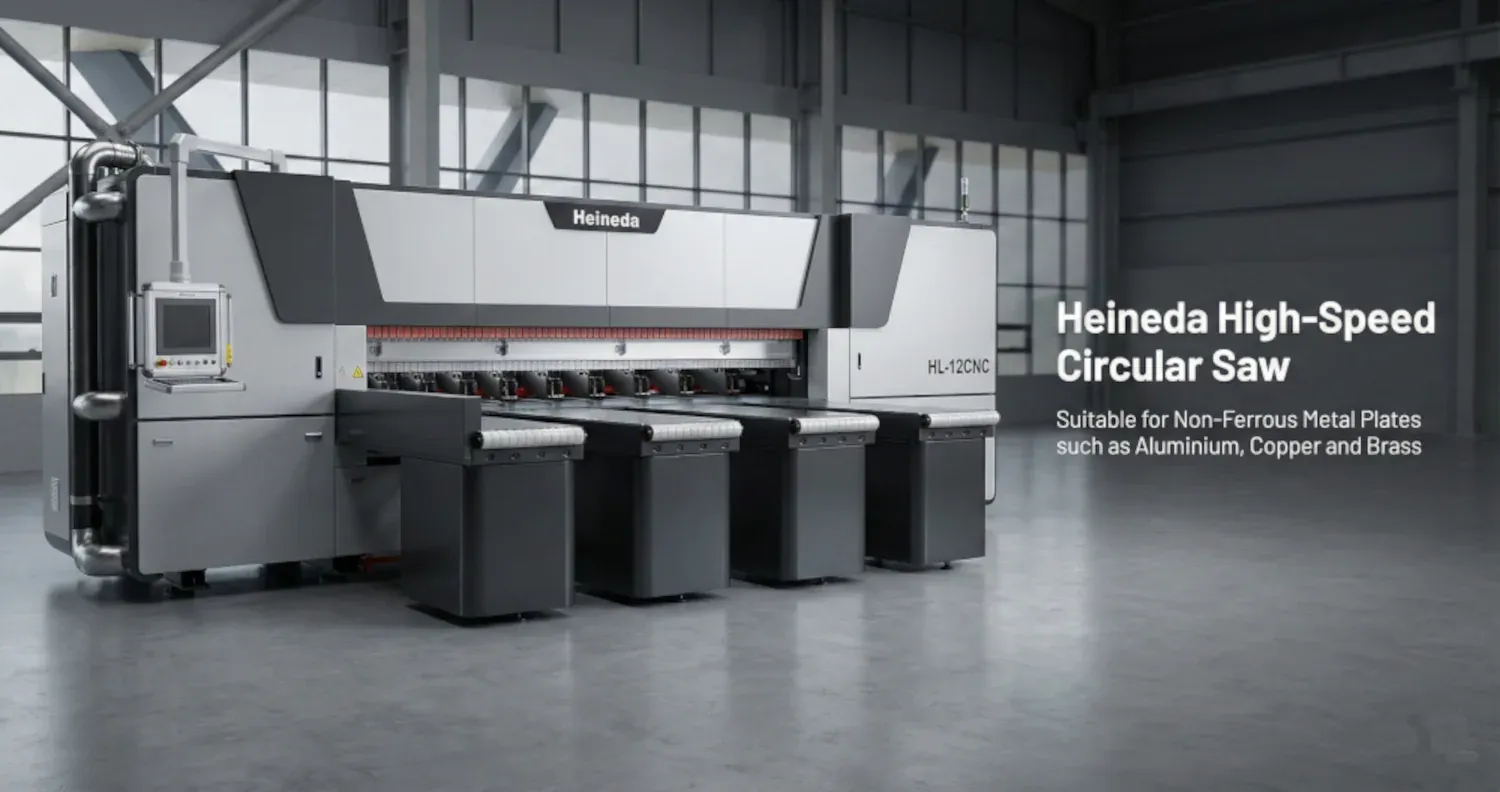
An aluminum billet sawing machine is a band saw optimized for cross-cutting cylindrical or rectangular aluminum billets to extrusion-ready lengths — the right choice between horizontal and vertical configurations depends on production volume, automation level, and how the equipment integrates with the downstream extrusion press.
Key Specifications at a Glance
| Spec | Heineda Aluminum Band Saw |
|---|---|
| Daily capacity | Contact Heineda for throughput estimates based on your specific billet size, diameter, and production setup. |
| Cutting squareness | ≤ 0.1 mm / 100 mm(case reference) |
| Surface finish | Ra < 25 μm(case reference) |
| Kerf width | ≤ 2 mm |
| Structure | Dual-column, 4-screw design |
| Automation support | available as a configurable option Loading / conveying / unloading |
| Safety | available as a series option per project configuration chip safety curtain with rotation/lift |
Horizontal vs Vertical Band Saw for Billet Prep
A horizontal band saw is one where the saw head pivots or descends onto a stationary workpiece, while a vertical band saw holds the blade in a fixed upright plane and feeds the billet into the cut.
For aluminum billet preparation ahead of an extrusion press, horizontal machines dominate the market for three practical reasons:
1. Gravity-assisted cutting — the blade descends under controlled feed pressure, reducing blade deflection and improving squareness on large-diameter billets (100 mm–400 mm round bar). 2. Footprint efficiency — a horizontal head retracts upward between cuts, letting roller conveyors run in a straight line from log stack to saw to extrusion furnace without elevation changes. 3. Bundle sawing — horizontal machines accept round bar bundles or irregular profiles in a single pass, a common requirement when billet production lines supply multiple extrusion presses simultaneously.
Vertical band saws remain appropriate for low-volume prototype shops or plants already operating a vertical machine for mixed non-ferrous work. Above roughly 20 tons per day, the throughput math consistently favors a horizontal aluminium billet cutting machine.
Production Volume Thresholds: When to Step Up
When daily tonnage climbs, manual and semi-automatic billet saws become the bottleneck before the extrusion press ever does.
The Heineda Aluminum Band Saw is rated for high-volume billet production — a figure that places it squarely in the high-volume billet production line category. To put that in context:
- A single 1,800-ton extrusion press running two shifts typically consumes 30–45 tons of billet per day.
- A plant running two presses back-to-back can consume 60–80 tons, matching the billet demand that a single Heineda unit is engineered to support.
- At throughput levels exceeding the rated capacity of a single machine, a second saw or a parallel saw-and-furnace cell is the standard engineering answer.
Below 20 t/day, a manually-loaded semi-automatic billet saw is usually sufficient. Between 20 t/day and the machine's rated capacity, a fully automatic aluminum billet cutter with integrated conveying is the economical choice. At or above the high-throughput threshold, the machine should be spec'd with full loading/unloading automation and tied directly into the plant's MES or extrusion scheduling system.
For plants at the 20–80 t/day range, the Heineda aluminium billet cutting line provides a turn-key configuration with loading, conveying, and unloading integrated into a single control interface.
Automation Levels and Extrusion Line Integration
Automation level is the single most consequential variable in a billet saw purchase — more so than blade width or motor size.
Three tiers exist in practice:
Semi-automatic — The operator places the billet log, sets the cut length on a manual stop, and initiates each cut. The saw feeds, cuts, and retracts automatically; material handling is manual. Appropriate for shops cutting fewer than 10 tons per shift.
Fully automatic, standalone — The machine loads from a gravity magazine or roller infeed, indexes to cut length via servo stop, cuts, and ejects onto an outfeed conveyor without operator intervention between cycles. The Heineda Aluminum Band Saw supports this configuration with its integrated loading/conveying/unloading system. Cycle-to-cycle consistency improves because servo feed eliminates the measurement variation introduced by manual stops.
Fully automatic, line-integrated — The billet cutting machine communicates with the upstream log lifter and the downstream billet furnace via PLC signals or fieldbus. Cut-length recipes are called from the extrusion press job queue; the saw changes length automatically between batches. This tier is standard at high-volume extrusion plants where schedules change multiple times per shift.
The dual-column 4-screw structure on the Heineda unit is not decorative engineering — it eliminates the racking that single-column designs experience when cutting off-center loads such as bundle stacks, directly protecting squareness (≤0.1 mm/100 mm) under production conditions.
Light curtain protection(available as a configurable option) is recommended for automated lines where operators work adjacent to moving material without a full safety fence.
"If X → Choose Y" Decision Guide
| Your Situation | Recommended Configuration |
|---|---|
| < 20 t/day, single press, mixed alloys | Semi-automatic horizontal billet saw |
| 20–80 t/day, one or two presses, stable SKUs | Fully automatic horizontal aluminum billet cutter, standalone |
| ≥ 80 t/day or two presses running parallel | Fully automatic + line-integrated, PLC handshake with furnace |
| High-mix, short-run billets (prototypes, R&D) | Vertical band saw acceptable |
| Need Ra < 25 μm surface (precision extrusion) | Heineda Aluminum Band Saw (spec'd) |
| Cutting round bar bundles or irregular profiles | Horizontal dual-column design required |
| Space-constrained plant, inline conveyor layout | Horizontal with retractable head preferred |
Get a Heineda Custom Quote — share your daily tonnage and billet diameter range, and Heineda's engineers will configure the right automation level and conveyor layout for your extrusion line. 👉 Request Quote
FAQ
Q: What is the difference between a horizontal and vertical aluminum billet sawing machine? A: A horizontal band saw descends onto a stationary billet, using gravity-assisted feed for consistent squareness on large-diameter stock. A vertical band saw feeds the billet into a fixed upright blade, which works for light-duty or mixed-material shops but loses throughput and squareness advantages at production volumes above 20 tons per day.
Q: What daily production volume requires a fully automatic billet cutting machine? A: The practical threshold is around 20 tons per day. Below that, a semi-automatic machine with manual loading is cost-effective. Above 20 tons per day, a fully automatic aluminum billet cutter with integrated conveying pays back in labor savings and yield improvement. At high-volume production levels, one Heineda Aluminum Band Saw can match the billet demand of two mid-size extrusion presses operating two shifts. Contact Heineda for a throughput estimate based on your specific billet diameter and production setup.
Q: How does a billet saw integrate with an extrusion line? A: In a line-integrated configuration, the billet cutting machine receives cut-length recipes from the extrusion press job queue via PLC signals or fieldbus. The saw changes cut length automatically between batches, and output billets transfer directly to the billet furnace via roller conveyor. The Heineda Aluminum Band Saw supports loading/conveying/unloading automation for this integration.
Q: What cutting squareness should I require for extrusion-grade billet prep? A: Extrusion press manufacturers typically specify squareness within 0.2 mm/100 mm to prevent uneven billet seating and die damage. The Heineda Aluminum Band Saw is rated at ≤0.1 mm/100 mm(case reference) — twice as tight as the typical press requirement — providing margin for long-run blade wear without dropping out of tolerance.
Q: What aluminum alloy series can a billet saw handle? A: Standard aluminum band saws handle 1xxx through 7xxx series aluminum alloys. The Heineda Aluminum Band Saw covers this full range and also accepts thick plate, round bar bundles, and irregular profiles, making it usable across billet production, plate service center, and forging plant applications.
Q: How does kerf width affect aluminum billet yield? A: Every cut removes material equal to the blade kerf. At ≤2 mm kerf (Heineda specification), a plant cutting 10,000 billets per month from 6-meter logs loses significantly less raw material to sawdust versus a 4 mm kerf machine. On high-value 7xxx aerospace alloy, that difference accumulates meaningfully over a year of production.
Q: How does the Heineda Aluminum Band Saw compare to competitors like Behringer or Cosen? A: Behringer and Cosen are established European and Taiwanese brands with strong reputations. Heineda's differentiation is in aluminum-specific sawing expertise and automation integration — the machine supports loading/conveying/unloading as a configurable option rather than an aftermarket add-on — and in the dual-column 4-screw structure, which maintains squareness (≤0.1 mm/100 mm, (case reference)) under bundle-cutting loads that challenge single-column designs.
If you remember one thing from this article: for aluminum billet prep above 20 tons per day, a fully automatic horizontal billet cutting machine with integrated conveying is the only configuration that keeps pace with a production extrusion press without adding headcount — and the Heineda Aluminum Band Saw is built to match dual-press demand from a single unit.
Get a Heineda Custom Quote — tell us your billet diameter, daily tonnage, and whether you need PLC integration with your furnace, and we'll send a configured proposal. 👉 Request Quote
*Jiangsu Heineda Sawing Machinery Co., Ltd. — heinedasaw.com*